
By Gabriela Afanador
Tuesday 6, October 2026
Nicky Zimmermann showed Kaleidoscope on October 5 in Paris, staged inside Le Carreau du Temple, a restored nineteenth century cast iron and glass market hall in the 3rd arrondissement. The choice of venue was deliberate rather than incidental. That ironwork and glass ceiling echoes the exact kind of Victorian conservatory and natural history hall where scientific specimens were once catalogued and displayed, which matters here since the whole collection is built around a pair of nineteenth century naturalists. Michelle Jank’s set design left that architecture untouched, keeping the space open and sunlit rather than dressing it over, so the Paris afternoon light moved naturally across the white runway floor as the show progressed, shifting color and shadow in real time the way actual daylight does rather than anything controlled by a lighting rig.
The soundtrack, composed by Mimi Xu with musician Karen Elson, opened on acoustic strings and soft vocal layering before gradually folding in rhythmic electronic pulses as the collection itself grew darker and more structured, the music tracking the clothes rather than sitting underneath them as background noise. Hair fell loose and center parted, styled by Damien Boissinot to move and separate with each stride, a deliberate echo of insect flight, while makeup stayed dewy and barely there, skin first rather than constructed. Casting pulled together a wide range of faces rather than one single type, and the whole presentation read less like a performance and more like an actual walk through shifting daylight, which is the effect Zimmermann was going for.
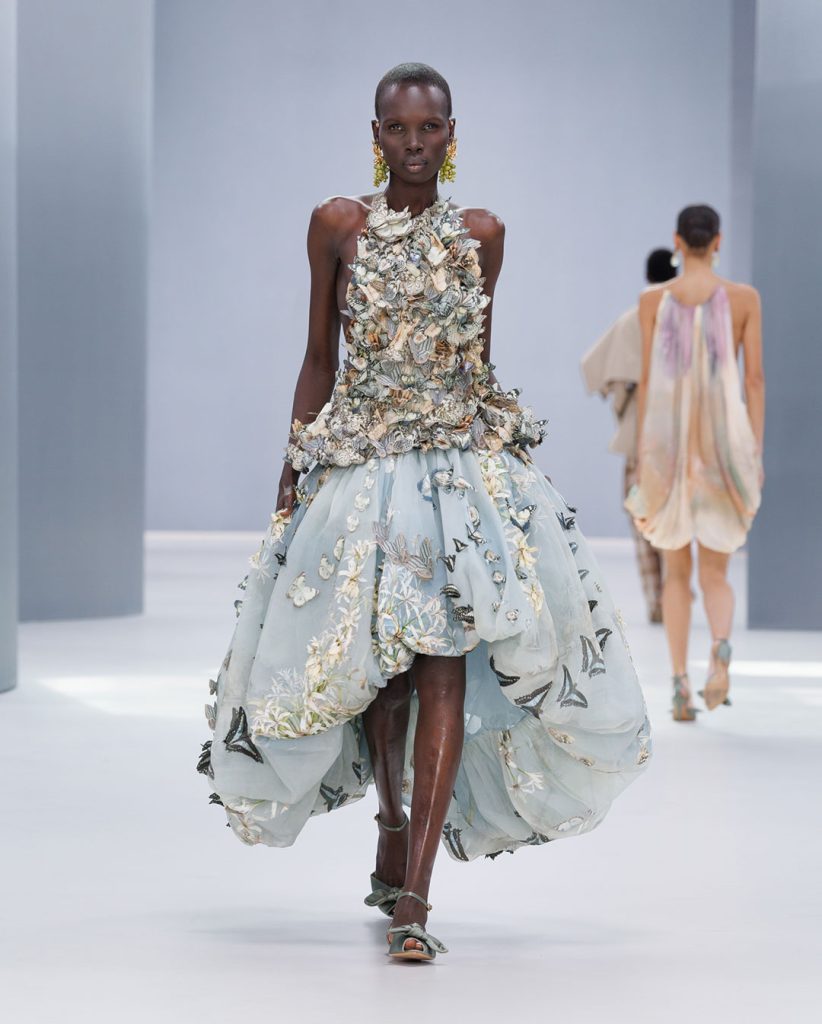
Photo via Zimmermann.com
The Collection
Zimmermann built Kaleidoscope around the butterfly, but not as a pretty surface motif applied to fabric. The word itself works on two levels at once, the entomological term for a roost of butterflies and the nineteenth century optical instrument that turns fragmented shapes into repeating, symmetrical patterns, and both meanings run through the actual construction of the clothes rather than staying metaphorical. The central reference is Harriet and Helena Scott, two sisters who spent the mid-1800s illustrating Australian butterflies and moths from Ash Island for their father’s scientific survey, working with precision at a time when women were largely excluded from formal scientific study. Their lithographs, with their exact bilateral symmetry and fine venation detail, show up directly in how this collection’s lace is cut and spliced, each side of a bodice mirroring the other the way a real wing does.
Alongside that historical reference, Zimmermann pulled from Sydney painter Lara Merrett, known for working with unstretched canvas soaked in diluted ink and pooled water, letting color bleed and spread unpredictably rather than staying inside any hard edge. That bleeding, atmospheric quality shows up throughout the collection’s prints, watercolor washes and ombré gradients that mimic how light actually refracts off a butterfly’s wing rather than any flat, printed pattern. A third reference, the physical, unromantic dynamism of Australian directors Gillian Armstrong and Kim Gehrig, kept the whole thing from tipping into something passive. This is not a collection about fragility for its own sake. It is specifically about the idea that softness and strength exist in the same body at once, which is why the silhouettes throughout carry real volume and presence even at their most delicate.
The Clothes
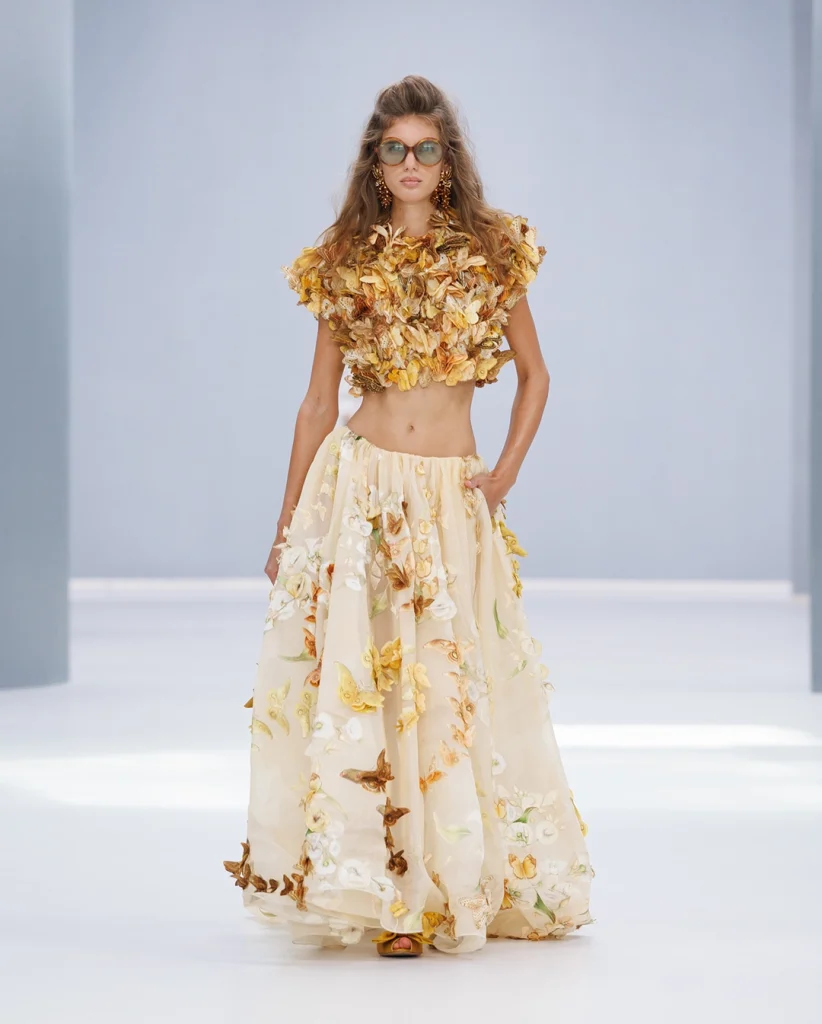
Photo via Zimmermann.com
The opening stretch of the show established that central idea immediately. The very first look sent a lemon botanical print crop top and matching maxi skirt down the runway, the print itself built from the same butterfly research running through the whole collection, paired with oversized shield sunglasses, a chartreuse butterfly encrusted pouch, and sandals in the same bright tone. Those sunglasses, wide and mirrored rather than small and round, read closer to a seventies or shield silhouette than true sixties peace sign style, but the overall feeling, bold and optimistic, lands in the spirit you’re describing. From there the show moved quickly into tailoring, an ivory poplin top with applique detail worn over vintage cream jeans, establishing the collection’s daywear vocabulary before any of the more elaborate construction appeared. A soft floral mini dress followed, then an early piece of real architecture, a draped drill jacket paired with wide, wave contoured flare trousers in the same lemon tone, the fabric here heavy enough to hold real structure against the lighter poplin and florals around it.
One of the clearest early high points is a spliced lace dress in butter yellow, built using the house’s bilateral cutting technique directly lifted from the Scott sisters’ own symmetrical illustration work, each lace panel mirrored precisely down the center of the body. This is where the concept stops being an idea and becomes something visible in the construction itself, the dress reading as scientific as much as romantic. The opening stretch closed out in coral check shirting, ivory utility jumpsuits, and poplin shirt dresses, keeping the whole first act grounded in wearable daywear even as the embellishment slowly increased, flat olive loafers underfoot the whole time rather than anything more formal.
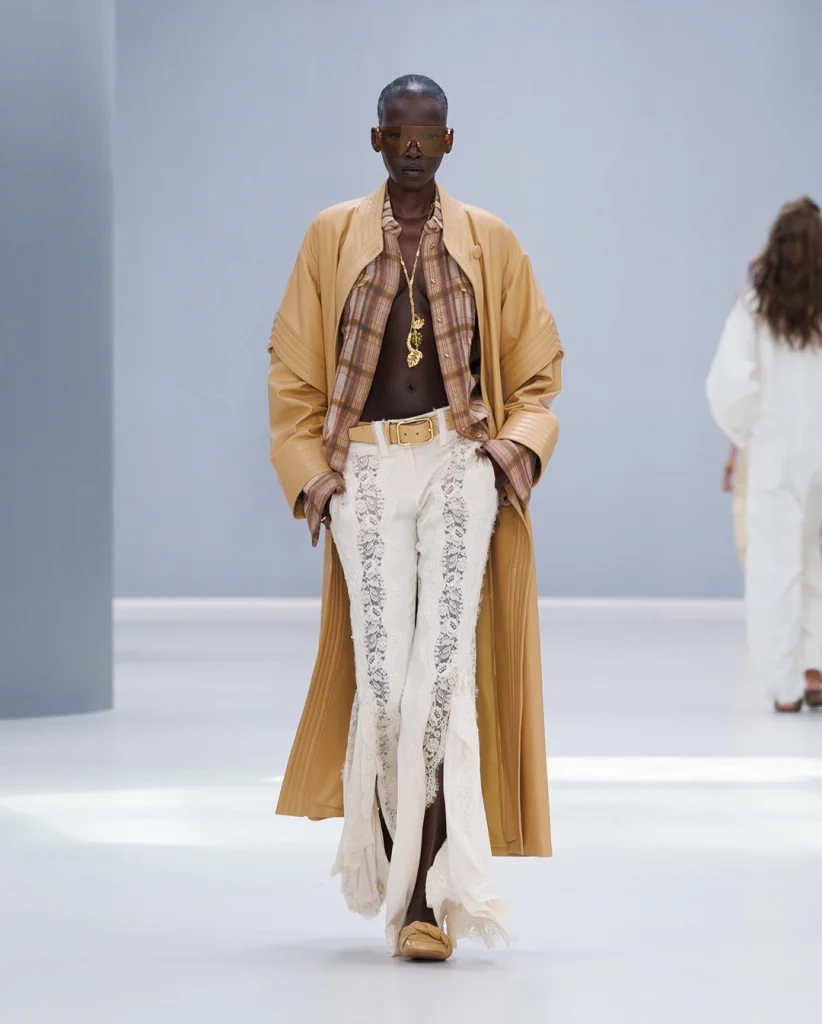
Photo via Zimmermann.com
The middle section of the show is where the collection’s central tension, quiet strength inside softness, becomes most visible as a design choice rather than just a stated idea. A boxy toffee leather jacket appeared layered over coral check shirting and a rose botanical mini skirt, heavy structured leather deliberately paired against something delicate and sheer underneath it. That same logic appears in one of the collection’s strongest looks, a full length camel leather trench worn wide open over a plaid shirt and sheer cream lace flared trousers, the lace running the length of each leg in open panels, finished with a thin gold waist belt and leather driving loafers. The trench itself is heavy, structured, almost architectural in its stiff standing collar, while what’s worn underneath is as fragile as anything in the whole show, and that contrast, rigid outerwear framing fragile lace, is the collection’s philosophy stated in one single outfit.
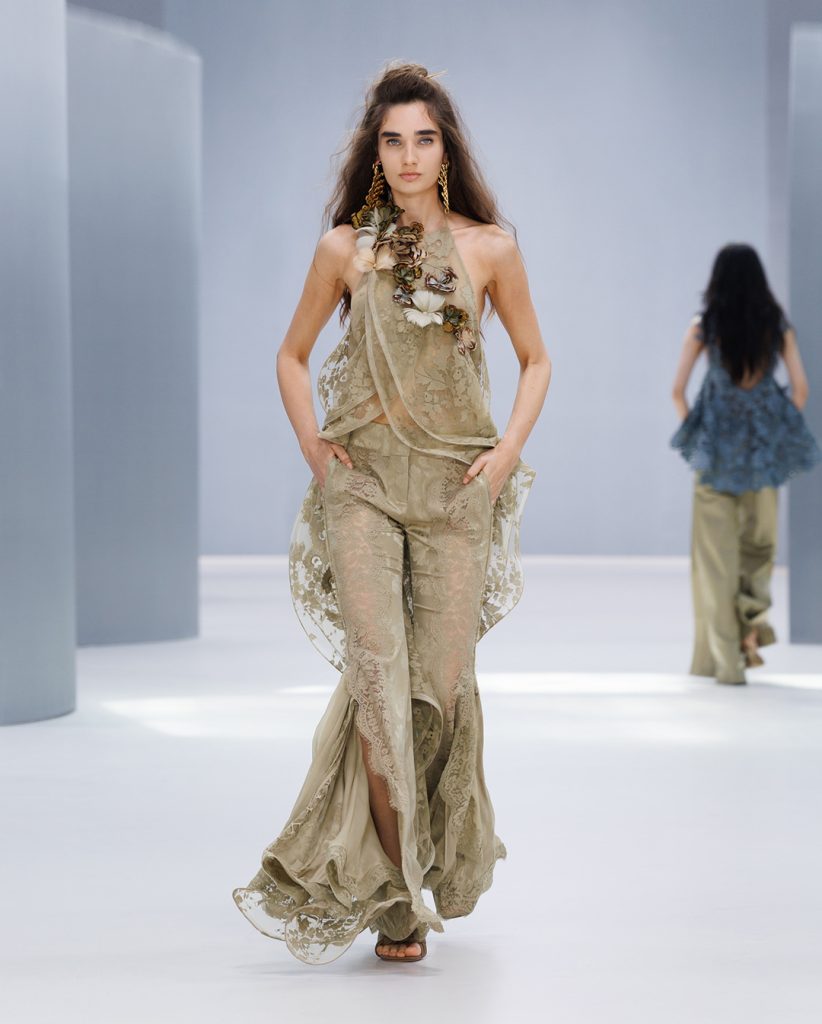
Photo via Zimmermann.com
This stretch of the show moved the palette into deep indigo denim, desert clay, and dusty rose, embroidered dresses and wave seamed flare jeans appearing alongside utility cargo trousers reworked in soft tan checks with oversized silk pockets. One particularly striking look pairs a sheer, embroidered cream lace blouse, long sleeved with a deep open placket, over wide leg jeans where the entire outer seam of each leg has been laser cut and appliquéd with butterflies cut directly through the denim itself, so the hardest, most utilitarian fabric in the whole collection becomes the surface for the most delicate technique in the show. It is a clever reversal of where you’d expect fragility to live, since the denim, not the lace, is the fabric doing the butterfly work in that particular look.
As the show moved further along, aquatic botanicals took over, draped mini dresses and pearl blue jersey sets in soft azure, before the whole collection shifted into what the house called its Motion capsule, a clear turn from daytime ease into evening transformation. A burnout top in a blue butterfly devoré print opened this stretch, paired with night sky denim, followed by pearl satin shorts and a matching sequin shirt that introduced real shine into the collection for the first time. From there the palette deepened fast, mocha silk, chocolate lace, midnight black, each exit growing more sculptural and more evening appropriate than the last.
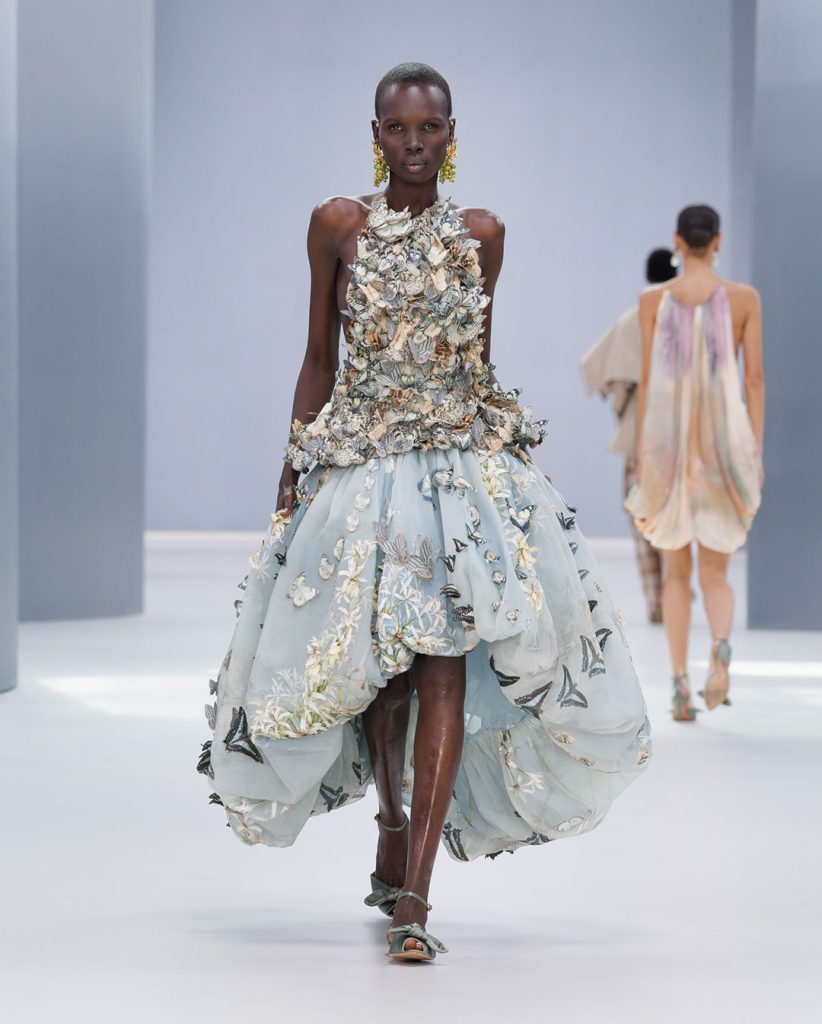
Photo via Zimmermann.com
One gown from this later stretch stands out in particular, a pale blue organza dress with a dense, heavily worked bodice covered entirely in layered fabric butterflies in cream, gold, and brown, releasing into a voluminous, asymmetric high-low skirt printed with butterflies and florals drifting across pale blue tulle. The bodice alone looks sculptural, built up in such dense layers that it reads more like a piece of wearable embroidery than a conventional fitted top, while the skirt beneath moves with real volume and lift, catching air the way a wing actually would mid-flight. Nearby, a caramel and cream chiffon caftan takes the same butterfly idea and applies it as a true wing print rather than dimensional applique, the fabric cut and draped so the print’s natural symmetry falls exactly where a real wing would fold across the body, gathered and knotted at the waist before releasing into long, fluttering sleeve panels.
A soft camel colored slip dress appeared further into this evening stretch, built from fluid draped silk with delicate lace inset along the hip and thigh, the straps finished in small dimensional butterflies at the shoulder, showing the motif could scale down to something quiet after the density of the earlier bodices. And one of the standout pieces of the whole collection is a blush pink gown with a deep V neckline, its entire bodice and skirt scattered with hundreds of small, hand applied butterflies in dusty rose, amber, and cream against a soft floral printed chiffon ground, the butterflies clustering more densely at the shoulder straps before thinning out as they drift down toward the hem, mimicking the way an actual swarm would disperse mid-air.
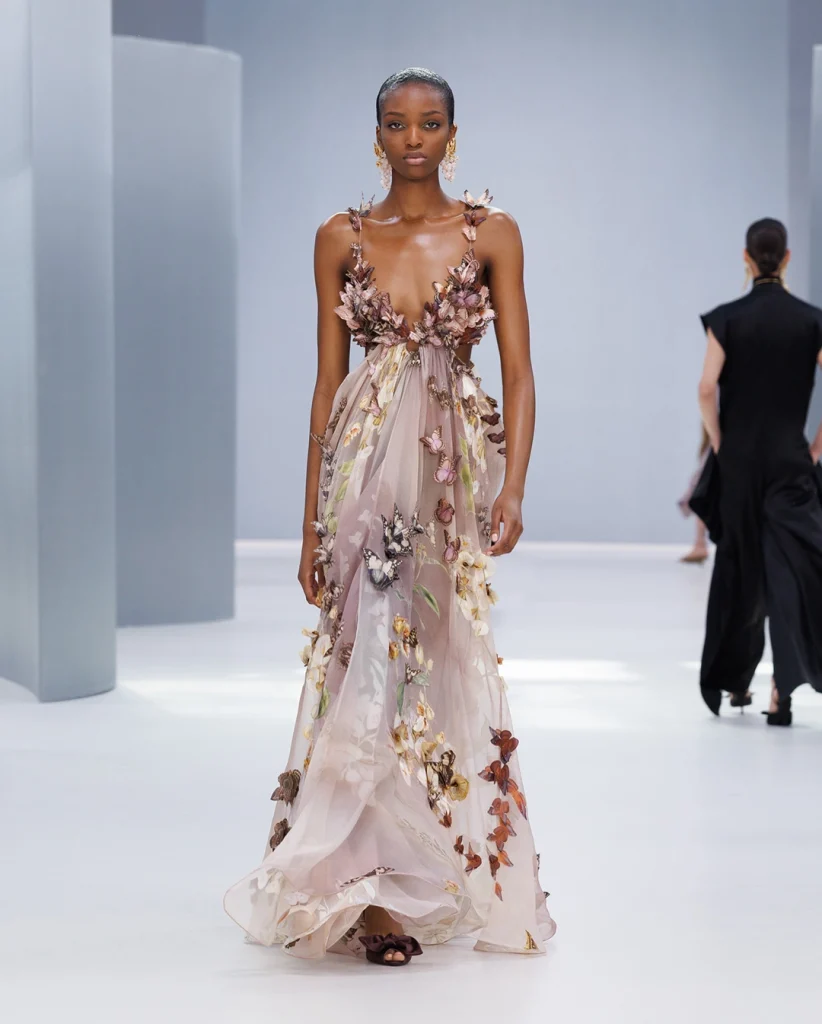
Photo via Zimmermann.com
By the time the show reached its final stretch, the collection had moved entirely into its nocturnal register, deep black lace, liquid metallic gold, and one last burst of electric chartreuse breaking through the darkness before the final exit. The show closed on a draped maxi dress in liquid gold, worn with chartreuse heels and warm amber jewelry, a fitting way to end a collection that spent its entire runway tracking the literal passage of an Australian day from dawn into night, since that final look reads like the exact moment the sun sets.
The Close
What makes Kaleidoscope work as a whole is how clearly the collection develops rather than simply accumulating looks. It opens in restrained, luminous daywear, poplin, light lace, soft florals, and only gradually introduces transparency, heavier embellishment, and real saturation as it moves forward, so the elaborate butterfly encrusted gowns toward the end feel earned rather than sudden. Nothing in this show reads as a disconnected collection of separate ideas. Every single look, from the simplest poplin shirt to the most densely embroidered evening gown, is working through the same central question, how do you build real strength into something that looks fragile, and the answer shows up differently at every stage of the runway, in a leather trench wrapped around sheer lace, in butterflies cut straight through heavy denim, in a bodice built up so densely in fabric wings that it holds its own shape without any internal structure at all.
This collection carries real Australian light and ease through every single look, grounded in enough technical ambition, the bilateral lace cutting pulled directly from scientific illustration, the laser cut denim, the hand molded three dimensional butterflies built up in the hundreds across certain gowns, to justify the craft comparisons critics have drawn to more established Paris ateliers. It is a collection that lets its own concept run all the way through, from the first poplin shirt to the final liquid gold gown, with a consistency that is worth real attention on its own terms.