
By Gabriela Afanador
Monday 8, June 2026

Photo Prime Video
Off Campus premiered on Prime Video on May 13th, 2026, and people have not stopped talking about it since. The show, created by Louisa Levy and co-run with Gina Fattore, adapts Elle Kennedy’s bestselling Off-Campus book series, and what it does differently from most romance content on television right now is worth paying attention to. At its core, it makes emotional stability the most attractive quality a person can have, not in a boring or conflict-free way, but in a way that feels genuinely fresh and that a lot of people are responding to with an intensity that says something about where we are culturally right now.
That cultural context matters more than it might initially seem to. A generation that grew up watching toxic relationships be romanticized, possessiveness framed as love, and emotional unavailability treated as depth has developed a real exhaustion with that formula. For years, the most commercially successful romance content operated on the premise that the more a male lead withheld, the more desirable he became, and that volatility between two people was a sign of chemistry rather than incompatibility. The characters who hurt each other the most were consistently the ones the audience was asked to root for hardest, and a significant portion of that audience went along with it because the alternative was rarely offered. Therapy culture, attachment theory, the way people now talk openly about green flags and red flags, the entire shift in how younger people discuss and evaluate relationships, none of that is accidental. It reflects a genuine and earned recalibration of what people actually find attractive, and Off Campus understands that emotional intelligence is not the opposite of passion but a different and more demanding version of it. The show takes that seriously, and the audience is feeling it.
The World the Show Builds
What makes Off Campus stand out most immediately is the relational environment it creates around its central story. Most romance content generates tension through cruelty within the friend group, the jealous girl trying to ruin everything, the best friend who betrays someone, the love triangle that turns people against each other, the rival who exists solely to create obstacles. These are not storytelling devices that reflect how most real relationships work. They are shortcuts, and audiences have been absorbing them for so long that many people have stopped noticing how much narrative energy is being wasted on manufactured conflict that exists to delay an ending everyone can already see coming. Off Campus removes almost all of that from its primary cast and finds that the tension does not disappear, it just becomes more interesting and more honest. When the people around the central couple are genuinely supportive of each other, the vulnerability between the main characters has nowhere to hide behind drama, and that exposure turns out to be more compelling to watch than anything a villain best friend could produce.
The disagreements that do arise within the core group are resolved through direct and uncomfortable conversation rather than spectacular fallouts, which sounds unremarkable until you realize how rarely television romance actually does this. The show treats conflict as something to be worked through rather than something to be escalated, and in doing so it creates a viewing experience that feels unusually safe without being dull, a balance that is much harder to achieve than it looks. There is real tension in Off Campus, real pain and real stakes, but it comes from the internal lives of the characters rather than from the behavior of people around them designed to make their lives difficult, and that distinction changes the entire emotional register of the show.
The friendships between the male characters are one of the show’s quietest and most effective achievements. The central group of roommates hold each other accountable and show up for each other in ways that feel real rather than performed, and the show uses those friendships to build a portrait of masculinity that does not rely on emotional detachment or competitive aggression to feel convincing. They are funny with each other, honest with each other, and capable of having difficult conversations without it becoming a confrontation. It is a small thing that adds up to something significant across eight episodes, because it means that every relationship in the show, romantic or otherwise, is operating from a place of genuine care, and the audience can feel that consistency even when it is not the focus of a given scene.
The female friendships carry the same weight. The dynamic between Hannah and her roommate Allie is written as a relationship between two people who are genuinely invested in each other’s lives and growth, not as a supporting structure for the romantic plot. They have their own conversations, their own concerns, their own dynamic that exists independently of the men in their lives, and that independence gives the female characters a fullness that romance television often denies them. When Hannah is going through something difficult, Allie’s response is not to offer plot-convenient advice that moves the story forward but to simply be present in a way that feels recognizable to anyone who has had a real friendship.
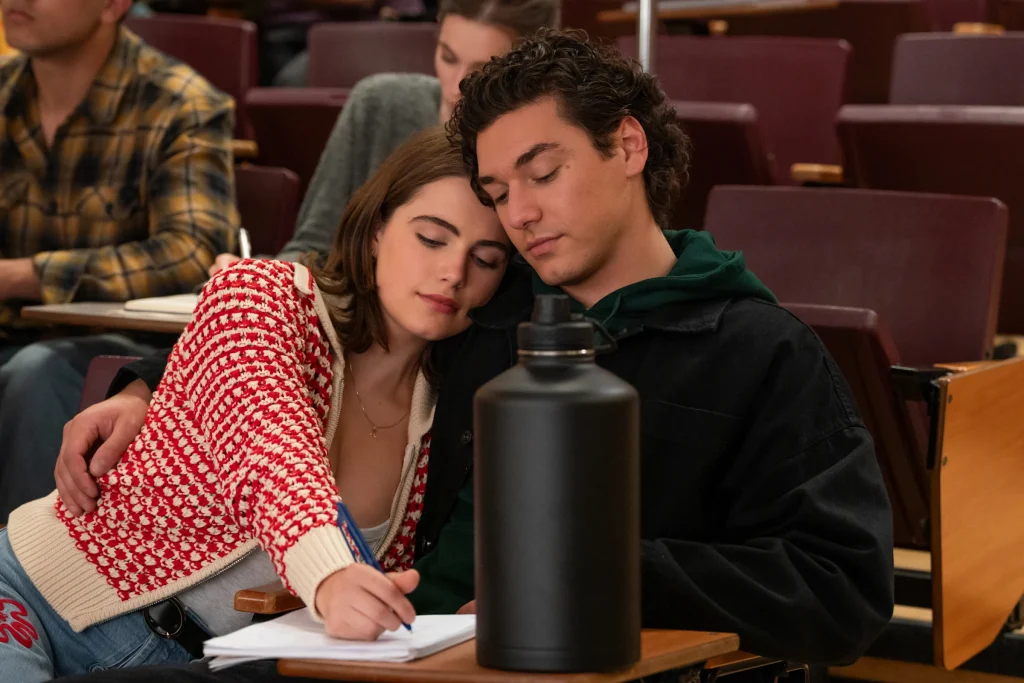
Photo Prime Video
The New Object of Desire
Garrett Graham, played by Belmont Cameli, is the character that has captured the most attention, and the reason why says something larger than anything specific about this one fictional person. He has everything the hockey romance archetype is supposed to have visually and athletically, the build, the easy confidence, the kind of presence that is supposed to make a room take notice. But what is actually making people emotional about him is something else entirely. It is the way he listens. Not politely, not while waiting for his turn to speak, but in a way that makes the person talking to him feel like what they are saying is genuinely important. It is the way his own painful history has made him more empathetic rather than more guarded, the way he has taken the worst things that happened to him and used them to understand other people’s pain rather than to justify his own behavior. It is the way he understands that caring about someone means paying attention to what they actually need rather than what would make him feel good about himself in a given moment.
These qualities are not dramatic or showy. They do not produce the kind of scenes that get clipped and reposted endlessly because they are breathtaking in a conventional sense. What they produce instead is a slow accumulation of moments where the audience realizes they are watching a character who is actually trying, not performing trying, but genuinely working to be the kind of person he wants to be in spite of everything in his history that would have made it easier not to. A previous generation of romance leads were not built this way, and the fact that this specific combination of qualities is generating the response it is generating says everything about what people are actually looking for right now.
Hannah Wells, played by Ella Bright, is equally important to what the show is doing and should not be reduced to the person Garrett’s emotional growth happens around. Her story is about reclaiming her own voice and her own sense of agency over her life and her body, and the show is genuinely careful to ensure that the relationship serves that process rather than replacing it. She does not become a better version of herself because of Garrett. She becomes a better version of herself because of her own work, and Garrett creates the conditions that make that work feel safe enough to do. The distinction matters, and the show understands why it matters, which is why Hannah reads as a complete person rather than a romantic counterpart.
The chemistry between the two leads works because of how specifically they are written rather than how attractively they are cast. They are two people with different and particular kinds of wounds that happen to meet in a way that creates real possibility, and the show earns that dynamic across eight episodes rather than asking the audience to accept it on the basis of good looks and proximity. The intimacy between them develops through small moments of honesty and attention rather than through dramatic declarations, which means that when the bigger moments do arrive they land with the full weight of everything that has been built leading up to them.
Why It Matters Right Now
Off Campus is ultimately making an argument that the most interesting love story is not the one with the biggest obstacles but the one where two people are genuinely trying to understand each other without a safety net. It is an argument that the most attractive thing a person can be is present, consistent, and honest about their own limitations. It is an argument that a relationship built on communication and mutual respect does not have to sacrifice tension or feeling to be those things, that in fact it produces a different kind of tension, the kind that comes from real vulnerability rather than manufactured drama, and that this kind is more affecting not less.
That argument is not new, but the moment in which this show is making it is specific and the audience it is making it for is ready for it in a way that perhaps was not true five years ago. The show is not asking people to lower their expectations. It is asking them to raise them in a different direction, toward the qualities that actually make relationships sustainable and meaningful rather than the ones that make them cinematic. The response it is getting suggests that a lot of people have already arrived at exactly that place on their own, and were waiting for a show that had arrived there too.