
By Gabriela Afanador
Sunday 8, March 2026

Carolyn Bessette Kennedy’s style gets called minimal all the time, but that word is too small for what she actually practiced. Minimal can suggest absence. Carolyn was the opposite. Her wardrobe was full of decisions. She dressed the way a great editor cuts a sentence: fewer words, sharper meaning. That is why her image keeps returning with such force. It is not only nostalgia for the 1990s. It is recognition of a kind of elegance that feels increasingly rare in a world where everything is explained, amplified, and performed.
The most useful way to understand her style is to stop thinking in terms of “outfits” and start thinking in terms of structure. Carolyn treated clothes as architecture. The foundation mattered more than the decoration. She relied on clean, vertical lines, balanced proportions, and fabrics that behaved. She chose garments that held their shape in real life, under real conditions, in a city where the sidewalk is the true runway. Her pieces did not need styling tricks to work. They were built to look composed even when the person wearing them was rushing, tired, distracted, or simply trying to live.
Her palette made the same argument. Black, white, grey, camel, deep navy, washed denim. These tones create a controlled frame around the body. They let hair, skin, posture, and movement carry the personality. They also reduce visual noise, which is part of the larger philosophy. Carolyn’s clothes never competed with her. They protected her. They sharpened her. They let her exist in public without giving everything away.

This is what people miss when they copy her: her style was not just “simple.” It was precise. The details were just quiet. Look closely at the way she chose a coat. It is long enough to create a vertical column, structured enough to hold the line, but never stiff. Look at her knitwear. It is often close to the body, never sloppy, and it sits cleanly at the shoulder. Look at her trousers. They lengthen the leg without becoming trendy, and they often carry a subtle menswear confidence without reading costume. She had a gift for selecting pieces that were reduced to their essence but still felt expensive because the quality lived in the cut.
There was also a tension in her wardrobe that made it feel alive. Hard and soft. Masculine and feminine. Public and private. She could wear something that looked borrowed from menswear and then soften it with the way it draped on her body. A crisp shirt under a long coat, a simple knit with a skirt that keeps the line elegant, a minimal dress that becomes unforgettable because it skims rather than clings. She understood that restraint can be seductive when it is deliberate. When nothing is screaming for attention, the person becomes the focal point. The clothes become a quiet amplifier, not the main event.
And then there is the reason her style is having such a specific resurgence now. Today’s culture is built on constant exposure. Everyone is visible all the time. Everyone is narrating their lives. In that environment, Carolyn’s silence becomes magnetic. There is only so much footage, only so many photographs, only so much access. Her mystery has not been manufactured. It is simply the result of a person who did not treat her public life as a performance. In the age of oversharing, that kind of privacy feels like power. Her clothes were part of that power. They were controlled in the same way her presence was controlled. The wardrobe becomes inseparable from the persona: composed, guarded, and completely uninterested in explaining itself.
That is why the current wave of interest in her is not just “90s revival.” It is a craving for a different set of values. Less novelty, more repetition. Less trend chasing, more refinement. Less overt branding, more precision. Carolyn’s look is a blueprint for dressing in a way that feels stable. That stability is emotional. It is not only about looking good. It is about feeling protected by what you wear.
Her wedding dress is the clearest symbol of this philosophy, and it is still one of the most influential bridal moments in modern fashion because it did not rely on bridal clichés to be memorable. The dress did not announce itself with volume or ornament. It did not need dramatic sleeves or heavy lace to prove it was important. It was a slip silhouette, cut close to the body, made to move with her rather than around her. The neckline, the straps, the way the fabric fell, everything was controlled. The effect was not “princess.” It was purity of line. It was the kind of elegance that looks effortless but is actually extremely hard to achieve, because it depends on perfect construction.
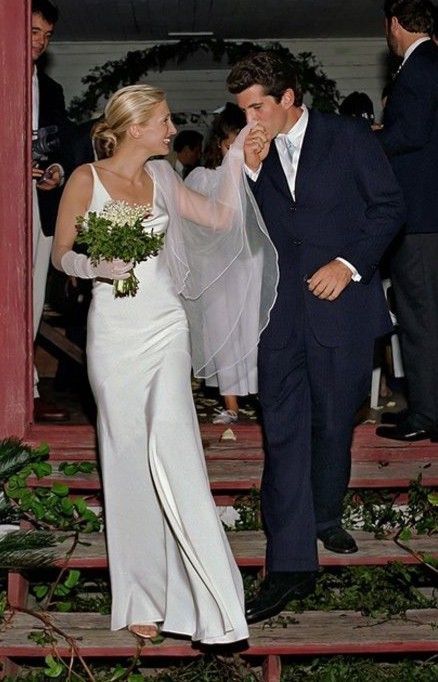
That dress remains timeless because it refuses to belong to one era. It looks as modern now as it did then, which is rare in bridal, a category that often dates itself quickly through trends. It also set a new standard for how bridal can express personality. The dress was not trying to transform her into a bridal archetype. It was letting her remain herself, just elevated. That is the core of her style: the clothes never swallowed the person.
If you look at bridal fashion since then, you can see her influence everywhere, even when her name is not mentioned. The rise of pared-back gowns, the return of slip silhouettes, the obsession with clean satin and minimal seams, the idea that the most powerful wedding look can be the one with the least decoration. She proved that a bride can be unforgettable without looking like she is wearing a costume version of romance. That is why the dress keeps being referenced. It is not simply iconic. It is structurally correct. It teaches designers and brides the same lesson: when the cut is right, you do not need anything else.
The fascination with her style also exposes something about how fashion works culturally. People want to believe that minimal dressing is easy. It is not. Minimalism is expensive, not because of price tags, but because it requires discipline. You have to know what fits. You have to know what proportion flatters you. You have to choose fabrics that do not cheapen under light. You have to commit to repetition and resist the urge to constantly reinvent yourself for attention. Carolyn did that naturally, and that is why she reads like an authority rather than a trend.
The renewed attention created by a major TV portrayal adds another layer. When a character is styled with this kind of restraint, every small choice becomes meaningful. A headband is not just a headband. It frames the face, changes posture, creates a certain distance. Tinted glasses become a barrier and a signature at once. A long coat becomes both elegance and privacy. A simple dress becomes stronger than an embellished one because it exposes the quality of the cut. That is why accuracy matters when recreating her style. It is not about copying exact pieces. It is about recreating the logic behind the wardrobe.

In the end, Carolyn Bessette Kennedy’s legacy is not “quiet luxury” as a marketing term. It is something more specific and more human. It is the idea that restraint can be a form of control, that repetition can be a signature, and that elegance can be built through line and material rather than through display. Her style teaches that the most powerful look is often the one that does not try too hard to be powerful. It just is.
And maybe that is why she continues to hold attention so strongly. In a world that moves too fast, her wardrobe moves at a slower pace. It invites you to look again, to notice proportion, to notice fabric, to notice how a person can be fully seen without being fully revealed. That is not just style. That is a philosophy of presence.