
By Gabriela Afanador
Sunday 25, January 2026
Rome’s Farewell
Rome gathered itself with a kind of measured grace. At the basilica, a handwritten message at the entrance compared Valentino to a flower, a simple note that managed to say what grand speeches often struggle to capture. Inside, the room filled with people who had known him in different ways: friends and peers, clients, studio hands, and those who came after him. In the days before, crowds moved through Piazza Mignanelli to pay their respects. Even the small details associated with him, including his beloved pugs, appeared as quiet reminders that he lived his world as deliberately as he dressed it. The atmosphere felt less like an industry ritual and more like a city acknowledging a man who turned elegance into habit.
A Life Built in Line, Color, and Craft
Valentino Clemente Ludovico Garavani was born in Voghera in 1932 and set his ambition early. He trained in Milan and then in Paris, learning two disciplines at once: Italian glamour and French rigor. In Paris he worked within couture houses where drape and structure were treated as serious engineering, absorbing how a garment can hold shape while still moving with ease. When he returned to Rome and launched his own maison around 1960, he brought that education with him. Soon, Giancarlo Giammetti joined him, and together they built not only a fashion house but a full world around taste, ceremony, and control. From the start, the promise was clear: romance without chaos, refinement without chill.
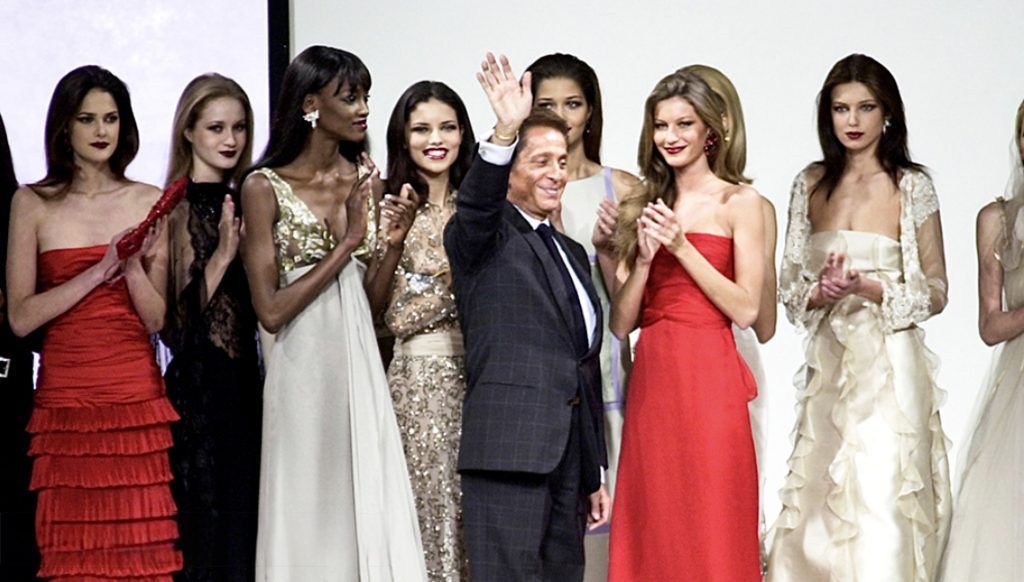
Valentino’s signatures were never accidental. His work relied on the discipline of line. Necklines were shaped to flatter rather than expose, waist placement was used to elongate the figure, and seams were positioned to lift and sculpt without visibly forcing the body. On top of that architecture, he placed the details that became his punctuation: bows with graphic crispness, lace used for luminosity rather than sweetness, embroidery applied with intention instead of excess. Then there was his red, unmistakable and specific, a shade that carried emotion without needing explanation. He also understood restraint as its own spectacle, proving that white can be as dramatic as any jewel tone when the cut is exact.
The women who wore him confirmed the point. Royals, first ladies, and Hollywood icons chose Valentino for moments that become history. These were garments built for ceremony, but also for the camera. He understood how a dress reads in motion, in flash, in memory. He dressed not only a body, but an occasion.
What made the house powerful was control. Patternmaking led, and decoration followed the logic of the cut. Capes opened with breadth but never swallowed the wearer. Ruffles, when present, carried air rather than bulk. His eveningwear often moved with a softness that looked effortless but was achieved through precision: bias cuts, careful weight distribution, fabrics chosen for how they sway rather than how they sparkle. Even when he approached ready to wear, he pushed it toward couture behavior through finishing, construction, and discipline. Over decades, the result was a remarkably consistent silhouette: upright, luminous, and unmistakably poised, never fragile.
Valentino did not only dress a world of glamour; he lived inside it. He hosted with the same refinement he demanded in fittings. The documentary that followed his final working years before retirement showed something runways cannot always reveal: how much labor it takes to make elegance look natural, and how much conviction it takes to sustain a point of view for decades. After stepping back from the studio, he remained present, watching, responding, showing up. He supported the designers who inherited the house, and when something moved him, he made it known. He allowed evolution without confusing change with disrespect.
Many brands survive by flattening their founders into a logo or a single motif. Valentino’s legacy is more useful than that. It is not simply about a famous red, or bows, or lace. It is a philosophy of glamour built through proportion and finish. It is the belief that where a shoulder sits matters, that how a skirt holds air matters, that satin can look cheap or extraordinary depending on how it is cut and handled. It is also a conviction that ceremony still belongs in modern life, and that a woman entering a room in a perfectly constructed gown changes the atmosphere without saying a word.
Fashion moves fast, but legacy only survives if it teaches. Valentino’s lesson is simple to say and difficult to deliver. Fit is not only technical; it is emotional. Color is not an accent; it is a decision. Glamour is not something added on top; it is built into the garment. Those ideas feel especially relevant in an era that often rewards speed and noise. Valentino’s work insists that beauty has requirements: time, attention, and a standard that does not bend with trends.
When the service ended, the city returned to its rhythm, but something remained suspended in the air: a collective understanding of what Valentino represented. Famous faces were present, but the strongest presence was the memory of the clothes themselves, the way a Valentino piece makes posture change almost automatically. The house will continue, interpretations will shift, seasons will come and go. What will not change is the foundation he refined for a lifetime: elegance that does not need to shout to be recognized. It stays.