
By Gabriela Afanador
Monday 6, October 2025
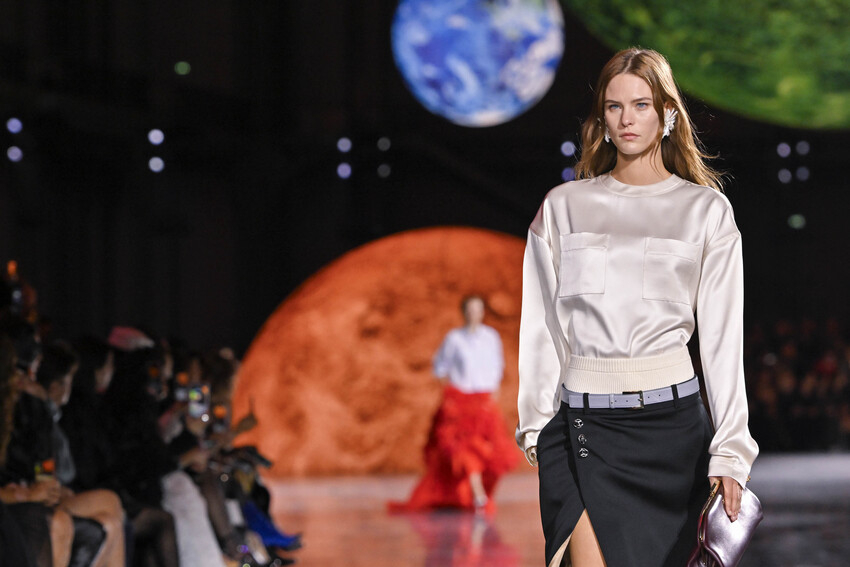
Photo: firstVIEW
About Matthieu Blazy
Matthieu Blazy is a studio-first designer with a résumé that runs through La Cambre, Margiela’s Artisanal workshop, Phoebe Philo’s Céline, and Raf Simons’s Calvin Klein before his breakout at Bottega Veneta. There, he fused rigor and craft into everyday icons, most famously trompe-l’œil leather “jeans” and quietly powerful intrecciato bags like the Kalimero and Andiamo, earning a reputation for materially intelligent clothes that move well and photograph even better. In December 2024, Chanel named him artistic director of fashion; his debut at the Grand Palais on October 6, 2025, reset the house’s pace with aerodynamic tailoring, elongated knits, and evening pieces that balanced showmanship with control.
Chanel Spring 26
Chanel Spring 2026 opens with tailoring that refuses stiffness. Cropped jackets set a firm shoulder and a clear vertical, while waistcoats are intentionally loose so the torso reads relaxed rather than armored. Long, straight trousers extend the leg line; cap-toe pumps and flats ground the pace. Precise edges moderated by ease.
The show then enters a measured release. As the soundtrack softens and brightens, silhouettes lengthen: silk skirts with liquid movement, shiny knits that catch light without shouting, and knit columns that finish with a floral at the hem. Oversized poplin shirts pocketed, boxy, almost clinical by design sit against tiered skirts to create contrast of planes: architecture on top, motion below. When color spikes, it does so deliberately. A full red skirt, built out with feathered, petal-like tufts, shifts the runway from line to mass, while a crisp shirt above steadies the frame.
Floral elements operate as structure. Spiky “silk-tree flower” blooms appear as earrings and headpieces that widen the portrait. At hems, the same language clusters as tactile wreaths, energizing the perimeter of skirts and knits. In the finale’s multicolor passage, it reads as motion first, color second.
Throughout, styling is disciplined: compact clutches, cap-toe footwear, and jewelry that frames rather than competes. House codes arrive edited. Tweed is cropped and squared off, trimmed with plush edging, flowers, or contrast bands that map the jacket’s architecture. Minis are direct, their line kept clean by the same cap-toe shoes. Crucially, tweed functions as a texture system rather than a heritage plaque sometimes knitted, sometimes fringed, sometimes layered over soft ruffles so hardness and softness share the frame. A leather trench drops in as utility gloss to meet all the silk, tightening the dialogue between polish and practicality.

Photo: firstVIEW
Toward the end, silhouettes turn more classical. The finale concentrates energy at the floor mesh or satin tops kept neutral above skirts that carry the story abstract floral panels, then full multicolor fringe sliced into petal-like strips so volume swirls rather than thuds.
If the poplin shirts feel stern or the waistcoats looser than “classic Chanel,” that friction is the recalibration. Jackets get stricter, cores get easier, and codes travel via proportion and texture instead of ornament alone. Spring 2026 proposes a working vocabulary to build on: a stricter jacket line, relaxed cores, engineered tweeds, and sculptural florals that frame the body rather than sugar it. The pacing from clipped tailoring to expansive evening tracks the musical arc and reads as chapter one of a new baseline rather than a one-season firework.