
By Gabriela Afanador
Sunday 21, September 2025
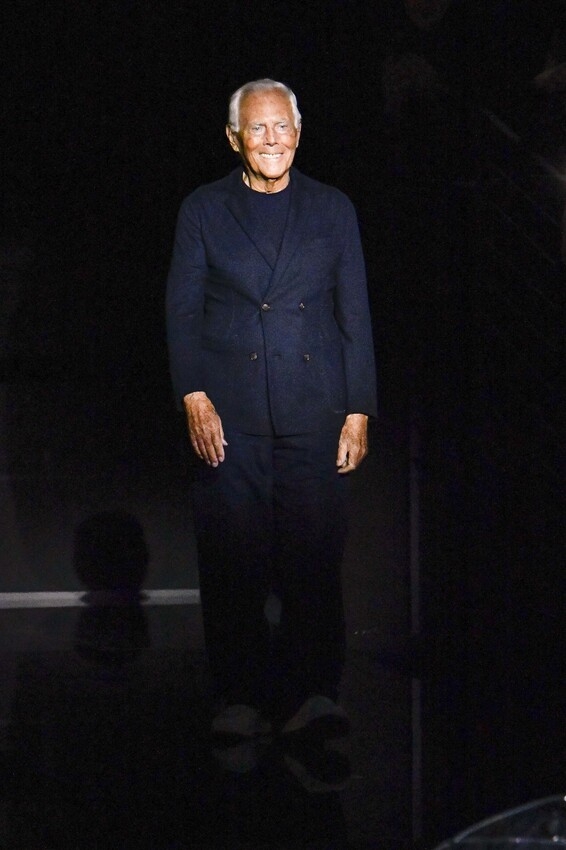
Photo: firstVIEW
Giorgio Armani died in Milan on September 4, 2025, at 91. Milan Fashion Week, already poised to celebrate the house’s 50th anniversary, became the setting for a rare kind of closing chapter: a final runway collection shaped under Armani’s direction. It did not read like a farewell staged for effect. It read like Armani doing what he always did, with even more clarity than usual: building emotion through restraint, precision, and control.
Milan and Pantelleria as a map
The evening unfolded in Brera’s courtyard with immaculate white seating and a soft wash of light that never competed with the clothes. Ludovico Einaudi played the piano. The casting moved at a deliberately unhurried tempo, faces calm, steps slower than the industry’s current default. Everything reinforced a simple instruction: look closely, and take your time. The audience mirrored it. The mood was respectful rather than performative, as if the room understood that Armani’s work had always required a quieter kind of attention.
The collection traced two places closely tied to Armani: Milan, a city of work and modernity, and Pantelleria, the island where he spent many summers. That geography became a color story and a shift in weight. The opening looks lived in pale neutrals and Armani’s familiar greige spectrum. Linen suiting, wide palazzo trousers, clean waistcoats. The silhouette was relaxed but never loose, generous but always exact. It was the kind of ease that comes from patternmaking, not from simply sizing up.
From there, the palette darkened gradually. Muted greens and utilitarian khakis appeared, followed by greyer tones and a cooler, denser atmosphere. Then blue began to take over, not as a dramatic turn but as a slow fade from daylight to evening. Blue-grey, then deeper navy, then shades that felt closer to midnight. The effect was almost meteorological, like watching the sky change rather than watching a trend arrive.
The cut held to his lifelong thesis. Jackets skimmed instead of gripping. Shoulders had structure without aggression. Trousers moved with air while keeping a clean vertical line. Even when the collection leaned into formal territory, it never turned into armor. Tuxedo ideas were translated through lightweight fabrics and fluid tailoring, so the body looked poised rather than posed. Accessories stayed disciplined: woven carryalls, compact clutches, sandals and pumps that supported the silhouette instead of competing with it. In the men’s looks, long coats, broad belts, and velvet suiting added depth without heaviness.
Evening without theatrics
As the show progressed, the fabrics and finishes quietly shifted toward night. Silk trousers took on a sober sheen. Jacquards and beadwork appeared, not as loud decoration but as texture that caught light at a distance. Greens deepened, then the spectrum moved toward violet and darker purples. Dresses were cut to move with the courtyard air, jackets became slightly more defined, and sheer elements appeared with restraint. The glamour was unmistakable, but it never felt weighted down. It was evening the Armani way: polished, light, and controlled.
Near the end, a clean, beaded column appeared with a young portrait of Armani worked into the surface, visible only when you looked closely. It felt intimate rather than monumental, a signature that asked for attention instead of demanding it. The runway received a standing ovation. Soon after, members of Armani’s inner circle stepped out for a bow in black velvet, a moment that carried unmistakable emotion while still holding the composure the house has always prized.
After the runway, the evening continued inside Brera with an exhibition that placed Armani looks alongside Italian art, extending the message beyond fashion as industry and toward fashion as visual language. It did not feel like borrowed prestige. It felt like a natural pairing. Armani’s work has always depended on balance, proportion, and restraint. The museum setting simply made that connection literal.
It would be easy to frame this collection as a greatest-hits recap. It did not read that way. What made it powerful was continuity under pressure. The neutrals were present, but they evolved. The tailoring stayed precise, but it refused stiffness. The shine of evening arrived, but it never accumulated weight. Armani’s modernity has never been about novelty. It has been about refining a system until it feels inevitable.
There was also an ethic embedded in the staging. The slow walk, the controlled atmosphere, the quiet focus on the clothes suggested a final insistence on something the fashion calendar often forgets: clarity can be a luxury. The details worth noticing were not the loudest ones. A rope-like belt that moved gently against a dark dress. The way a midnight jacket absorbed light instead of reflecting it. The lowered waistline that makes the torso look calm. Small decisions, carefully held.
What remains is not one dress but a method: reduce until the cut carries meaning, calibrate weight until evening feels buoyant, slow the pace so the garment can breathe. Armani left that lesson in Brera with the calm authority only a lifetime of discipline can produce. He did not need spectacle to be memorable. He never did.