
By Gabriela Afanador
Tuesday 28, July 2026
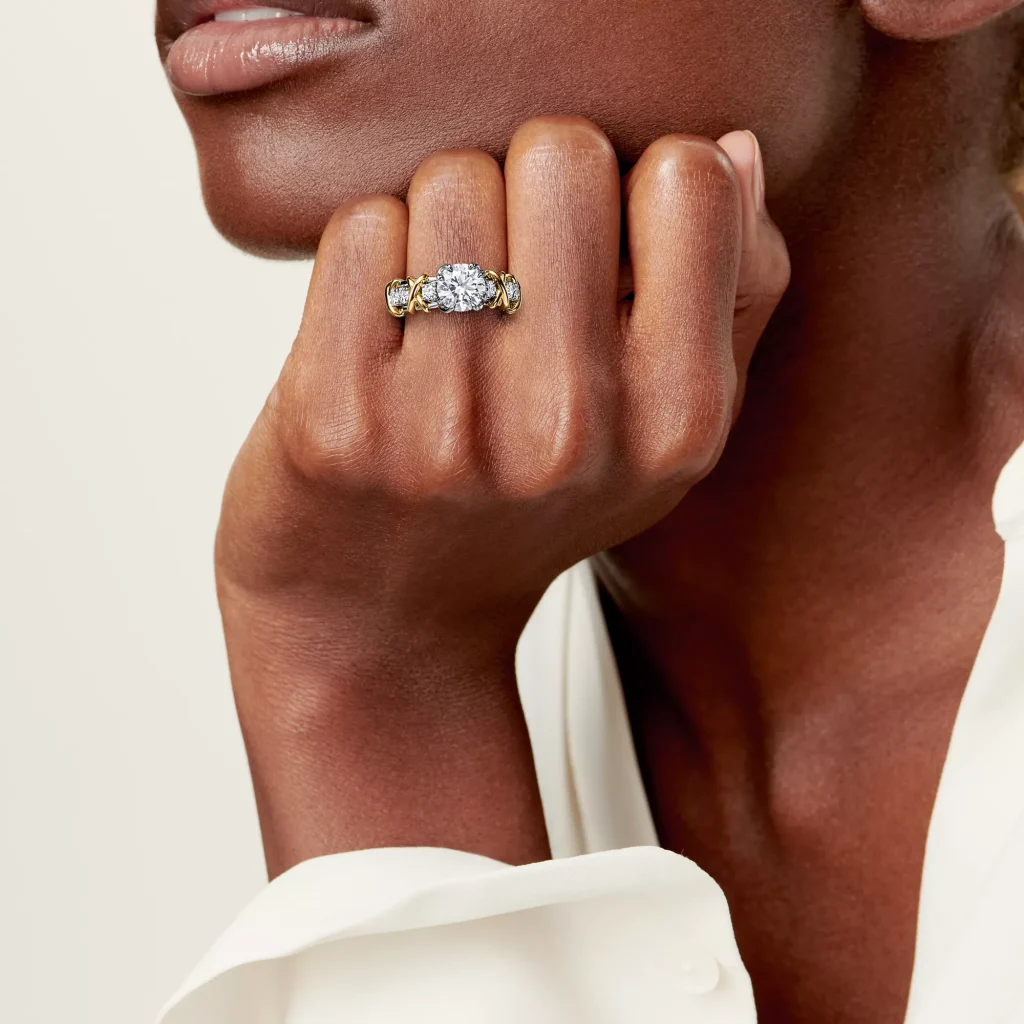
To understand why the new Sixteen Stone solitaire diamond ring matters, you have to start in Alsace, France, in 1907, where Jean Schlumberger was born into a family of textile manufacturers. The context is not incidental. Schlumberger grew up surrounded by fabric, by the logic of weaving, by the way threads cross and interlock to create patterns that are simultaneously structural and decorative, and that early visual education became the foundation of everything he would eventually produce in gold and platinum and precious stones. He moved to Paris in his twenties to pursue his artistic instincts, found his way into the orbit of Elsa Schiaparelli, for whom he designed buttons and bijoux that carried the same surrealist energy and technical imagination as the couture pieces he was adorning, and spent years building a reputation as someone who understood jewelry not as ornamentation but as a form of design thinking, a discipline with its own logic and its own demands that happened to be executed in extraordinarily precious materials.
By 1956, Walter Hoving, the chairman of Tiffany and Co., had seen enough of Schlumberger’s work to invite him to join the house as Vice President, making him the first designer in Tiffany’s history to work under his own name, a distinction that reflected both the rarity of his talent and the institutional confidence that his work warranted. What Schlumberger brought to Tiffany was a complete and coherent visual language rooted in the textile world of his childhood, the translation of woven ropes and tassels and ribbons and cross-stitches into precious metals, the transformation of something soft and everyday into something hard and permanent. His signature use of woven gold, intricately worked alongside platinum in combinations that referenced fabric and thread without imitating them, became one of the defining elements of Tiffany’s design vocabulary, still visible in the house’s work more than fifty years after his death.
In 1959, Schlumberger introduced the Sixteen Stone ring, originally designed as a wedding band. The ring placed sixteen round brilliant diamonds in a continuous circle, each one framed by an X motif in gold that created the visual impression of a cross-stitch, the diamonds appearing to be held together by precious metal thread rather than set in conventional prongs. The effect was simultaneously delicate and structural, the geometry of the X motif giving the band an architectural quality that distinguished it immediately from anything else in the Tiffany collection and from anything else in fine jewelry at the time. The cross-stitch reference was deliberate and personal, Schlumberger drawing directly from his family’s textile heritage and from the world he had grown up in, and the result was a ring that looked like nothing that had existed before it.
The technical execution of the Sixteen Stone is part of what makes it significant as an object beyond its design. Only a small number of master craftspeople at Tiffany possess the skill to assemble it, each of them having undergone more than two decades of specialized training before being trusted with the construction of a piece this intricate. The X motifs must be formed and set by hand, the diamonds positioned within them with a precision that cannot be standardized or mechanized, and the relationship between the platinum and gold elements of the ring requires a level of control over both materials simultaneously that most jewelry training does not produce. The ring is, in a very literal sense, a demonstration of what sustained human expertise produces when it is applied to an extraordinarily specific problem, and that demonstration is built into every piece that leaves the atelier.
The Cultural History of the Ring
The Sixteen Stone accumulated its cultural significance gradually and through genuinely significant associations. Bunny Mellon, the philanthropist and garden designer whose personal aesthetic became one of the defining references of a certain kind of American elegance, wore the Sixteen Stone consistently enough that the ring became associated with her name and with the understated, deeply considered approach to luxury she represented. The ring has also been linked to Jacqueline Kennedy, specifically to what has been described as her swimming ring, a piece she was said to wear informally and privately in a way that suggested genuine personal attachment rather than the performative display that characterized so much celebrity jewelry of the period. Whether the specific connection to Kennedy is fully documented matters less than what it reflects about the ring’s place in the cultural imagination, the Sixteen Stone as the kind of thing that the most stylish and most significant women of the twentieth century chose for themselves rather than received for occasion.
That distinction, the ring as a self-purchase rather than a gift, as a personal object rather than a symbolic one, is one of the threads that runs through the Sixteen Stone’s history and that connects directly to how Tiffany is positioning the new solitaire version in 2026. The ring has always occupied a slightly different category from the conventional engagement ring or the formal high jewelry piece, something closer to a personal talisman, a piece that its wearers chose because it meant something specific to them rather than because it communicated a specific social message to anyone else.
What Just Happened
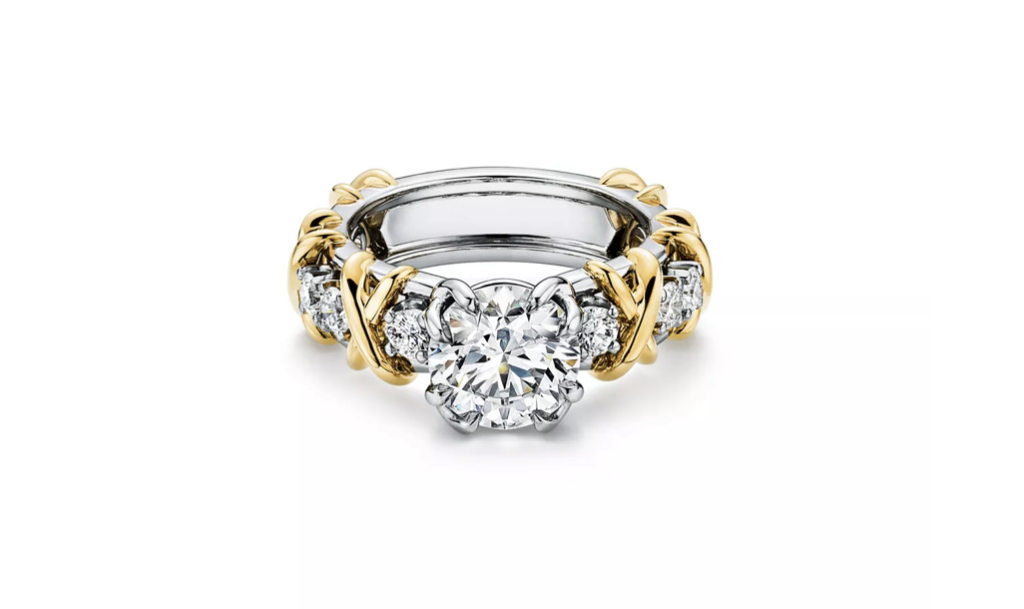
The new Sixteen Stone solitaire diamond ring, introduced in 2026, is the first time in the design’s sixty-seven year history that the house has reimagined it with a center stone. The original Sixteen Stone band places its diamonds in a continuous circle with no hierarchical focal point, each stone equal in the pattern, the ring working as a unified composition rather than as a setting for a single significant gem. The new solitaire takes the X-shaped prong basket that forms the structural and visual heart of Schlumberger’s original design and uses it as the setting for a center diamond, the cross-stitch motif now functioning as the mount for a solitaire rather than as the pattern of the band itself. The basket of X-shaped prongs that holds the center stone is drawn directly from Schlumberger’s early sketches, designs he produced in the 1950s and 60s that were never fully realized in the original collection and that have been brought to completion now, sixty years after they were first conceived.
The result is a ring that is simultaneously entirely new and entirely continuous with the design it comes from. The center diamond gains the architectural frame of the cross-stitch motif, which gives it a visual context and a structural setting that differs completely from the conventional solitaire prong configurations that dominate the engagement ring category. The sixteen round brilliant diamonds of the original band ring remain present in the new solitaire as accent stones surrounding the center, so that the continuity with the original design is visible and legible rather than simply referenced in the press material. The combination of platinum and 18k yellow gold that has always defined the Sixteen Stone’s two-tone character is preserved throughout, the warm gold of the X motifs sitting against the cool platinum of the band in the same relationship that Schlumberger established in 1959.
The campaign that accompanies the new ring stars Mikey Madison and sits within Tiffany’s broader Love and Celebration framework, which has been deliberately expanded beyond the conventional bridal context to make room for self-purchase, friendship, and personal milestones that have nothing to do with romantic partnership. The Sixteen Stone solitaire can mark an engagement. It can also mark something entirely personal, a moment of individual significance that a woman chooses to commemorate in a piece she buys for herself rather than waits to receive. A series of craft films released alongside the campaign document the making of the ring in detail, tracing the evolution from Schlumberger’s original sketches through the atelier work that produces the finished object, which is the kind of transparency about process that the house rarely extends to individual pieces and that reflects how seriously Tiffany is positioning this particular launch.
The significance of the new solitaire as a product development is hard to overstate within the context of what the Sixteen Stone represents to the house. Introducing a center stone to a design that has existed for sixty-seven years without one is not a minor extension of a collection. It is a fundamental reimagining of what the design is capable of doing, and doing it by returning to Schlumberger’s own unrealized sketches rather than by extrapolating from the existing pieces gives the new ring a legitimacy and a continuity that a more freely interpreted update would not have. The house found the answer to what the Sixteen Stone could become inside the archive of the designer who created it, which is both the most conservative and the most creatively honest approach available to it, and the ring it produced from that research is a genuine addition to what is already one of the most significant design legacies in the history of American jewelry.