
By Gabriela Afanador
Monday 13, July 2026

Photo via @Schiaparelli on Instagram
Daniel Roseberry opened Paris Haute Couture Week on July 6th at the Petit Palais with a collection titled The Abyss, and from the moment the first look appeared it was clear that the title was not a mood or an aesthetic but a genuine destination. The show notes Roseberry wrote for the season reached back to June 1940, when Elsa Schiaparelli boarded a ship for New York ahead of the Nazi occupation of Paris, leaving behind the fragile and brilliant world she had built around surrealism and the idea that a dress could be a provocation. He described the collection as dedicated to that period, to the sunset of elegance and to the end of the world as we knew it, a phrase that carries considerably more weight when applied to the work of a house whose founder actually lived through that ending and whose own archive is one of the primary records of what fashion looked like in the moment before everything changed. The Abyss is the space between what existed and what came after, and Roseberry descended into it with the full technical resources of the Schiaparelli atelier and a set of material ambitions that the house had never previously attempted.
Outside the Petit Palais before the show the arrivals functioned as their own event, which at Schiaparelli they reliably do. Bad Bunny, who had won Album of the Year at this year’s Grammys wearing custom Schiaparelli menswear, arrived in a butter yellow double-breasted suit with a trompe l’oeil braided hair tie and sat front row beside his younger brother Bernie Martínez Ocasio, the two of them representing the kind of genuine personal relationship with a house that produces a different quality of front row presence than a contractual arrangement does. Emma Corrin arrived as what could only be described as a Schiaparelli bird of paradise, wearing a feathered blazer covered in hand-painted plumes from a previous haute couture collection with four hand-sculpted bird beaks protruding from the breast and back of the garment, worn open over black trousers and heels, the look immediately becoming one of the most discussed arrival images of the season and a reminder that the clothes Roseberry makes exist in the world outside the runway in a way that most couture never achieves. Michelle Yeoh sat nearby in a black midi dress with a statement feather trim. Chiara Ferragni wore one of the house’s trompe l’oeil anatomical body print dresses with large gold earrings, the hyperrealist print of the female form that has become one of Roseberry’s most recognizable signatures communicating the house’s creative DNA without requiring any explanation.

Photo via Schiaparelli on web
The Schiaparelli show opening Paris Haute Couture Week is a position the house has now occupied for several seasons, and the role it plays in setting the tone for the week as a whole is significant. Where the collections that follow might offer romance or tailoring or historical research, Schiaparelli offers provocation and craft in equal measure, the technical achievements of the atelier always present beneath the theatrical surface, and The Abyss was the fullest expression yet of what that combination can produce when Roseberry and his team are genuinely willing to go somewhere new.
The Collection
The conceptual and material engine of The Abyss was the ocean floor, and the specific creatures that inhabit it, and Roseberry used that world not as a decorative theme or an aesthetic reference but as a genuine material investigation, asking what couture could look like if it abandoned the fabrics and techniques it has always used and started from the question of what lives at the bottom of the sea. The answer required the atelier to develop materials and construction methods that had not previously been used in haute couture at this level of ambition, and the results were sufficiently extraordinary that the craftsmanship drew as much attention as the concept, which is the ideal relationship between the two in a couture context.
The centerpiece of the collection and the piece that defined the season most completely was a humanoid bodice that Roseberry described backstage as a Prometheus-inspired design, the shape of a corset rendered in a material the house had never previously worked with. The process began with clay, the bodice sculpted by hand before being cast in silicone and painted a milky blue that sits somewhere between the color of deep water and the color of skin under pressure. Roseberry called it an augmented version of reality, and the description is precise, the bodice reproduces the shape of a couture corset with such hyperrealism that it simultaneously reads as the garment it references and as something entirely different, a second skin cast from a body rather than constructed around one. At the back, the silicone is pierced with a series of eyelets that create the illusion of a spine running down the wearer’s back, the most private and structural element of the body made visible through the surface of the garment in a way that is simultaneously clinical and intimate. The bodice was modelled by both Amelia Gray and Karlie Kloss during the show, the two presentations showing how the piece read differently depending on the body wearing it, which is the most fundamental test of whether a couture garment is genuinely made for a person or simply made to be looked at.
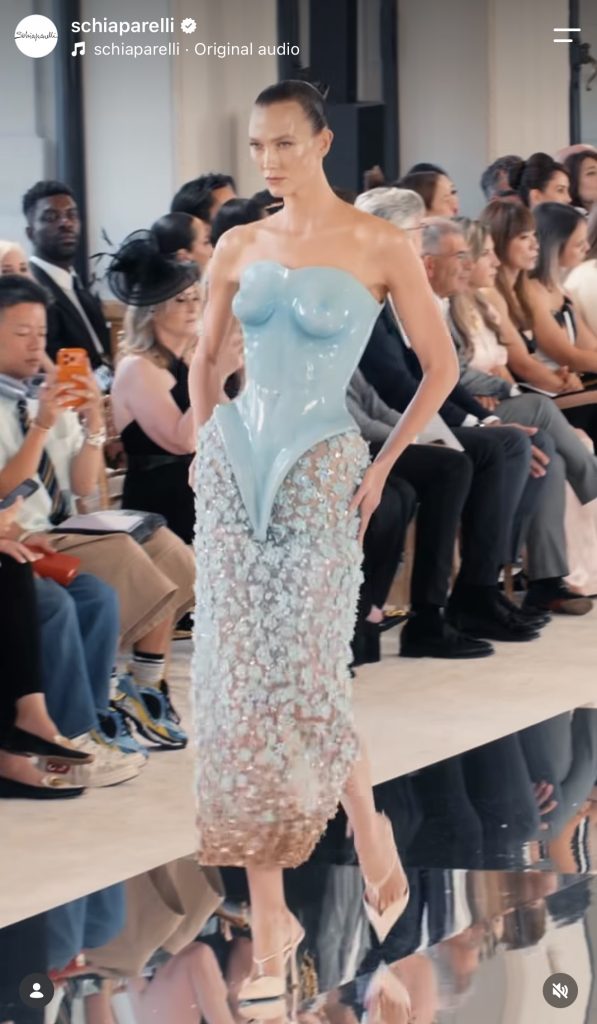
Photo via @Schiaparelli on Instagram
The skirt paired with the silicone bodice was built from hundreds of individual flowers made from hosiery stretched on metal wires and pearls, the colors graduating in ombré from cornflower blue at the top to a caramel at the hem designed to fade into the tights worn beneath, so that the boundary between the garment and the body dissolved as the eye traveled downward and the skirt appeared to grow directly from the leg rather than sitting on top of it. This dissolution of the boundary between clothing and body ran through the entire collection as one of its most consistent ideas, the garments not covering the body but becoming continuous with it, which is the surrealist tradition the house was founded in translated into a contemporary material language.
The ocean imagery arrived in its most direct form across a series of looks built around deep sea creatures, the most theatrical of which were inky black latex pieces whose shoulders erupted into kinetic latex tentacles that moved with the wearer in a way that recalled the bioluminescent predators of the deep ocean floor. Roseberry’s specific reference point was Ursula from The Little Mermaid, whose own design was inspired by the legendary drag queen Divine, a chain of cultural translation that moved from nature to drag to animation and then to haute couture in a sequence that is exactly the kind of layered, unexpected referencing that the house does better than anyone working in couture today. The tentacles were attached to the shoulders rather than hanging from the body, which meant they moved with the motion of walking rather than simply swinging, responding to the wearer’s movement in a way that made them feel genuinely alive rather than decorative.
Other gowns were spiked like purple sea urchins, the spikes constructed from a material light enough to hold their shape without adding significant weight, so that the silhouette was as dramatic as it appeared without the physical burden that a more conventional construction of the same shape would produce. Looks that glowed from within like bioluminescent deep sea fish moved through the evening section of the lineup, the light-up quality achieved through a technique the atelier has declined to detail publicly, which is the appropriate response from a house that understands that the mystery around how something is made is part of what makes it compelling. Oyster decorations created deliberately yonic forms, the organic geometry of the shell appearing across multiple pieces as an opening rather than a surface, the shapes carrying a biological directness that the surrealist tradition Elsa Schiaparelli inhabited would have recognized immediately.
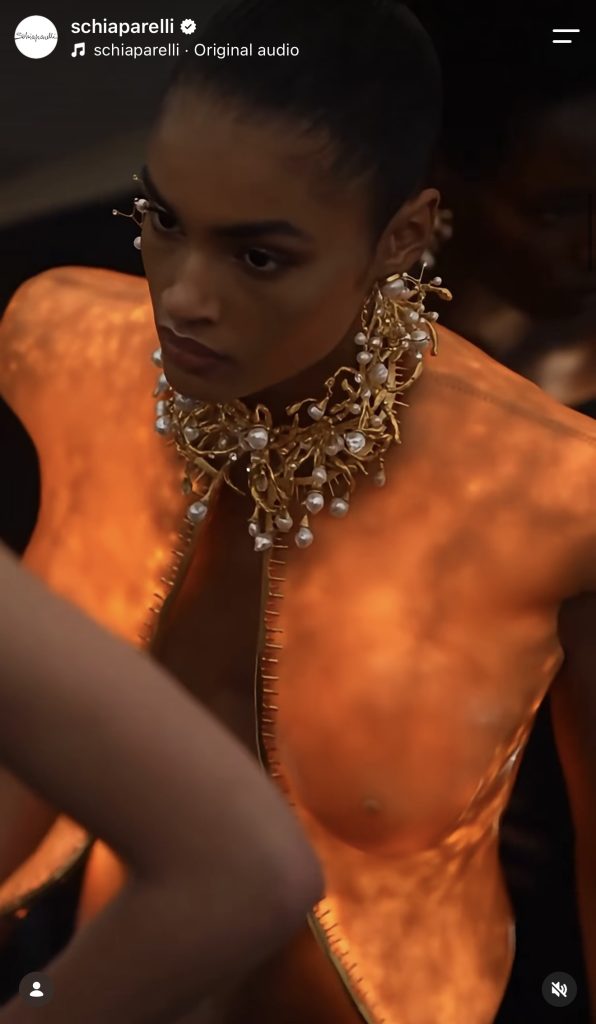
Photo via @Schiaparelli on Instagram
A jacket and matching pair of leggings encrusted with real flowers, fish scales, and ribbon flowers, with kinetic latex tentacles scrolling from the shoulders, was the collection’s most conventionally couture piece in the sense that it represented the most sustained application of traditional atelier techniques, real materials applied by hand to a garment over a process that requires weeks of work and that produces a surface of extraordinary complexity. Another dress bristled with weightless sculpted crinoline tubes, the crinoline a reference to the most structural and historically loaded material in couture’s past, here reimagined as something light and spiny and genuinely strange rather than as the foundation of a skirt. Throughout the lineup the iconic Schiaparelli jacket appeared treated as an accessory rather than as the primary garment, embroidered and detailed but positioned to enhance rather than to define the look, the house’s most recognizable silhouette deliberately displaced from its conventional function in a gesture that said something about where Roseberry sees the jacket in the hierarchy of the house’s codes.

Photo via @Schiaparelli on Instagram
The Accessories
The accessories extended the collection’s deep water logic with the same commitment and the same level of craft as the clothes. The Secret bag, one of Schiaparelli’s most recognizable shapes, appeared alive with crinoline spikes and embroidered flowers, each version a different interpretation of the organic forms running through the collection. The new shoe, which Roseberry named The Bubble, featured an alien metallic shape fitted with a silicone sleeve, the foot encased in the same material as the bodice in a connection between the shoe and the central garment that made the accessories feel like extensions of the same idea rather than separate objects. The jewelry was the most complete expression of the ocean floor theme across the full collection, gold-plated shell earrings with blush-pink porcelain interiors casting the inside of the shell in a material as unexpected as the outside was expected, gold earrings and bracelets and necklaces shaped like writhing octopus tentacles in a genuinely beautiful and genuinely strange combination, and a silicone choker and cuff designed to recall sea anemones, the soft and contractile quality of the original creature translated into a material that carries its own uncanny softness.
What The Abyss Said
Roseberry reflected afterward that developing the new materials for this collection reminded him that true mastery in couture might mean being brave enough to create in a space of not knowing, of taking flight and trusting that the net will appear beneath you, a description that mirrors Elsa Schiaparelli’s own creative practice, her willingness to use materials and make gestures that had no precedent and whose outcome was genuinely uncertain. The Abyss was a collection that operated in that space consistently and completely, technically extraordinary and conceptually committed and built on an idea, the ocean floor as a place of darkness and pressure and extraordinary living forms, that gave every garment in the lineup a reason to exist beyond its own beauty. The house has been here for a long time now, Roseberry has been at Schiaparelli since 2019 and has produced enough seasons to have established a genuine and recognizable creative identity, and The Abyss felt like the season in which that identity was pushed furthest from its own comfort zone and found something genuinely new waiting on the other side.