
By Gabriela Afanador
Wednesday 30, September 2026
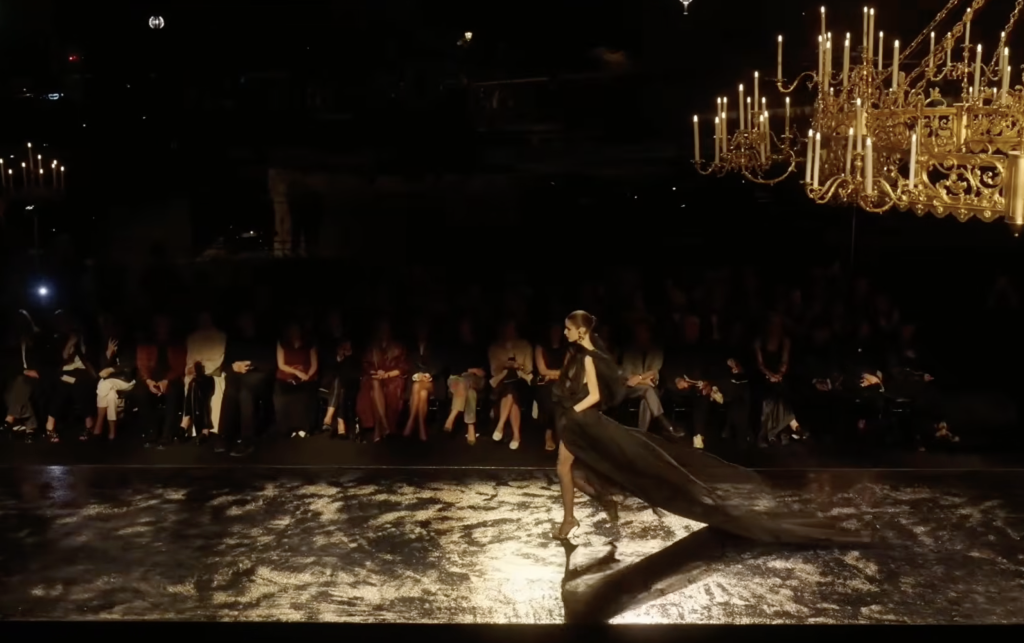
Anthony Vaccarello showed Saint Laurent’s Spring/Summer 2027 collection at dusk on September 29 in the Trocadéro gardens, with the Eiffel Tower lit up directly behind the runway. The whole space was staged beneath a series of large golden chandeliers hanging over a raised, mirrored circular runway, so the dusk light, the stadium rigs, and the Eiffel Tower’s own ironwork all reflected back up off the floor as the models walked. Those chandeliers were a direct callback to the Hôtel Inter-Continental in Paris, the ballroom where Yves Saint Laurent himself staged his couture shows from 1976 through 2001, so Vaccarello essentially took that old indoor salon and moved it out into the open Parisian night. The timing mattered too, 2026 marks fifty years since that first Inter-Continental show back in 1976, and Vaccarello had already explored that same ballroom idea once before, inside an enclosed space for his Autumn/Winter 2023 collection. This time he took it outdoors completely, which changed the whole feeling of the reference, less private salon and more open, public setting. The mirrored floor was a specific choice too, it meant the gold clothing was doubled visually all night, every model reflected beneath her own feet, which made the whole space feel even more saturated in that single color before the clothes themselves even needed to do the work.
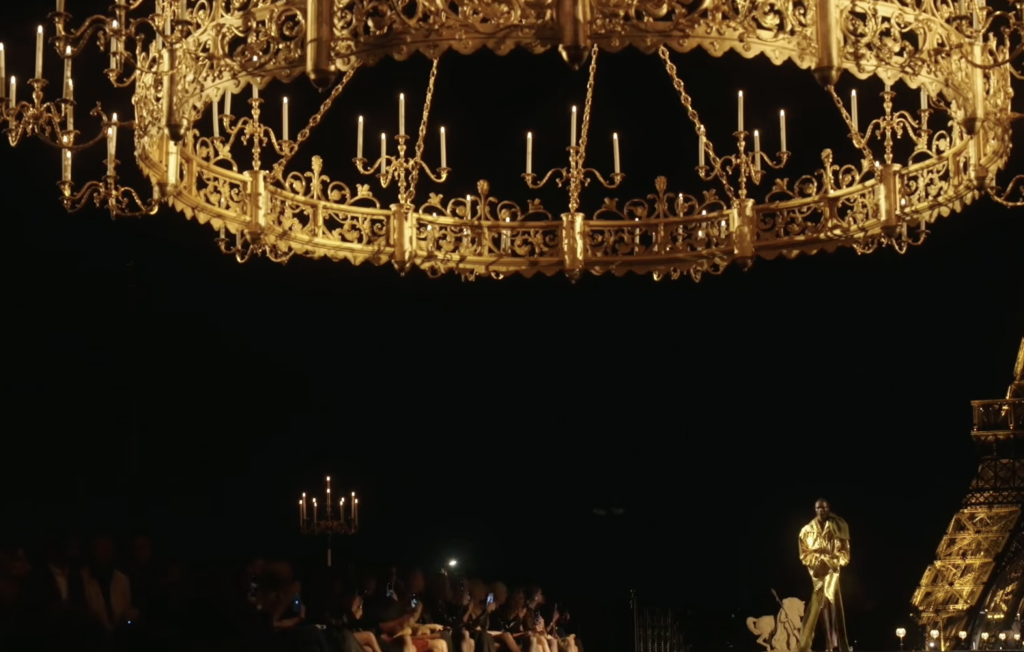
The show also landed exactly ten years into Vaccarello’s time at the house, so the whole evening carried the weight of an anniversary alongside everything else happening on the runway. That timing shaped a lot of how the collection was talked about afterward, since ten years is long enough for a designer to have fully built out his own version of a house, and short enough that people still remember what came before him. Vaccarello has spent that decade steadily narrowing in on a specific version of Saint Laurent, built around sharp tailoring, a very controlled sense of glamour, and a handful of recurring silhouettes he returns to again and again in different materials, and this show read like the fullest, most confident version of that whole decade of work compressed into one evening.
The Collection
The premise of the show was as bold as the setting, forty nine consecutive looks in gold, with no other color allowed in until a sudden, total shift into black at the very end. Vaccarello built the whole idea around a line from Yves Saint Laurent himself, who once said gold was a magical color, the color of the sun reflecting off a woman, and Vaccarello had apparently been sitting on this idea for years before finally building an entire collection around it, waiting for the right moment in his own career to actually do it. A second line included in the show notes, about what passes sometimes leaving more light than what remains, gave the evening a reflective feeling before anyone even knew about the ending, and in hindsight, given everything that happened at the very close of the show, that line reads almost like a warning about what was coming.
Rather than keeping to a single, flat shade of gold, the collection used many different versions of it, pale antique leaf, warm bright twenty four karat gold, oxidized darker finishes, matte textures closer to worn metal than shiny foil, so that even with color held completely constant, no two looks felt repetitive. This is a continuation of something Vaccarello has worked on for years, sending near identical silhouettes down the runway in different fabrics or transparencies, except this time he flipped the exercise, keeping color fixed instead and letting texture and construction create the variety. It is a genuinely difficult thing to attempt, building a collection where the audience’s attention has to be held by shifts in surface and weight rather than by a rotating palette, and it says a lot about how confident Vaccarello has become in his own design language that he chose to do it now, ten years in, rather than earlier in his career when the stakes felt lower.
The collection also referenced Yves Saint Laurent’s long relationship with Morocco, which began on his first trip there in 1966, alongside the sharp power tailoring of the 1980s, pulling from two different chapters of the house’s own history into one show. Both references have appeared in Vaccarello’s work before in smaller doses, but here they were combined more directly than usual, the loose, draped quality associated with the Moroccan references sitting right alongside the squared, structured shoulders of eighties tailoring, both rendered in the same gold. Notably, there was not a single handbag anywhere on the runway, a deliberate choice that kept attention on the clothes and the tailoring rather than on accessories, which several critics read as a pointed statement against how much of modern luxury fashion leans on bags and small leather goods rather than the actual garments themselves. In an industry where runway shows often function as elaborate advertisements for whatever bag needs to sell that season, leaving them out entirely was itself a small but clear argument about what Vaccarello wanted this particular show to be about.
The Clothes
Every look in the golden stretch of the show built on Saint Laurent’s classic silhouettes, translated entirely into metallic fabric, the boxy safari jacket, the sharp tailored skirt suit, the trench, all rebuilt in a crackly, almost paper like metallic cotton that held its shape well as the models walked and made a rustling sound with every step. That sound became part of the show’s texture in its own way, a whole runway of models moving in fabric that rustled rather than staying silent, which added to how physical and present the whole thing felt rather than just visual. A number of looks carried long, flowing trains behind them in soft chiffon, each one a different accent color against the gold, a green, a mustard yellow, a burnt terracotta, a pale gold, a deep blue, a warm brown, and that small pop of color trailing behind each fully gold outfit was one of the most striking details of the whole collection. Those trains moved independently of the rest of the garment too, catching air and lifting slightly with each stride, which gave even the most structured, boxy jackets a sense of motion and softness they wouldn’t have had otherwise.
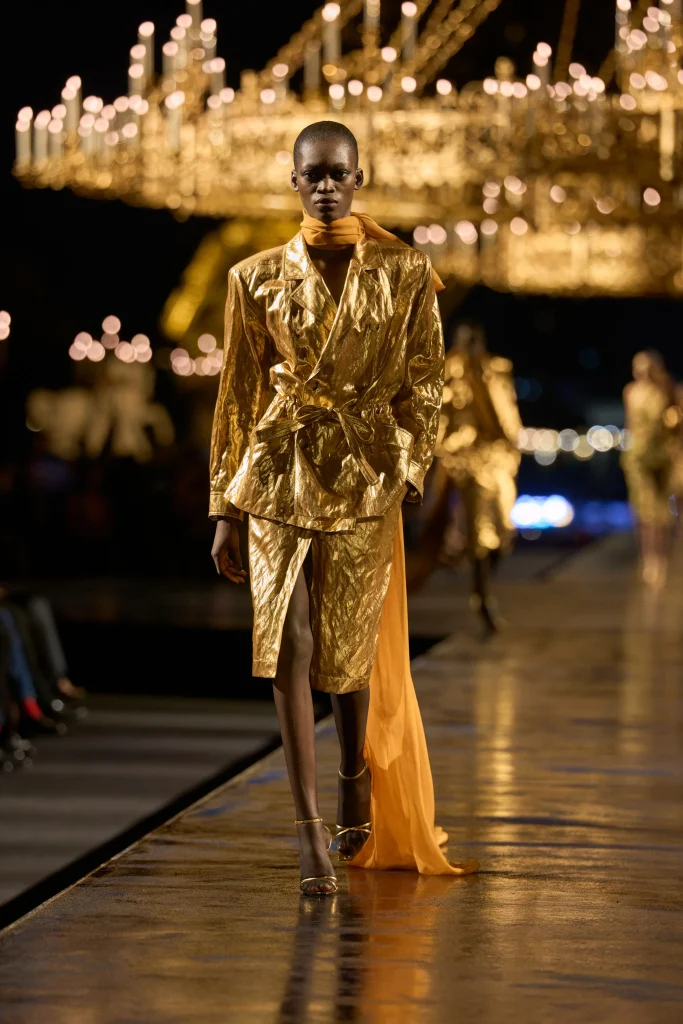
Looks 6 and 7 captured this pairing especially well, one styled as a trench and the other as a jacket and skirt combination, both finished with that same colorful chiffon train sweeping out behind them, gold structure up front with a soft wash of color following behind with every step. Look 12 stood out as one of the strongest moments in this opening stretch, the tailoring reading as crisp and considered even at that early point in the show, with the same squared, padded shoulders that have run through Vaccarello’s whole time at the house. Look 18 was another highlight, a shirt and skirt combination that felt lighter and more relaxed than the structured suiting around it, while still staying completely within that gold palette, proof that the collection could soften without losing its overall discipline. Look 22 pushed the metallic quality of the fabric further than most, reading as solid gold from head to toe in a way that few other looks in the show quite matched, and it stood out precisely because so much of the rest of the collection relied on some kind of contrast, a train, a texture shift, a softer drape, to keep things visually interesting.
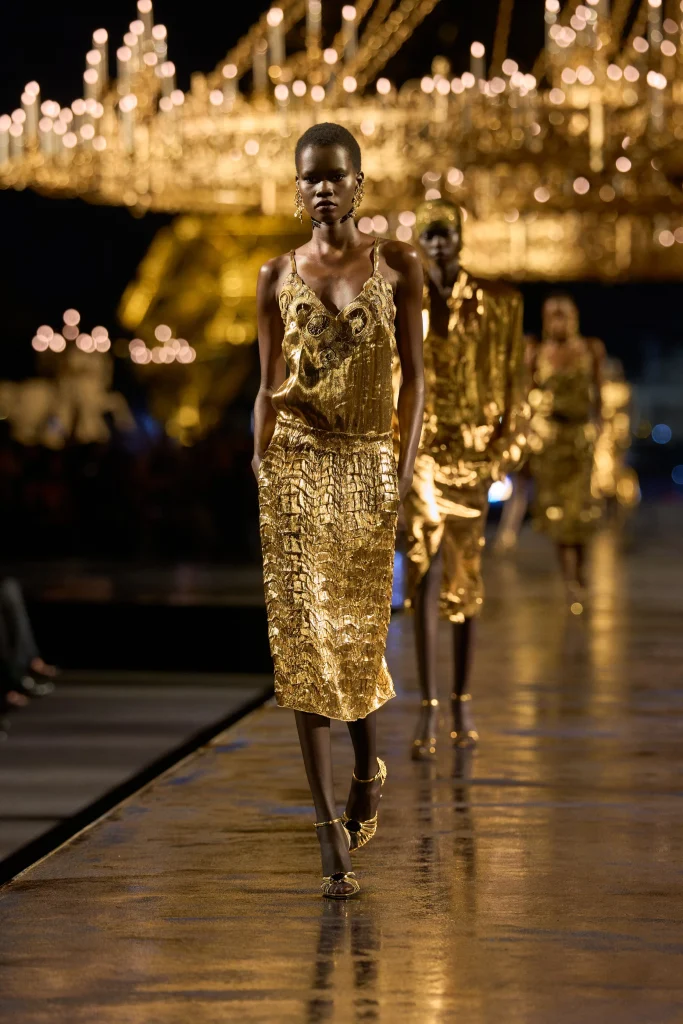
As the collection moved further along, the tailoring gave way to more fluid dresses, skirts, and evening pieces, the fabrics shifting from that crisp, structured cotton into liquid lamé and sheer, draped mousseline, and into gold leaf applied directly onto latex for a few looks, which gave those particular pieces a close, second skin fit against the body. That latex and gold leaf combination was one of the more unexpected technical choices in the whole show, taking a completely synthetic material and treating it with real gold leaf so it behaved almost like a second skin rather than a garment, tight and reflective in a way that read as more architectural than sensual. Look 40 brought in a tuxedo inspired mini dress, a way to fold Saint Laurent’s own menswear heritage into the collection’s evening wear stretch, low slung and body skimming where the earlier tailoring had been boxier and more structured, a good example of how the whole show kept returning to menswear silhouettes even once it had moved fully into eveningwear territory.
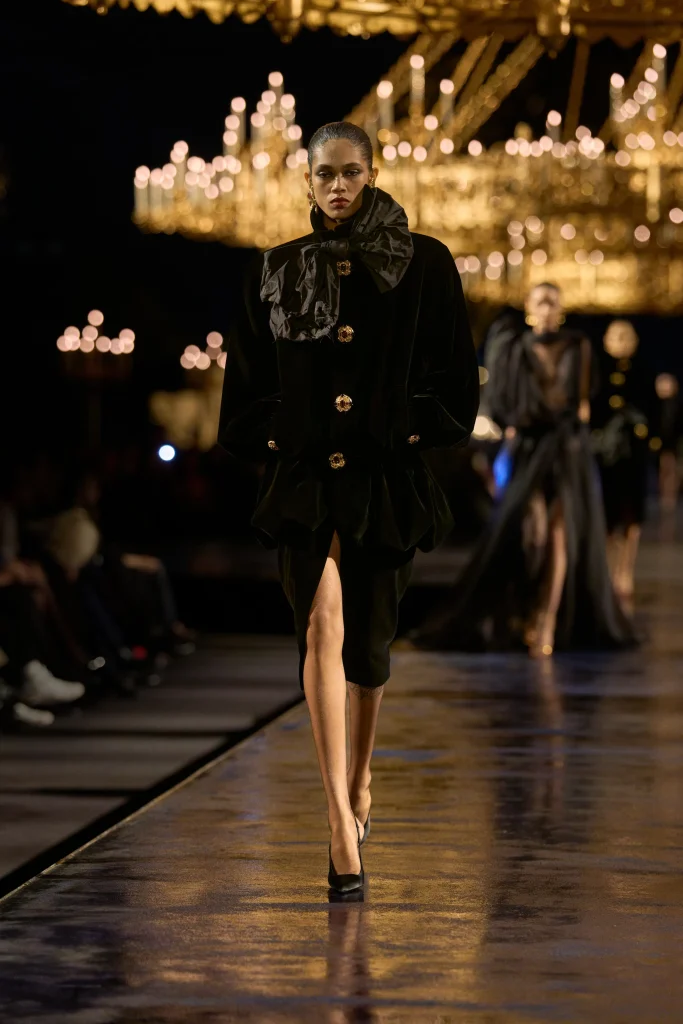
Then, right at look 50, the entire palette broke, gold disappearing completely in favor of ten consecutive looks in deep, saturated black, the house’s other signature color and one just as tied to Yves Saint Laurent’s own legacy as the gold that came before it. This closing sequence was led by longtime house muse Anja Rubik, and it included a tailored black velvet suit finished with large jeweled buttons, a direct nod to Yves Saint Laurent’s own tailoring from the late 1970s, along with several flowing black silk mousseline gowns that critics described as looking like dark clouds moving down the runway. Look 54 was a particular highlight in this closing run, carrying the same sharp, structured quality as the black tailoring throughout this final stretch, velvet and jeweled buttons giving it real weight after such a long stretch of gold. There was something almost architectural about how abruptly the color changed, no gradual fade or transition, just gold and then, ten looks later, total black, which made the ending feel less like a natural continuation of the show and more like a second, separate statement tacked onto the first.
The whole collection reads as unmistakably Saint Laurent, the safari jacket, the sharp shoulder, the disciplined tailoring, but pushed further than the house’s usual register, more maximal in its execution while still staying true to where it all comes from. The accessories that did appear, since bags were off the table entirely, leaned into sharp footwear, one stiletto heel shaped like a curving golden serpent tapering to a point, alongside gold chain fringe sandals and pointed slingbacks finished with metallic toe caps in gold, black, and burgundy. Jewelry stayed just as ornate, with large gold filigree chandelier earrings that echoed the actual chandeliers hanging over the runway, plus a few draped, jeweled turbans that pulled directly from Yves Saint Laurent’s own Moroccan inspired collections decades earlier. Hair and makeup stayed simple by comparison, slicked back or pulled into low chignons with clean, natural skin, which kept all that gold and all that jewelry from tipping into costume, letting the clothes themselves carry the drama rather than the styling around them.
The Close
What makes this collection stand out is the discipline behind carrying a single color across forty nine looks without ever losing the audience’s attention, which is a much harder thing to pull off than introducing new colors every few looks to keep things interesting. The variation came entirely from texture and construction instead, crinkled cotton against liquid lamé against gold leafed latex, and that restraint made the eventual shift into black even more effective, a real reset after such a long stretch of gold. It takes real confidence to trust that an audience will stay engaged through nearly fifty looks in the same color, and the fact that it worked, that the show never felt repetitive despite the constraint, says a lot about how carefully every individual piece was constructed.
Anja Rubik leading that closing black sequence tied the ending back to the house’s own history of muses and long standing relationships, and Charlotte Gainsbourg closing out the whole show with a live vocal performance, dressed in a sharp black Saint Laurent suit, added one more personal, unscripted layer to an already carefully built evening. Ten years in, this felt like Vaccarello working through his own creative language at full strength rather than reaching for something new just to prove a point, a designer who has clearly settled into exactly what kind of Saint Laurent he wants to make and is no longer interested in convincing anyone otherwise.
The show closed with him handing a small key to his young son during his final bow, a quiet, personal gesture that came right alongside reports that this could be his final season at the house, and depending on how you read it, that small moment either meant nothing more than a father sharing his work with his child, or it meant something closer to a goodbye. Either way, it gave the whole evening one more thing to think about after the lights came back up, and it is hard not to read the whole show differently in light of that gesture, forty nine looks of gold followed by a sudden turn to black taking on a slightly different meaning if this really does turn out to be an ending rather than simply an anniversary. Between the setting, the commitment to a single premise, and just how much craft went into carrying gold through forty nine entirely different looks before that final turn into black, this stood as one of the most fully realized collections of the whole season, and a fitting way to mark ten years of work at a house this closely tied to its own founder’s legacy, whatever comes next for the man who built it.