
By Gabriela Afanador
Thursday 8, October 2026
Roberto Cavalli showed its Spring/Summer 2027 collection on September 24 during Milan Fashion Week at the Teatro Alcione in Piazza Vetra, a theatre that was transformed for the evening into a round room with mirrored walls and a mirrored floor. The lights were kept low and warm, and the whole space felt a lot like a club in Los Angeles in the early 2000s, which is exactly the place and the period the collection was built around. Because of the mirrors, guests could see each look from the front, the side, and the back at the same time as the models walked past, which suited a collection where so much of the interest is in the prints and in the way they wrap around the body. Forty five looks were shown in total, and the setting made it easy to follow the details of each one up close.
The Collection
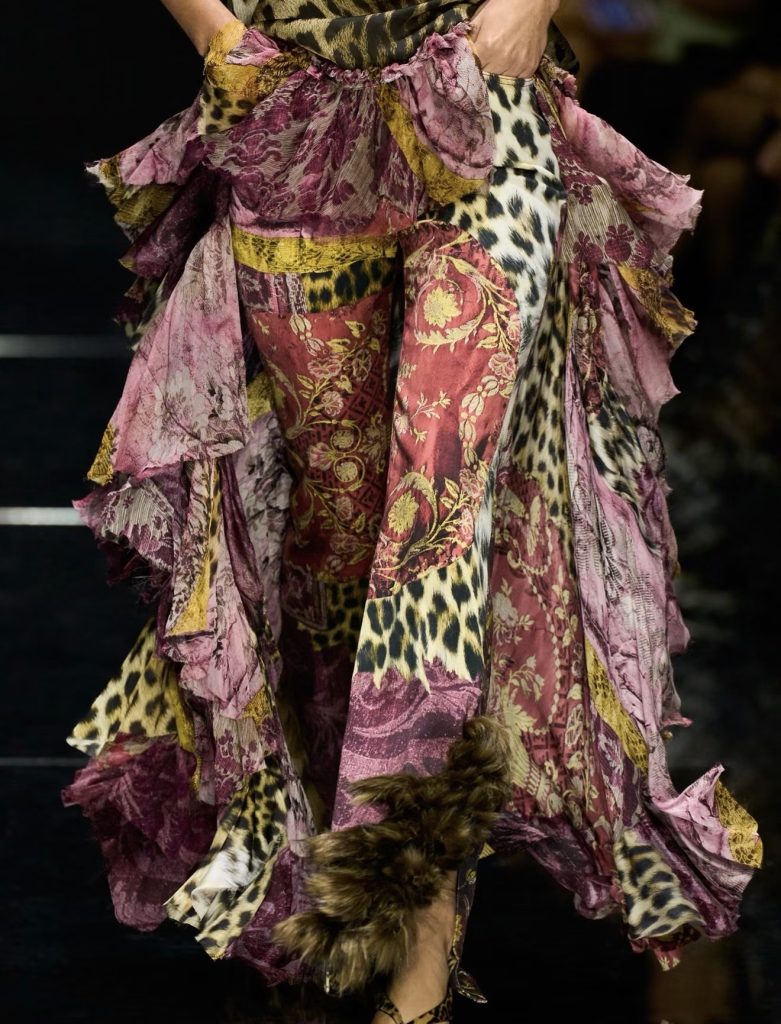
Photo via @Robertocavalli on Instagram
The collection is called House of Prints: The Muses in Los Angeles, and it comes from two ideas that Fausto Puglisi, creative director of the house since 2020, brought together. The first is the Cavalli archive from the early 2000s, the years when the brand’s printed jeans, animal patterns, and embellished evening dresses were worn all over the world and became a big part of how people remember that decade. The second is Los Angeles, a city Puglisi sees as glamorous and a little messy at the same time, where the sunsets look beautiful partly because of the smog over the freeways. Putting the Italian craftsmanship of the house in that California setting gave him a way to revisit the archive while giving it a looser and more relaxed attitude.
Printing has always been at the center of what Cavalli does. Roberto Cavalli started his career printing fabric, and he grew up around his father’s work restoring paintings, so pattern was part of his life long before it became the signature of his brand. For this season the house described its prints as layered on top of each other without any hierarchy, which means no single pattern is meant to lead and they are all mixed freely, often several in the same garment and across different decades of the archive. That idea shapes almost every look, and it is what gives the collection its playful and spontaneous feeling.
This was also the first collection shown since Marquee Brands became the majority owner of the house earlier this year. Puglisi stayed on as creative director, and he decided to begin this new period by going back to the codes Cavalli is best known for, which makes the collection feel like a clear statement about who the house is and what it wants to keep.
The Clothes
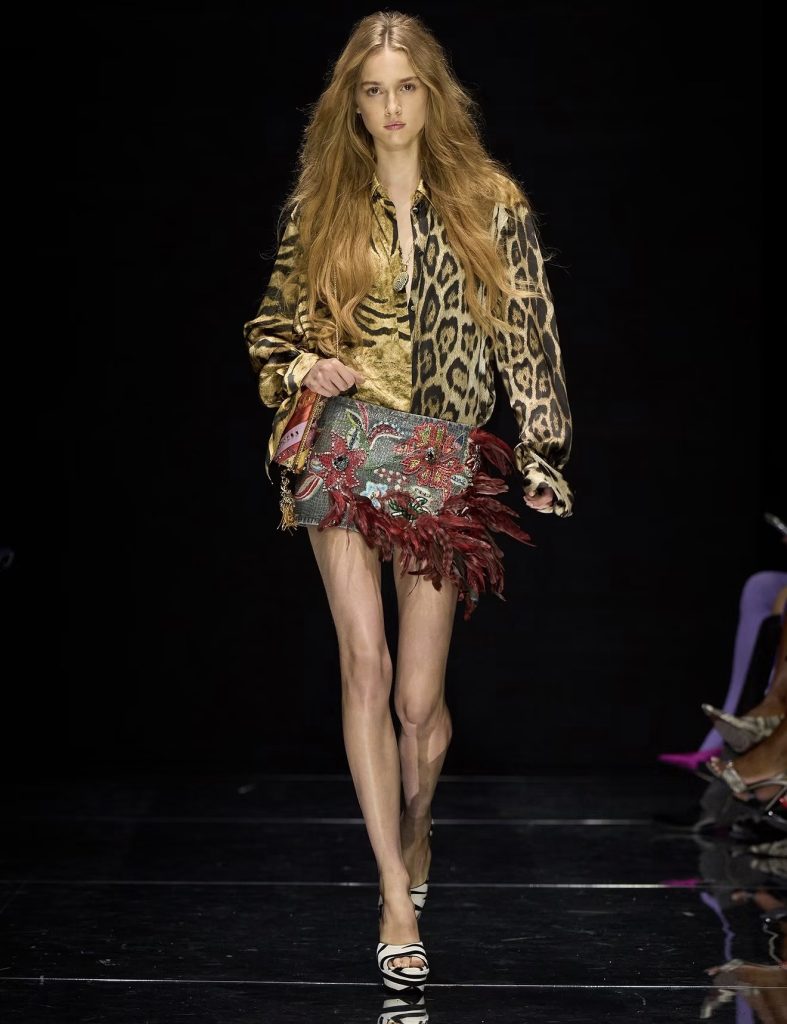
Photo via @Robertocavalli on Instagram
The show started with leopard and with red leather printed with tattoo drawings, two of the most familiar Cavalli signatures, and the tattoo motif returned throughout the collection on leather and printed fabrics alongside the animal patterns.
Denim was the foundation of the collection, and Puglisi gave it a lot of attention. The jeans were cut apart and sewn back together, and then printed with a trompe l’oeil effect and finished with appliqués in two separate rounds, so that the surface has a soft, faded look, like a pair you have owned and worn for many summers. Some pairs were covered in crystals, some had feathers rising along the seams, and others had small flowers woven directly into the hems, so each pair had its own personality. They were worn low on the hips, often under long, loose robes and kimonos, with only a thong or a small bra top underneath, which gave these looks a relaxed and sensual summer feeling. Puglisi said backstage that at Cavalli “you have the possibility to create jeans as an object,” meaning a piece you keep in your closet for a long time and enjoy every time you wear it, and the care that went into each pair shows how seriously he takes that idea. Denim has been part of the house since Roberto Cavalli presented his first printed jeans in 1988, and this season it held the whole collection together.
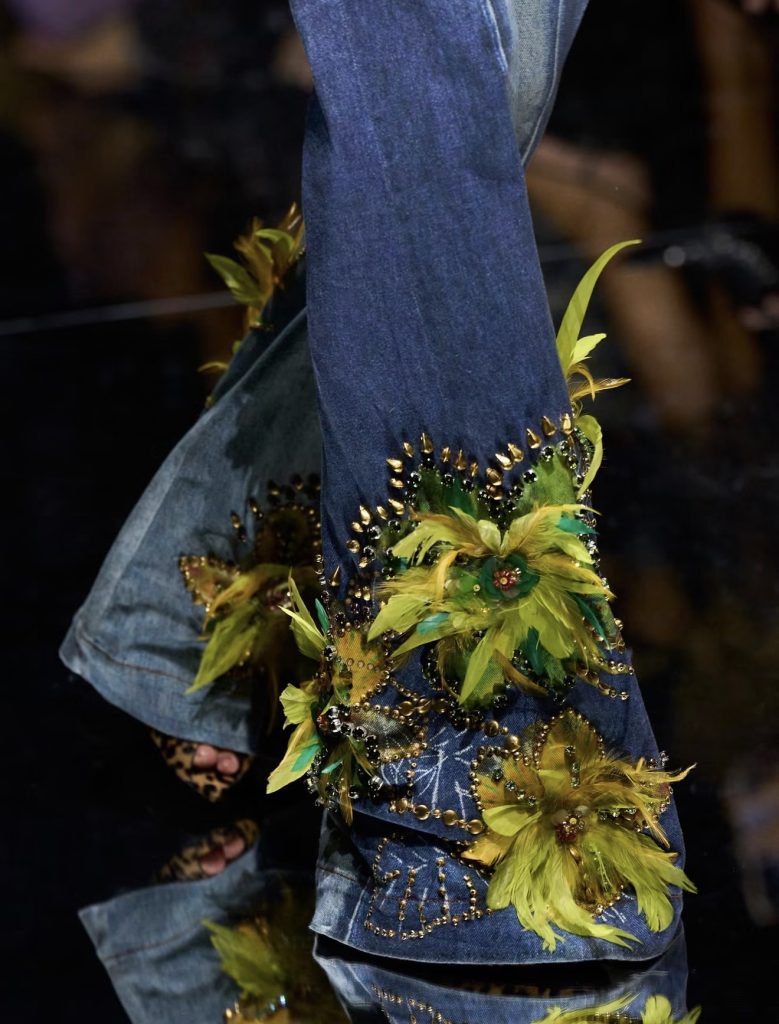
Photo via @Robertocavalli on Instagram
The prints were mixed on top of that denim base, and this is where the collection is most fun to look at. Leopard was layered over tiger, florals were placed next to python, and tattoo drawings and ray skin textures appeared in the spaces in between, so many garments ended up looking like a patchwork of different patterns. One look paired a zebra print kimono with printed jeans and a matching thong, and another was a long tunic with a large cheetah face printed across the front, which looked a bit like a luxurious beach towel turned into a dress. Some of the dresses were made in devoré, a technique where parts of the fabric are burned away so that some areas become sheer while others stay soft and velvety. On these dresses the prints look almost hand painted, which makes sense for a house that began with printing, and the sheer areas let the body show through the pattern in a subtle way. Other prints were applied on satin in rich, saturated pigments, which gave them a glossy depth under the low lights.
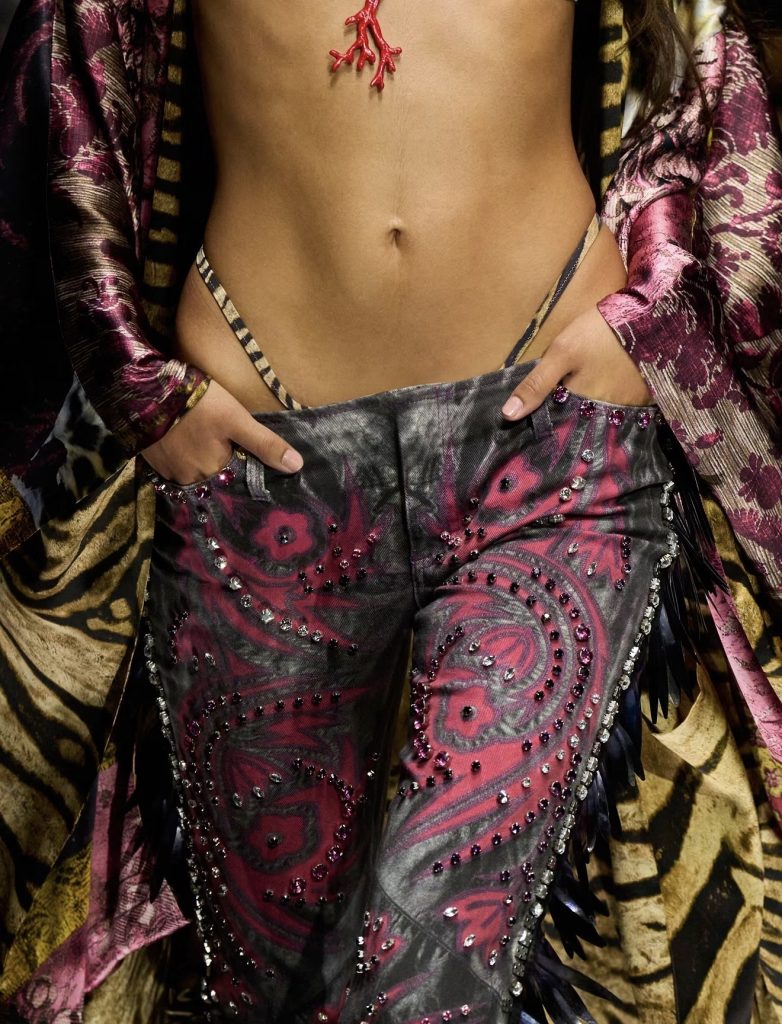
Photo via @Robertocavalli on Instagram
The colors were just as varied as the prints. The palette moved from yellow into fuchsia and a bright tiger orange, with mustard gold and a metallic cherry red appearing along the way. The brown of the leopard prints and a faded, washed stone color balanced all of that brightness and kept the collection from feeling too loud. The washed stone tones connect well with the sunbleached idea of Los Angeles, while the fuchsia and orange are the colors of a California sunset, so the palette follows the concept closely.
Many of the looks played with proportion by putting very small pieces next to very big ones. In one of them, a tiger stripe triangle bikini top was worn with low slung trousers covered in crystals and a long kimono lined in the same tiger stripe, which fell from the shoulders all the way to the floor. The difference in size between the little bikini and the long kimono makes the look feel like something you could wear at the beach and at a party on the same day, and that balance between relaxed and glamorous runs through the collection. There was some tailoring as well, like a cropped leather moto jacket worn with a high waisted pencil skirt printed with large leopard faces, which brought a sharper line into the show. Other pieces stayed close to the body, such as a halter gown in a tie dye print dotted with crystal chevrons that ended in a long fringe of ribbons, and a mesh minidress that opened into crinkled golden ruffles at the hem.
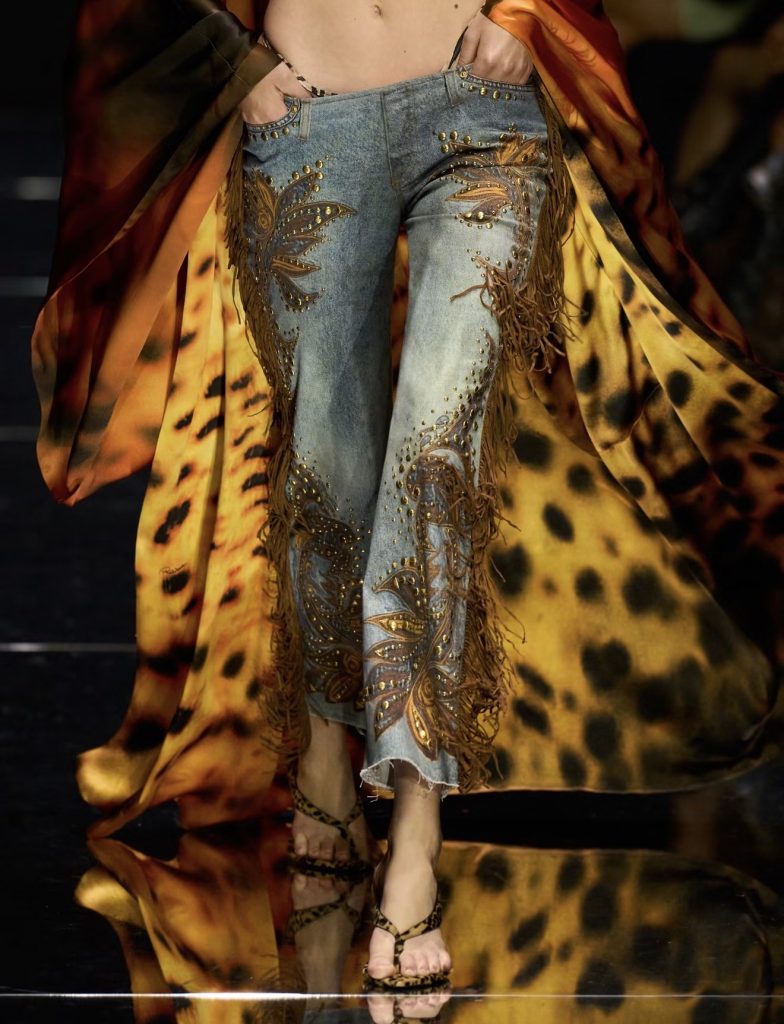
Photo via @Robertocavalli on Instagram
As the show went on, Puglisi spent more time taking garments apart and putting them back together. He sewed brocade, a rich and formal fabric usually associated with evening wear, together with leopard print and torn chiffon in the same piece, so the elegant and the raw sit side by side. A leopard lace camisole was worn with ruffled trousers pieced together from leopard print, brocade, and fur, and one dress made from pink brocade, animal print, and torn silk looked as though it had been cut up and rebuilt by hand. A leopard patchwork dress cut on the bias followed the shape of the body before ending in uneven hems and shredded ruffles, and several long chiffon skirts had shredded hems that moved as the models walked. Mixing expensive fabrics with frayed edges is a direct way of showing the glamorous and slightly messy sides of Los Angeles at the same time. The embellishment followed the same thinking, with crystals and rhinestone studs placed along the curves of paisley prints, silver studs running down the sides of trousers, and long black feather fringe falling along the outer seams of low slung pants.
Close to the end, the show switched to black for two looks, both simple, close fitting, and sensual, which gave the eye a short rest after so much color and pattern. The final look went back to animal prints with a long, dramatic gown built from several layers of leopard, tiger, and other wild prints, with the curved, fitted shape of an old Hollywood evening dress, and it closed the show with the same mix of prints and glamour that defined the collection from the beginning.
Accessories and Shoes
The accessories also looked back to the late 1990s and early 2000s. On the feet, there were jeweled sabots and the house’s snake designs, which came back in both heeled and flat versions and wrap around the foot almost like a piece of jewelry. Many of the looks were styled with aviator sunglasses, which added to the Los Angeles mood of the show. The return of the Dea bag was another nod to the archive, since it is a design from the house’s mid 2000s years that many people remember, and it fits naturally into a collection that draws so much from that period.
The Close
What I like most about this collection is that the freedom in how the prints are mixed is backed by careful work. Pairing leopard with tiger, or florals with python, feels fun and well put together here because of the craftsmanship underneath, like the denim that was cut apart, rebuilt, and printed twice so it looks worn in, or the devoré that makes the prints look painted and lets the skin show through. Combining brocade with torn chiffon is also a smart way to bring the glamorous and messy sides of Los Angeles into the clothes, and it gives familiar Cavalli pieces a more personal and handmade feeling. The colors support all of this, with the bright fuchsia and orange balanced by leopard brown and washed stone, so even the busiest looks stay easy to read.
I love how freely this show mixes patterns and colors while still looking completely like Roberto Cavalli. Puglisi took the codes the house is best known for, the animal prints, the embellished denim, and the Hollywood glamour, and put them together in a fresh and playful way that makes the archive feel current. The collection has strong statement pieces like the layered animal print gown at the end and the long tiger stripe kimono, and it also has pieces that are easy to imagine wearing, like the reworked jeans and the cropped leather jacket. It is a collection about enjoying getting dressed, and I love it.