
By Gabriela Afanador
Wednesday 1, July 2026

Photo via @MarcJacobs on Instagram
There was a lot of context sitting in the room at the New York Public Library on the evening of June 29th when Marc Jacobs presented his Spring Summer 2027 collection. In May 2026, LVMH announced the sale of the Marc Jacobs brand to WHP Global and G-III Apparel Group in a 50/50 joint venture, ending a decades-long relationship with the conglomerate that had shaped a significant chapter of the house’s history. G-III Chairman Morris Goldfarb was in the front row alongside LVMH’s Sidney Toledano, which made the audience an unusually charged document of transition. Julia Fox was there. So was June Ambrose. The show started at exactly 7:30pm, as Marc Jacobs shows always do, and it lasted just under four minutes. Thirty-one looks. The collection was titled Gratitude, and Jacobs wrote in his show notes that creating as an act of gratitude is his truest form of self-expression, that he hopes to offer light, shine, color, beauty, and joyful exuberance in return for the people and experiences that have shaped him. Given the circumstances, the word gratitude carried more weight than it might have in a quieter season, and the collection carried it without making a performance of it.
What Jacobs presented was a collection built almost entirely around transparency, color, and layering, three elements that have defined the most energized moments of his career and that he deployed here with a precision that felt like both a survey and a reset. The show opened with Yasmin Wijnaldum in a see-through shirt and trousers, sleek and saturated, establishing the visual logic immediately. Everything that followed was built on the same principle, multiple fabrics in conversation with each other, sheer over opaque, matte against glossy, the body visible beneath layers that were never purely about concealment or revelation but about what happens to color when light passes through it. Silk organza read almost like plastic. Mesh pieces layered color in a way that produced secondary tones at the intersections. Matte cotton absorbed light while glossy leather reflected it, and PVC introduced an almost liquid quality to pieces that might otherwise have read as straightforwardly minimal. Transparency here was not a provocative gesture. It was a material language.
The color palette was the collection’s most immediate achievement. Crimson tights glowed beneath translucent skirts. Pale blue shirting sat against vivid red organza. Black, orange, powder blue, and scarlet appeared in combinations that recalled the concentrated energy of Jacobs’ earlier work without tipping into nostalgia. The layering system meant that color was never fixed, every movement altered the relationship between fabrics and shifted the tone of a look in real time. Semi-sheer tights stacked beneath skirts created secondary colors beneath the garments themselves, so that what you saw depended on where you were standing and how the light was hitting the room. At one point in the collection the tights were doing as much design work as the clothes on top of them.
The References
Jacobs listed his references in his show notes, which he has done before and which is one of the more unusual and revealing things any designer can choose to do. The list included Chanel Spring 1993, YSL Spring 1993, Junya Watanabe Spring 1996, Prada Spring 2007, Bob Fosse’s 1979 film All That Jazz, YSL’s Love greeting cards, and his own Spring 1998 and Spring 2000 collections for Marc Jacobs alongside his Louis Vuitton Spring 2009 show. The chain belts that appeared throughout, supersized and metallic, worn over sheer bottoms and short shorts and layered across jackets, came directly from the multi-chain belts Lagerfeld sent down the Chanel Spring 1993 runway, pieces that became one of the most immediately recognizable accessories of the mid-2000s when they filtered into mainstream fashion a decade after the show. The sheer nylon layers, the trompe l’oeil lingerie slip dresses, and the slick transparent shirts pulled from Watanabe’s Spring 1996 collection, one of the more specific and less cited references in contemporary fashion, rendered here in the vibrant pinks, blues, and purples that Jacobs has made his own rather than the quieter tones Watanabe used originally. The Prada Spring 2007 reference showed up in the treatment of trousers as something almost optional, a garment worn more as a suggestion than a commitment, beneath layered sheer pieces that made the bottom half of the body a site of visual complexity rather than resolution.
The nod to Bob Fosse came through the stacked chain belts and the short, body-conscious silhouettes, the particular quality of showgirl dressing that exists at the intersection of theatrical and real, glamorous and practical, the kind of clothes that belong both on a stage and somewhere you are actually going. The mid-2000s nostalgia that ran through the accessories, chunky necklaces worn in clusters, layered belts, skinny heels, was not ironic or distanced but genuinely affectionate, the work of a designer looking back at a moment in his own history and finding it still alive rather than finished.
The Clothes
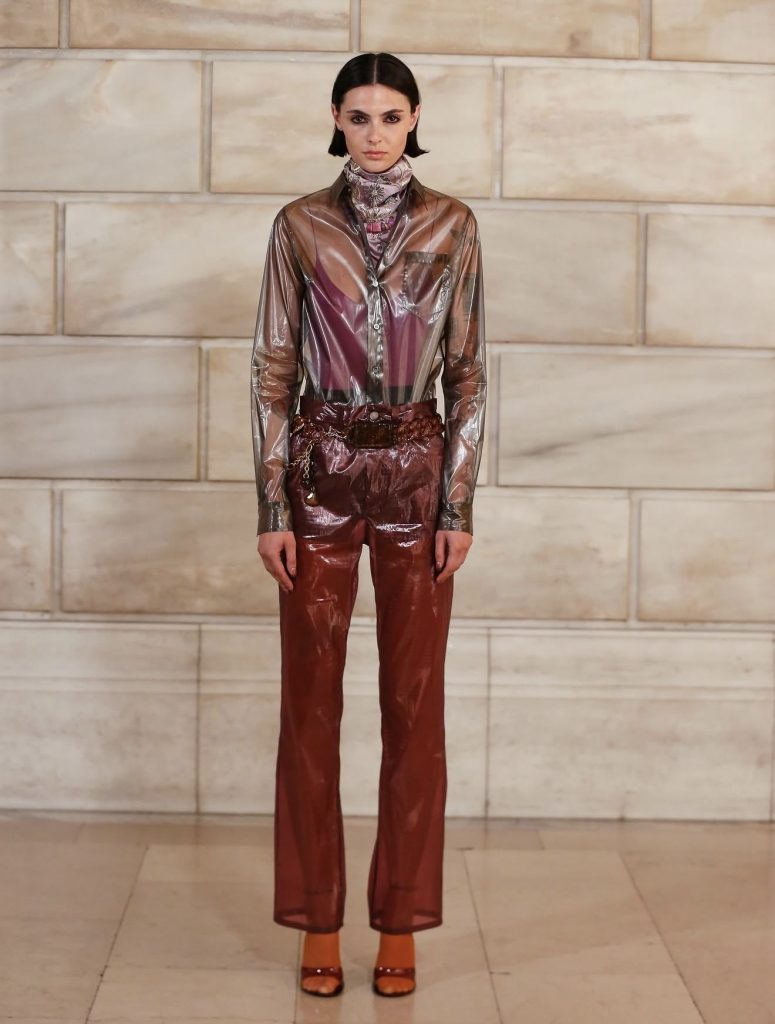
Photo via @MarcJacobs on Instagram
PVC-fringed minidresses appeared early in the lineup paired with tights in turquoise, mustard, and lilac, the fringe adding kinetic movement to silhouettes that were otherwise quite controlled. Embellished 1970s-inspired jackets were worn over contrasting underwear and those stacked chain belts with nothing else beneath, the jacket functioning as a complete look rather than as a layer over something, which changed the proportion and the attitude of the piece entirely. The sculptural minis and vinyl and silk dresses that appeared toward the end of the lineup carried the energy of Jacobs’ Louis Vuitton Spring 2009 show updated for now, still irreverent and youthful but with the confidence of someone who has made that kind of dressing so many times he no longer needs to prove it works. Polka dot pleated skirts appeared alongside plastic-y scoop tanks as a direct callback to his own Spring 1998 and 2000 collections, the kind of self-reference that reads not as nostalgia but as evidence of a consistent creative sensibility across nearly three decades of work.
The accessories completed the picture. The shoes were skinny-heeled sandals in colors that matched or contrasted the tights, the footwear as deliberate in its reference as everything else in the collection. The handbags were present but secondary, the jewelry and belts carrying the decorative weight of the looks rather than the bags, which is a different priority than most houses would set for a commercial collection and one that says something about where Jacobs places his trust in terms of what actually makes a look feel finished.
Thirty-one looks in under four minutes is a format that demands commitment to a single idea rather than the range a longer show can afford, and Gratitude committed completely. It was not a collection that argued for its own importance or made statements about its moment. It was a designer doing the thing he does best, building a visual world out of color and fabric and reference and layering it until the whole thing feels more alive than the sum of its parts, and then sending it down a runway at the New York Public Library on a Monday evening at 7:30pm exactly, as a thank you to everyone who showed up.