
By Gabriela Afanador
Monday 14, September 2026
Khaite showed its Spring/Summer 2027 collection on September 12, staged inside the Brooklyn Storehouse at the Brooklyn Navy Yard, a massive industrial warehouse that creative director Catherine Holstein and her husband, architectural designer Griffin Frazen, turned into a pitch black space cut through with sharp overhead spotlights. Each model walked through her own beam of light while the audience sat in near total darkness around them, which gave the whole show a much more dramatic, stripped down feeling than a typical runway. Instead of a soft ambient soundtrack, the show ran on PJ Harvey’s 1993 track Rid of Me, all raw guitar and sudden bursts of distortion, which gave the whole presentation an edge that a quieter score would not have. The show also marked Khaite’s tenth anniversary, and rather than treating that milestone with any kind of big celebratory moment, Holstein used it instead as a reason to look inward at her own design process.
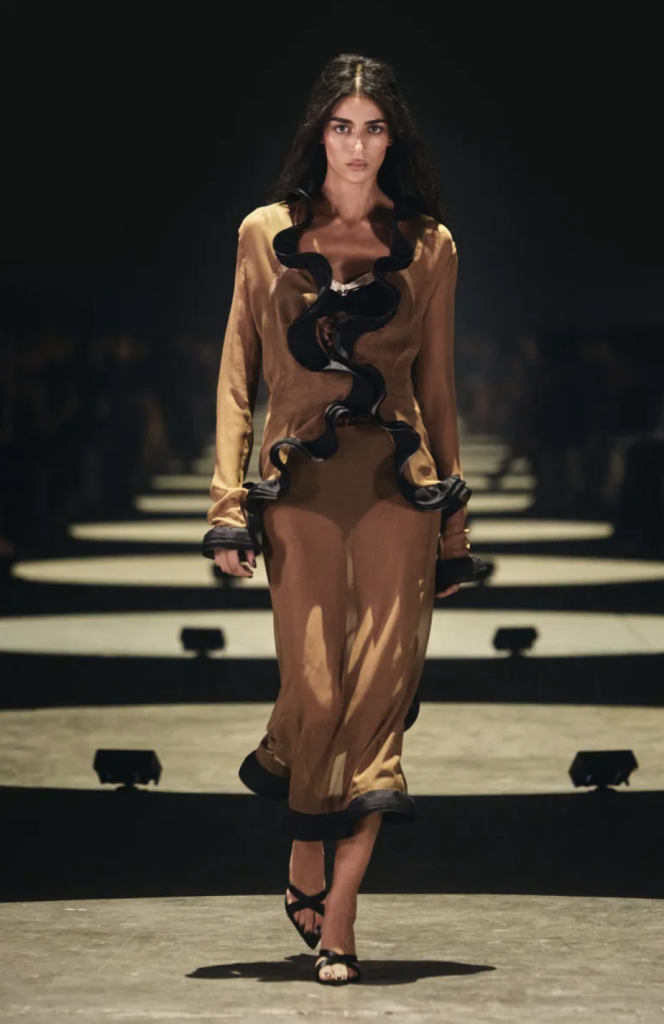
Photo via Khaite.com
The Brand
Khaite is a brand that built its name on a very specific kind of minimalism, sharp, protective, almost armor like clothing that became known for exactly what it left out rather than what it added. For ten years, Holstein’s process worked by subtraction, taking a garment and stripping it down until only the sharpest, most essential version remained. For this collection, she went the opposite way, asking what could be added back in instead, down to the smallest detail, and the result was a collection built around visible construction, historical references, and a much softer, more intimate feeling than the label’s usual output. A lot of that shift came from her own life, from reconnecting with a more personal, sensory way of getting dressed after having children, and from time spent in Venice, where the ornate plaster ceilings and aged gilding of a hotel bar she frequented ended up directly inspiring the floral and equestrian embroidery that showed up throughout the collection.
The Clothes
What comes through immediately in this collection is how much it plays with structure without ever feeling stiff, which is exactly the tension you picked up on. Pieces that look architectural and considered from a distance move very differently up close, softer, almost undone, which is part of why the whole thing reads as so springlike despite some genuinely rigid materials running through it. Holstein pulled directly from several different historical eras at once rather than committing to one, borrowing the exposed foundations of Victorian corsetry, the dropped waistlines of the 1920s, the fuller skirts of the 1950s, and the slip dressing of the 1990s, and instead of hiding the structural pieces that usually stay invisible inside a garment, like boning, crinoline, and basting stitches, she brought them out to the surface as the actual design.
The crinoline in particular got a complete rework here. Rather than being hidden under a skirt the way it traditionally would be, it showed up as standalone pieces, structured peplum belts worn over dresses, or built into exaggerated hems that held fabric away from the body in clean, geometric lines rather than a soft natural drape. That is likely part of what you were picking up on in some of the earlier looks, pieces where the fabric holds its own shape almost independently of the body underneath it, which can look like it is sitting oddly large on a model even though the structure is completely intentional. Horsehair canvas, normally hidden inside a blazer’s chest piece, was pulled out and used to trim sheer evening jackets and skirts, giving those pieces a bouncy, springy movement as the models walked that added a strange kind of life to otherwise very sheer, delicate fabric.
The color story moved in a clear progression across the show, opening in stark black and white, shifting into practical, earthy neutrals like khaki and tobacco brown, before landing on a stretch of soft, sun faded pastels, rose, pale blush, ivory, that were meant to evoke the peeling walls and reflected light of Venice. The final stretch of the show returned to black, but through sheer, transparent fabric rather than the heavier, more opaque leather the brand usually works with. That progression is probably part of why the middle section of the show, where those pastels came in, felt like the freshest and most springlike part of the whole thing, which lines up with your read on looks 9 and 11 feeling especially light and easy.
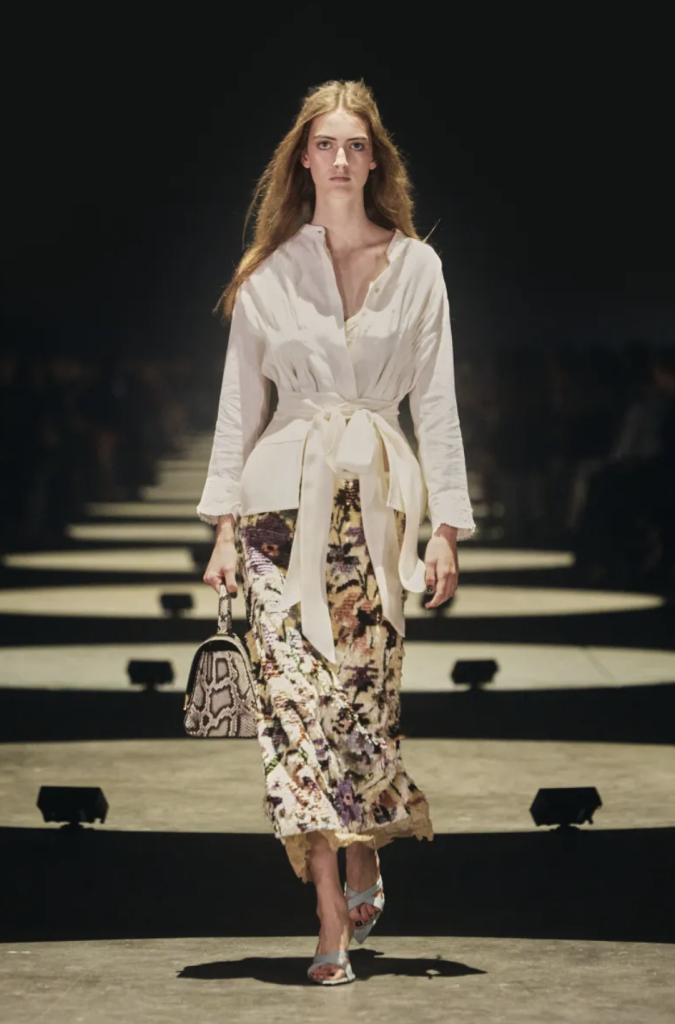
Photo via Khaite.com
Look 14, the loose trench paired with a sequined, floral skirt, sits right at that same sweet spot, a piece that manages to feel structured through the coat while still reading soft and seasonal through the skirt underneath it, which is probably why it stood out as one of the strongest moments in the show. Look 37 falls later in the collection, closer to where the sheer, horsehair trimmed evening pieces come in, and those looks tend to have more visible construction to them, exposed basting, unfastened closures, structural trim, which gives them a different kind of presence than the earlier, looser looks.
As for the fit feeling off on some of the earlier looks, especially around look 27, that is a fairly reasonable reaction given how deliberately oversized and structurally exaggerated some of those pieces are. A lot of the early daywear leaned into the crinoline and structural pieces without much softening around them, so some looks read as more sculptural than wearable, closer to an architectural statement than an easy piece of clothing. That was clearly part of the intent here, using clothing to make a point about visible structure rather than easy fit, but it does mean a personal reaction like this one, finding some of those pieces a little overwhelming on the body, tracks with how deliberately unconventional those particular silhouettes were built to be.
Accessories throughout stayed fairly quiet by comparison. Footwear moved entirely toward sharp, pointed toes, either high stiletto pumps or slim slingback sandals, which gave even the most voluminous skirts a grounded, sharp base underneath them. Bags stayed close to the brand’s known shapes but softened, less structured and more relaxed than in past seasons, and jewelry was kept minimal throughout so it never competed with the lace, embroidery, and exposed stitching doing most of the visual work.
The Close
Overall, this felt like a solid, well considered show rather than one built to overwhelm. It is not the kind of collection that grabs you immediately the way something bolder or more theatrical might, but the fabrics and the construction reward a closer look, and there is real craft in how Holstein reworked things like the crinoline and the horsehair trim into something completely different from their traditional use. It makes sense that a collection built around historical undergarments and visible construction would land somewhere between structured and soft, and that mix is really the whole point of what this collection was going for.