
By Gabriela Afanador
Thursday 2, July 2026
In October 1996, Bernard Arnault made one of the most consequential decisions in the history of modern fashion. He moved John Galliano from Givenchy, where the British designer had just become the first of his nationality to head a French haute couture house since World War II, to Christian Dior, replacing Italian designer Gianfranco Ferré at the helm of one of the most storied names in the industry. Dior at that moment was a house of tremendous prestige and relatively limited creative energy, a legacy brand living comfortably inside its own history without anyone particularly interested in pushing it further. Arnault needed someone radical enough to bring a new generation to the house without destroying what made it matter in the first place. What he got was fifteen years that redefined what a fashion show could be, what a fashion house could say, and what haute couture was allowed to mean in the late twentieth and early twenty-first century.

Photo via @Jgalliano on Instagram
Galliano had come up through a very specific London formation. Born in Gibraltar and raised in South London, he trained at Central Saint Martins, graduating in 1984 with a collection titled Les Incroyables, inspired by the dandies of post-Revolutionary France, that was immediately purchased in its entirety by influential London boutique Browns and placed directly in the windows. He had worked briefly at the National Theatre before fashion, which is not an incidental detail. It explains something fundamental about how he approached a runway show as a total theatrical environment rather than a presentation of clothes, about why his sets felt like stage designs and his models felt like characters rather than mannequins. By the time he arrived at Dior he had already spent over a decade building a design language rooted in deep historical research, narrative construction, and an absolute conviction that the woman wearing the clothes should inhabit a specific persona rather than simply display a garment. He told his models to think of themselves as characters. He worked obsessively with milliner Philip Treacy and makeup artist Pat McGrath, building a creative circle whose collective output would come to define the visual language of an entire era. His financial situation in the years before Givenchy had been precarious enough that he was sleeping on friends’ sofas while preparing collections, and Anna Wintour, who had recognized what he was doing early, had introduced him to the network of support and visibility that eventually made his appointment to a major house possible. What Arnault was hiring in 1996 was not simply a talented designer but a fully formed and deeply specific creative vision that had been developing and intensifying for over a decade.
The Debut and What It Promised
His debut haute couture collection for Dior arrived in January 1997 and the industry understood immediately that something had changed. Inspired by Marie Antoinette and the opulence of the Rococo period, it placed voluminous skirts, nipped waists, delicate silks, boning and corseting against tousled hair and a sense of deliberate disorder that made the whole thing feel alive rather than archival. It was not a revival. It was a reinterpretation, Dior’s own New Look filtered through Galliano’s obsessions and then pushed somewhere the house had never considered going. The critical response was swift and almost unanimously rapturous. From that first show it was clear that Dior under Galliano was not going to be content with beautiful clothes. It was going to build worlds.
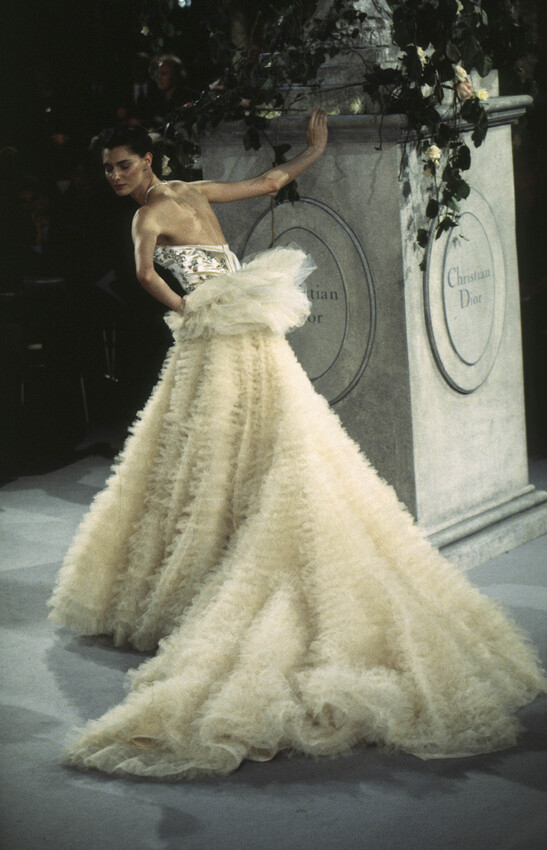
Photo: firstVIEW
The Autumn Winter 1997 haute couture show deepened the argument immediately. Drawing inspiration from Mata Hari, the legendary Dutch exotic dancer and spy executed by France in 1917, Galliano produced dresses that merged French guipure lace with jewellery crafted in collaboration with Goossens, floral motifs dipped in metal and reassembled with chain links and rhinestones and topaz stones in combinations that made the garments feel like wearable artifacts rather than clothes. The Mata Hari reference was characteristic of how Galliano chose his subjects throughout his Dior tenure, always a woman at the extreme edge of something, a woman whose relationship to her own appearance and her own identity was as intense and uncompromising as his own. That consistency of subject, the woman who refuses to be ordinary, the woman whose existence is itself a kind of performance, ran through fifteen years of collections and gave the whole body of work a coherence that was easy to miss season by season but unmistakable when viewed across the full span.
Opera, Marble, and the Marchesa Casati
The Spring Summer 1998 haute couture show, staged at the Paris Opera Garnier, remains one of the most visually magnificent presentations in the history of the runway and the collection most associated with Galliano’s name in the popular imagination of the period. Inspired by the Marchesa Luisa Casati, the Italian heiress who spent her entire fortune constructing a living work of art out of her own appearance and who once walked a pair of cheetahs on leashes through the streets of Venice, the show sent models descending the grand marble staircase of the Opera in hoop skirts and mink fur trims and sculptural silhouettes that met the architecture of the building at its own level of grandeur. Galliano understood that the Opera Garnier was already a character in the show and dressed the collection to meet it rather than compete with it. The Casati reference was not decorative but philosophical. She was the most extreme possible version of Galliano’s core belief that a woman’s appearance could be the total expression of her identity, that dressing was not a superficial act but an existential one, and he built an entire collection around that idea with the full resources of the Dior atelier behind him for the first time.

Photo: firstVIEW
What those resources made possible was visible in every garment. The embroidery, the construction, the volume of the skirts, the precision of the corsetry, all of it reflected the accumulated skill of a couture atelier that had been producing at the highest level since 1947 and that was now being asked to execute the most ambitious creative vision it had encountered in decades. The partnership between Galliano’s imagination and the Dior ateliers’ technical capacity produced a tension that was entirely productive, his ideas requiring the craftspeople to find solutions that had not existed before, the craftspeople’s skill giving his ideas a material reality that exceeded what he could have achieved anywhere else. It was the defining condition of his Dior tenure and the thing that made it irreplaceable.
The Street, the Metro, and the Saddle Bag
Not everything Galliano produced at Dior existed in the register of gilded historical fantasy, and some of his most interesting work came from the tension between that fantasy and a completely different kind of observation. The Spring Summer 2000 ready-to-wear collection, known informally as the Hobo collection, was inspired by the displaced and homeless people Galliano encountered on his daily runs through Paris, and it produced a show of deliberately ravaged and layered garments accessorized with empty liquor bottles and debris that asked questions about luxury and visibility and who fashion chooses to look at that the industry was not entirely comfortable engaging with at the time. Critics have revisited the collection with considerably more scrutiny since, questioning whether the experience of poverty is an appropriate source of inspiration for a luxury house, and those questions are legitimate and ongoing. But within Galliano’s own logic the collection was entirely coherent, the same impulse that sent him to the Marchesa Casati and to Mata Hari sending him here, the conviction that the most interesting subject for fashion was always the person whose relationship to dressing was the most extreme.
It was in this same season that the Dior Saddle Bag made its first appearance. A shape inspired by the equestrian world and constructed with the particular combination of functionality and luxury that defines the most enduring accessories, the Saddle became one of the defining objects of the early 2000s almost immediately, appearing on Carrie Bradshaw in Sex and the City and subsequently on the arms of virtually every significant cultural figure of the period. Galliano continued to develop it across seasons in denim, camouflage, and newspaper print, the latter becoming one of the rarest and most sought-after versions on the resale market. When it disappeared from the Dior lineup after his departure and returned under Maria Grazia Chiuri to enormous commercial success, its second life confirmed what the first had established: that Galliano had not just created clothes and accessories but had embedded objects in the culture deeply enough that they continued to carry meaning long after their original context had dissolved.
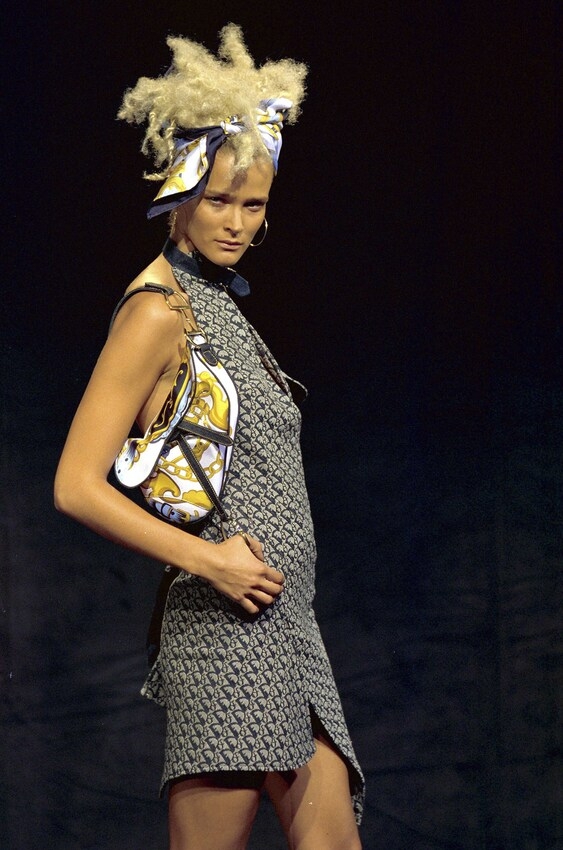
Photo: firstVIEW
The Fall Winter 2000 ready-to-wear show built yet another world. Staged inside a life-sized replica of a Parisian metro station constructed specifically for the occasion, the audience descended into a complete underground environment where the models moved through the set with the ease of commuters rather than runway walkers, the clothes reading against tiled walls and platform edges rather than any conventional backdrop. It was the kind of show that made the clothes feel genuinely inhabited, as though they had been worn before the audience arrived and would continue to be worn after they left, which is the hardest thing a fashion presentation can achieve and the thing Galliano was most consistently able to do across his entire tenure.
The Range of a Fifteen-Year Vision
The breadth of what Galliano produced across fifteen seasons was genuinely extraordinary and resists easy summary because the references moved so widely and the execution varied so completely from one season to the next. He drew from Madame Butterfly and from Egyptian mythology, producing shadow-dyed organza and masks of Tutankhamen and Egyptian gods of Horus and Anubis all designed by Philip Treacy. He moved through the Belle Époque, through Symbolist painters, through the underground club kid movement of the 1980s, through the romanticism of the Victorian era with its corseted bodices and voluminous embellished skirts. The Fall Winter 2004 couture show, inspired by Victorian romanticism, featured some of the most technically complex construction of his entire tenure, gowns with volumes and embellishments that required months of atelier work and that existed at the outer edge of what the human body could carry without external support. The Spring Summer 2006 show, titled Remove Before Flight, pulled from the underground club kid scene of the 1980s and mixed it with military influence, sending models down the runway with bright orange aviation tags hanging from garments and accessories, the kind of irreverent juxtaposition that only worked because the underlying craft was so serious.
In 2008 he produced a collection inspired by Blanche DuBois from A Streetcar Named Desire, and the specificity of that reference, not Tennessee Williams in general but that specific character in that specific psychological state, was characteristic of how he worked throughout. His references were never broad cultural touchstones but precise points of identification, a particular woman, a particular moment, a particular image that he had encountered in his research and that unlocked a complete visual world. The bias-cut slips and the newspaper print dresses that became commercially dominant during his tenure were the most widely distributed expressions of that visual world, pieces that could exist in the wardrobe of someone with no particular interest in fashion history and still communicate something about ease and confidence and modernity. But the haute couture shows, fifty to sixty looks presented twice a year in venues and settings that Galliano and his team had constructed from nothing, were where his imagination operated without any constraint at all, and they constitute a body of work that has sustained a decade and a half of retrospective analysis without exhausting what is there to be found.
The End of an Era
By the mid-2000s, Galliano was navigating a deeply difficult period in his personal life, marked above all by the death of his closest friend and creative partner Steven Robinson in 2007, a loss that those around him say he never fully recovered from. In 2011, after fifteen years, his tenure at Dior came to an end. He stepped away from fashion for a period, sought help, and returned in 2014 as creative director of Maison Margiela, where he has continued to work with the same depth and imagination that defined everything he built at Dior, finding in that house a different but equally compelling creative home.
What He Left Behind
The complexity of his legacy is real and does not resolve cleanly, and the fashion industry has not pretended otherwise. What is also real is the scale of what he built. Under his creative direction Dior became one of LVMH’s most commercially successful brands, reaching 826 million euros in revenue by 2010, a number that reflects not just critical acclaim but genuine mass cultural resonance. His theatrical approach to runway shows became an industry standard that designers are still working within. His narrative-driven collections established fashion as a legitimate form of cultural storytelling in a way that subsequent creative directors across multiple houses have built their entire identities around. His mixing of deep historical research with contemporary construction and his conviction that a runway show should be a complete experience rather than a dressed rehearsal presaged everything that the industry now considers essential to a major presentation.
Dior acknowledged his contribution formally by including his work in the house’s 70th anniversary exhibition at the Musée des Arts Décoratifs in 2017. The Assouline monograph Dior by John Galliano, written by Metropolitan Museum of Art curator Andrew Bolton and published in 2022, documented the full fifteen years across 448 pages with photographs by Steven Meisel, Annie Leibovitz, Irving Penn, and Paolo Roversi. The book opens with the midnight blue satin slip dress Princess Diana wore to the 1996 Met Gala and closes with a canary yellow tulle dress from his final haute couture collection for the house in 2011, inspired by illustrator René Gruau, and the distance between those two objects contains one of the most sustained periods of creative ambition a fashion house has ever supported.