
By Gabriela Afanador
Tuesday 17, March 2026
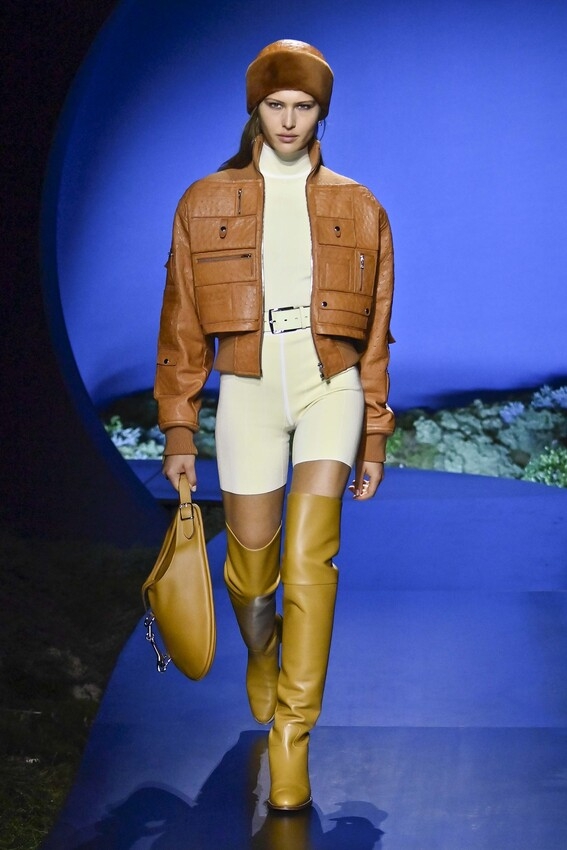
Photo: firstVIEW
Hermès Fall Winter 2026 unfolded like a slow change in light. Not a dramatic transformation, not a costume shift, but the subtle moment when day stops being day and night is not yet fully night. Nadège Vanhee chose that in between state as the emotional center of the collection, and the clothes were built to behave the same way. They did not announce themselves loudly. They revealed themselves gradually through texture, shine, and line, the way a city looks different when the sun drops and everything becomes sharper in shadow.
The show took place at the Garde Républicaine, a setting that carries the disciplined gravity of Hermès heritage. Yet the space was transformed into something closer to a nocturnal landscape. The floor was covered in moss and lichen, not as a decorative trick but as a sensory grounding. It softened the room, changed the acoustics, and introduced a faint organic presence that made the air feel different. Lighting did most of the storytelling. Blue shadows, deepened corners, and a glowing circle at the back that read like a full moon. Models emerged from that light like silhouettes stepping out of a threshold. It made the audience look harder, because the clothes were designed to be read through movement rather than through instant impact.
A collection like this depends on a clear protagonist, and Hermès offered one. A woman who moves with purpose. She is not dressed for display. She is dressed for distance, for the long walk, for the late hour when the city feels both familiar and slightly charged. That idea of agency showed up in the way the silhouettes held the body. The lines were clean, vertical, and determined. Even the more sensual pieces were controlled. Nothing felt fragile. Nothing felt fussy. The sexiness was in the precision and in the confidence of a garment that does not need reassurance.
The equestrian language was present, but it was rewritten for speed. Jodhpurs appeared with a sleeker, more elongated cut that lengthened the leg and sharpened the stance. Thigh high boots became one of the defining features of the show, creating a continuous line from foot to mid thigh that turned every look into a deliberate stride. Many were flat, which mattered. It kept the body grounded and emphasized that this was a wardrobe for movement, not for posing. Cropped riding jackets carried saddle and harness references through curved seams and buckle details, but the effect was modern, not costume. It felt like heritage turned into function.
Leather did much of the heavy lifting, and the collection treated it with unusual nuance. Ostrich leather appeared repeatedly and not as a decorative exotic note. It was used like structure, like musculature, shaping the body in jumpsuits, dresses, and jackets that looked engineered rather than simply styled. Ostrich has a natural three dimensional surface that catches light differently, and under the twilight lighting it created a quiet shimmer without obvious shine. Glossy box calfskin brought a sharper edge, the kind of leather that reads like armor when it is cut close to the body. Patinated finishes gave certain pieces depth, as if they had traveled, as if time was built into the surface.
What made the material story compelling was the tension between the technical and the tactile. Tuscan shearling appeared as oversized collars and inside out contrasts, softening leather silhouettes and giving them a feeling of protection. Mohair and cashmere silk knits acted as weightless underlayers that calmed the more aggressive pieces. Some knits shifted subtly in tone depending on the angle of the light, reinforcing the idea that these garments are meant to be seen in real environments, not only under runway flash. There were also practical elements that felt intentionally modern, including technical nylon used for utility pieces and bag covers, a quiet nod to how luxury needs to survive actual weather and actual travel.
Print was restrained to one main thesis motif, and it was used like architecture rather than decoration. A modernist scarf design with a vanishing point structure appeared in different scales and placements, creating the illusion of depth on the body. It showed up on carré style wraps worn like capes, on quilted pieces, on outerwear that treated the graphic like a framework. As the models walked, the lines seemed to shift and recede, playing with perspective the same way twilight plays with perception. It was a smart choice because it let the collection remain serious and minimal while still giving the eye a concept to follow.
Color moved like a timeline. Early looks carried the warmth of late day in deep burgundy, oxblood, and earthy neutrals like camel, ochre, and burnt brown. Then came flashes that felt like the last sparks of sunlight, sharper yellows and mango tones that punctuated the heavier palette. Greens appeared next, forest and pine shades that blended with the mossy set, alongside brighter lime notes that felt almost biological, like something glowing in the dark. Finally the collection descended into inky blues, petroleum tones, grey black, and steel shades that looked like night settling in. It did not feel like random color choices. It felt like the sky changing.
The silhouettes reinforced that progression. Early looks felt more grounded and tailored, then the collection introduced more aerodynamic shapes. There were biker dresses with spiral closures and diagonal zips that could be adjusted, making the garment feel responsive rather than fixed. Cycle shorts appeared layered under coats and jackets, a technical athletic note that made the body look sleek and modern. Jumpsuits zipped up the front and cinched at the waist emphasized the idea of a controlled figure that is ready to move. Outerwear remained the infrastructure of the Hermès wardrobe, with A line coats, modular trenches, and double breasted jackets that held their shape while still allowing ease.
Accessories extended the narrative instead of simply finishing it. Bags appeared as punctuation marks, often in new or reworked silhouettes that felt designed for a life in motion. A micro version of a classic bucket shape appeared with a firmer leather body and integrated padlock details, turning a familiar idea into something more architectural. A watch clutch returned as a clever hybrid object, with hardware that hides a timepiece within a structured form, a small secret in the hand that fits the twilight theme perfectly. New zip top and flap shapes suggested a fresh approach to the everyday Hermès bag, still rooted in equestrian logic through buckle and strap details, but designed with a cleaner modern profile.
One of the most interesting practical moves was the introduction of full bag covers, designed like functional equipment rather than precious protectors. These covers were made with technical fabric and leather details, sometimes with exterior pockets, turning an icon into something operational. It was a quiet statement. Hermès is not softening its luxury. It is making it more usable without making it casual. That is a difficult balance, and it is where Vanhee’s vision feels most contemporary.
Jewelry and belts echoed the same balance between heritage and edge. Instead of leaning on the expected buckle as the main symbol, the belts explored chain draping and utilitarian references that felt almost like modern tools. Padlocks and keys appeared as motifs, sometimes wrapped in leather, sometimes rendered in enamel, turning familiar Hermès codes into small charms that felt personal rather than branded. A strap inspired necklace idea brought the house’s hardware language into jewelry scale without feeling like costume. Everything remained sculptural and restrained.
Beauty stayed consistent with the twilight mood. The eyes carried smoky depth, not overly dramatic but intentionally shadowed, like someone who has been out late and looks better for it. Hair was kept understated, almost undone, letting the clothes remain the focus. The overall effect was editorial without feeling artificial, a look that supported the idea of a woman moving through the evening rather than a woman preparing to be photographed.
Hermès Fall Winter 2026 succeeded because it did not chase a trend headline. It built an atmosphere and then designed every element to serve it. The clothes were disciplined, but not cold. The palette was moody, but not heavy. The materials were luxurious, but not delicate. The collection offered a new kind of Hermès elegance that feels more nocturnal and more charged, without losing the house’s core seriousness. It is a wardrobe for the blue hour, for the moment when the city becomes a little less predictable and a woman becomes more herself as the light fades.