
By Gabriela Afanador
Monday 10, August 2026
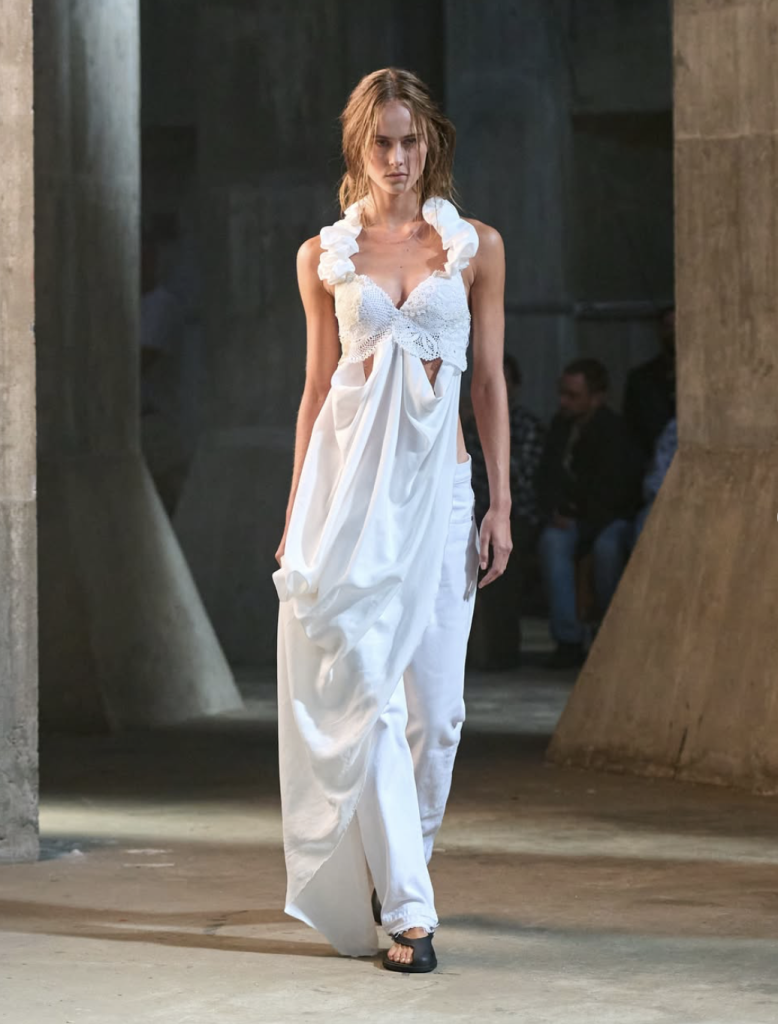
Photo via @studio_constance on Instagram
Rebecca Dovenryd Almberg has never been interested in making quiet clothes. Since launching Studio Constance in 2020, she has been building something that sits firmly outside the restrained Scandinavian minimalism that defines so much of what comes out of Nordic fashion, and the collection she showed at Copenhagen Fashion Week SS27 was the clearest expression yet of what that actually looks like on a runway. Raw concrete venue, wet hair, barely-there makeup, and neon green kitten heel flip flops on every single model. It was not trying to be anything other than exactly what it was, which is also what made it work.
Before the collection even registered, the setting did. The venue was a raw industrial concrete space, the kind of environment that strips away any softness and forces the clothes to hold their own without the support of lighting design or elaborate scenography. Models walked with wet hair and minimal makeup in what felt closer to a private moment than a public presentation, the atmosphere charged and slightly uncomfortable in the way that genuinely interesting fashion shows sometimes are. Almberg has spoken before about working from a raw emotional standpoint, and the space she chose for SS27 communicated that without ceremony.
Studio Constance also made history this season as the first Swedish brand ever admitted into the CPHFW NEWTALENT programme, a scheme that has existed since Copenhagen Fashion Week’s founding and has always been exclusively Danish. The expansion is significant not as a formality but because of what it says about where Copenhagen sees the boundaries of its creative territory right now, and the collection Almberg showed made a convincing case for why those boundaries needed to move. Almberg studied knitwear design in San Francisco and worked at Proenza Schouler, Totême, and Acne Studios before launching the label, and that combination of American fashion school rigour and European luxury house experience is visible in how she approaches construction, the clothes always technically considered even when they are pushing toward something extreme.
The Collection

Photo via @studio_constance on Instagram
The palette across the collection was deliberately contained, deep black, pure white, dusty blush, and a warm tobacco brown, four colors that each carried a different emotional register and a different relationship to the body. The blacks were the most structured and the most dramatic. The whites were the most exposed and the most fluid, doing the most work in the collection’s strongest looks. The blush and tobacco tones were the most intimate, sitting against the skin with a warmth that made them feel less like clothes and more like something the body had grown into rather than been dressed in. Working within a restrained palette like this puts enormous pressure on silhouette and construction to carry the visual interest, and Almberg understood that and delivered on it consistently across the 25 looks.
The show opened with an oversized black utility jacket worn completely open with nothing beneath it, paired with wide cropped trousers and neon green Havaianas on the feet, and it set the tone for everything that followed without needing to announce it. The jacket was not dressing the model, it was framing her, the chest completely bare, the neon shoe the only interruption in the full black. It was a confident opening that asked for nothing from the audience except attention, and it got it. There is a specific kind of self-assurance required to open a runway show with a look this exposed and this stripped back, because there is nowhere to hide if it does not work, and it worked completely.
The crochet pieces were the collection’s most technically ambitious and most visually immediate moments. A full-length white dress constructed entirely in dense crochet lace had sculptural shoulders and a boat neckline, the pattern intricate and architectural at the top before loosening into open layered tiers at the hem that the model gathered and held as she walked. It had the particular quality of something that looks effortless to wear and is genuinely extremely difficult to make, and the fact that the construction read as natural rather than laboured is a significant technical achievement. Crochet at this scale, with this level of pattern complexity, requires the kind of sustained manual attention that most brands have abandoned entirely, and Studio Constance brought it to a Copenhagen NEWTALENT slot, which says something about where Almberg’s priorities are. Another look paired a white crochet bralette with wide ruffled straps over an enormous pool of draped white fabric falling to the floor, two completely different materials and construction philosophies in the same look, the handmade rigidity of the crochet at the top against the complete fluidity of the fabric below, working together naturally rather than competing for attention. The back view of this look, the open crochet bralette revealing a bare back above the pooled white fabric, was one of the most photographed images from the show.
The oversized pieces were where Almberg’s design philosophy was most visible and most direct. A lightweight white cotton anorak worn open with nothing beneath it billowed around the hips into a bubble silhouette that came from sheer scale alone, no internal structure, just the jacket existing at a proportion large enough to create its own volume and its own presence. The fabric moved as the model walked in a way that made the look feel alive rather than constructed, the bubble shape appearing and shifting with each step. The same idea in black read sharper and more graphic, the color shifting the entire mood of the silhouette without changing a single seam, and seeing the two versions in the same collection made it clear how much work the color is doing in Almberg’s design process, not as decoration but as a fundamental variable in how a silhouette communicates. An oversized white shirt cinched with a leather belt at the waist gathered into an exaggerated volume below it, the most familiar garment in the collection made completely strange by how far the proportion was pushed. The shirt remains entirely recognizable as a shirt and yet it is doing something a shirt has no business doing, which is exactly the kind of tension that makes a designer worth paying attention to.
A one-shouldered black floor-length draped dress worn with long black leather gloves carried a 1970s glamour that felt entirely intentional, the lean of the shoulder and the fall of the fabric to the floor in deep folds achieving elegance through simplicity rather than through elaboration. It was the collection’s most quietly confident piece, the one that required the least to say the most. A strapless tobacco brown balloon skirt gathered tightly at the bodice and expanded into an enormous spherical volume below, the warmth of the tobacco sitting against the skin in a way that the black and white pieces could not replicate, the color making the volume feel sensual rather than architectural. A barely-there white halter slip in completely sheer fabric was the most stripped back moment in the lineup, the translucence making it as much about the body beneath it as the garment itself, and in the context of a collection built around exposure and framing rather than coverage it felt like exactly the right note to hit.
The finale was a white halter dress with an extraordinary exaggerated panniers construction at the hips, the fabric extending outward on each side in a wide horizontal volume that the model carried as though it weighed nothing. It was the most extreme silhouette of the collection and somehow one of the most assured looking, the construction so precise that the volume read as inevitable rather than exaggerated. Panniers as a construction reference go back centuries in the history of Western dress, the side-extending hip volumes of eighteenth century court fashion, and seeing them reappear in a raw concrete venue in Copenhagen on a NEWTALENT runway in 2026 alongside crochet bralettes and neon rubber sandals is the particular kind of unexpected combination that makes fashion genuinely interesting when it works. Here it worked.
The Shoe
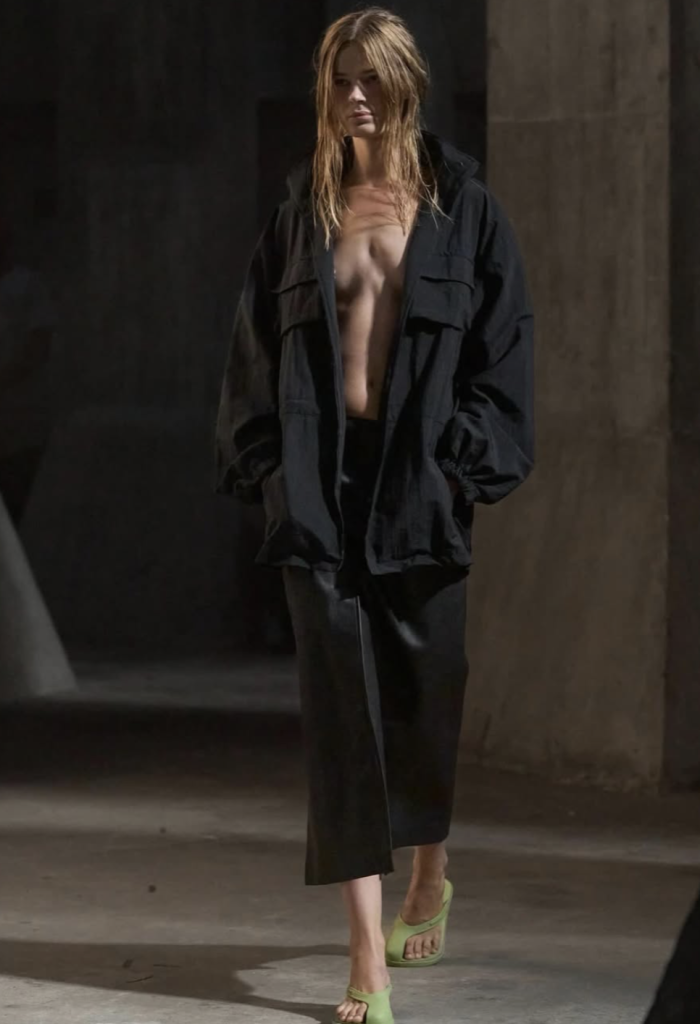
Photo via @studio_constance on Instagram
Every one of the 25 looks was paired with the same shoe, and that shoe became the most talked about footwear moment of Copenhagen Fashion Week SS27 before the show had even finished. Havaianas debuted its first ever heeled sandal on the Studio Constance runway, a kitten heel flip flop that manages to remain unmistakably itself while being something the brand has never done before in 64 years of making rubber sandals.
The design keeps everything that makes a Havaianas a Havaianas intact. The rubber thong straps. The signature rice-grain texture insole that anyone who has ever owned a pair knows by feel before they know it by name. The fundamental simplicity of construction that has kept the brand relevant across six decades without requiring significant reinvention. What it adds is an asymmetric elliptical heel of about two inches and a reinforced toe cap that covers only the big toe, just enough elevation and just enough structure to shift the sandal out of its natural territory without losing any of the ease that defines it. The result is a shoe that reads immediately as a Havaianas from across a room and reads as something new when you look closely, which is a genuinely difficult balance to achieve in footwear design and one the kitten heel pulls off. It came in vibrant green, black, and off-white across the collection, and the neon green version worn against all-black looks produced the image that circulated most widely after the show, the contrast between the severity of the look and the cheerfulness of the shoe doing something that neither element could have done alone.
The choice of Copenhagen for this launch was not arbitrary and it was not simply about the show. Havaianas is already embedded in the street style vocabulary of this fashion week in a way that no other footwear brand has managed to replicate, editors and buyers arriving in their rubber sandals before the first show of the week opens every August, the brand present in the crowd before it is present on any runway. That existing relationship meant the kitten heel did not need to introduce itself from scratch in Copenhagen. It only needed to show up differently from what everyone already knew, and pairing it with a collection as considered and as fashion-forward as Studio Constance’s placed the shoe in a context that made immediately clear what it is for. Not resort, not casual Friday, not beach. Fashion.
The heel had been teased on Havaianas’ social media in the days leading up to the show, which generated anticipation without revealing the full design, and the Studio Constance runway was the first time anyone saw it properly. The response was immediate, the shoe photographed extensively across Copenhagen street style coverage from the same day, worn by attendees who had clearly found their way to a pair before the collection had even reached retail. Havaianas also hosted a separate event during the week on Green Island in Copenhagen Harbor titled From Sea Level to New Heights, with Brazilian music, food, and a floating customization activation with Brazilian jewelry designer Alan Crocetti, extending the launch beyond the runway and into the city itself rather than keeping it contained within the show context. By the end of the first day the shoe was everywhere online and on the street, and the collaboration between two brands whose natural registers could not be more different, a Swedish luxury knitwear label and a Brazilian rubber sandal manufacturer, had produced one of the more memorable pairings of the Copenhagen week.