
By Gabriela Afanador
Saturday 26, September 2026
On September 25, during Milan Fashion Week, Demna showed Gucci’s Spring/Summer 2027 collection under the title The Store Show. He built an actual working replica of a multi room luxury flagship inside an industrial hall on the outskirts of Milan, marble on the walls, modular seating lounges scattered through the space, and an exterior path where the models walked past windows before stepping into the store itself. This came twelve months into his time at the house, after a year that had mostly been archival research and smaller interim presentations. The idea behind it reached back to where the house began, to Guccio Gucci working as an elevator porter at London’s Savoy Hotel, watching aristocrats and industrialists and traveling performers pass through the same lobby every day and realizing that a store could be a place where all of them came to try on a different version of themselves for a while. Demna kept coming back to that idea all night, and it gave the whole collection something to hold onto even when the looks themselves pulled in very different directions.
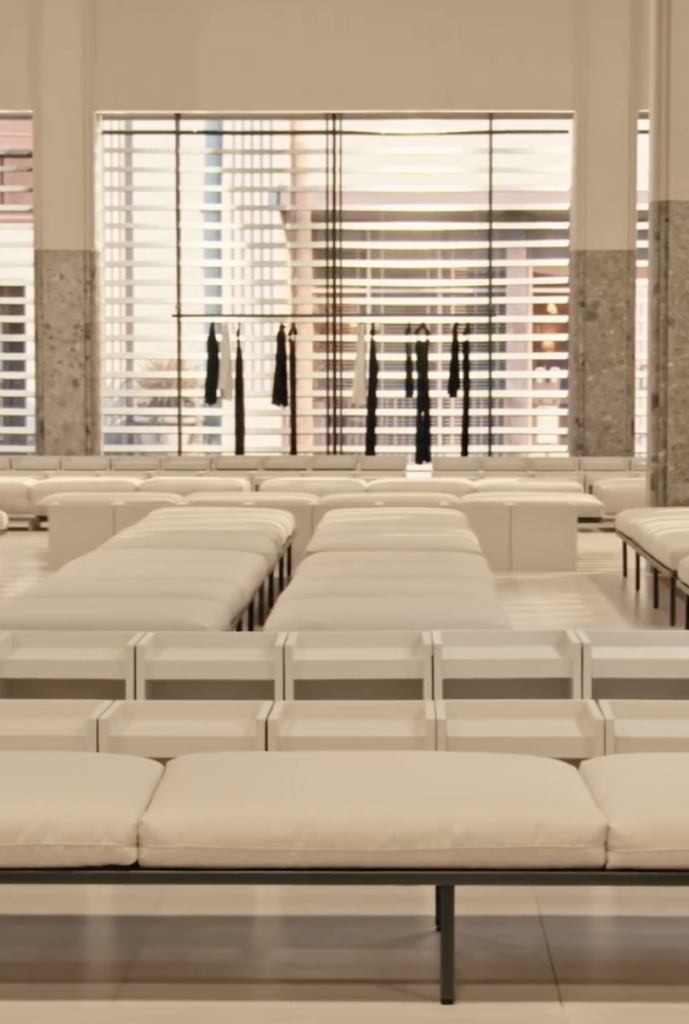
Photo via @gucci on Instagram
The show moved differently from a normal runway because it leaned so fully into the store concept. Mirrored columns ran through four separate rooms, each one set up like its own section of a boutique, and the models paused to check a hemline in the mirror or adjust a collar as they walked, small gestures that made the whole thing feel like watching someone actually shop. Menswear opened the night with a sharp, assertive kind of Italian tailoring, ankle cropped trousers, loafers worn without socks, jackets fitted close through the shoulder, and slowly loosened into rounder leather bombers and slouchy premium denim. By the end of the menswear segment you could feel the show setting up a conversation between formal tailoring and something closer to streetwear. Womenswear picked that conversation back up and ran it through four different moods, starting with mid century equestrian pieces, moving into sharper suiting that borrowed from both eighties power dressing and the sensuality Tom Ford brought to Gucci in the nineties, then into a section that clashed collegiate stripes with Scottish tartan on purpose, before closing on eveningwear built for much later in the night. The music, done by Gucci’s music director Loki, moved right alongside the clothes, bossa nova at the start, tango through the middle stretch, and a building wall of orchestral percussion by the time the gowns came out.
The Early Looks
The early looks stayed close to that equestrian idea and felt almost formal at first. Look 1 set the tone with a navy riding jacket cinched at the waist, a small Horsebit plaque pinned near the lapel, worn over a crisp white shirt with an exaggerated stand collar and white jodhpurs, boots coming up to the knee, and a small GG canvas bag held loosely at the fingertips. From there the formality started coming apart piece by piece. A full length black leather coat went over that same equestrian base a few looks later, and a fitted leather mini skirt pushed the whole silhouette somewhere sharper and more knowing. There was a return to tailored daywear in the middle of the show, a restructured trench and a pleated white shirtdress, before a cropped black jacket exposed the midriff entirely and later looks shortened both jacket and trouser to bare the calves.
Look 16 landed in the middle of all that movement and felt like one of the calmer moments of the night, a black mini dress with sharp padded shoulders and almost nothing else, sunglasses hanging loosely from one hand instead of being worn, a small black bag held in the other. There is something very direct about that look, more so than most of the rest of the collection, which kept layering and shifting between characters most of the night. It is the closest the whole show came to the kind of stripped down sensuality Tom Ford brought to this house decades ago, tailoring pared all the way down instead of being built back up into something new.
The Later Looks
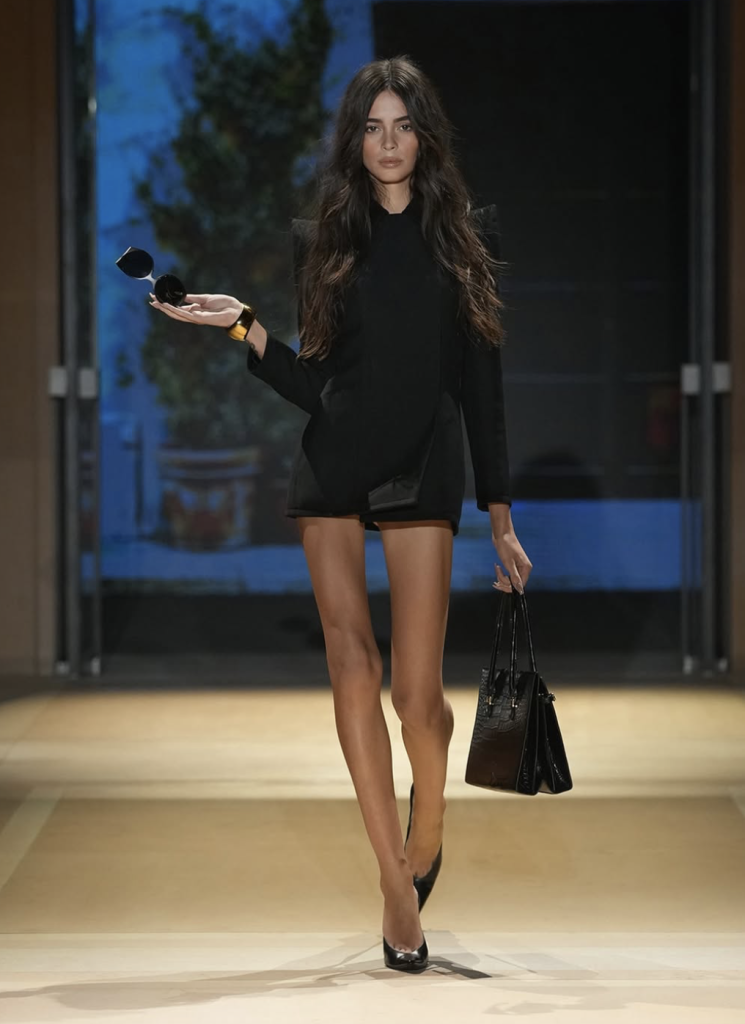
Photo via @gucci on Instagram
The second half of the show belonged to a much louder version of the house. Full length leopard print coats started showing up, and the silhouettes kept getting bigger and rounder from there. Look 30 was a good example, an oversized leather bomber with a rounded, exaggerated shape worn over wide leg grey wool trousers and a striped polo underneath, everything about it loose where the earlier looks had been so precise. Elsa Hosk wore something close to this same idea down the runway, her bomber sleeves pitched out dramatically, paired with shiny cargo trousers and sharp stiletto pumps, which captured that tension the whole back half of the show was playing with, sportswear ease pushed right up against eveningwear sharpness. Look 38 pushed the volume even further, a huge faux fur coat wrapped around a narrow black pencil skirt with pointed pumps underneath, and Rosie Huntington-Whiteley walked a version of that pairing too, fur worn open over a black lace corset and a high waisted skirt, built specifically around that contrast between how much space the coat takes up and how little is underneath it. Later there was a shimmering metallic mini dress with an asymmetrical cutout at the waist, and one of the strongest moments of the whole night came near the end, a floor length black jersey gown with deep cutouts running from the ribcage down past the hip and a slit cut almost to the thigh, styled with a hit of hot pink eyeshadow that gave the black fabric somewhere to land visually. The final look of the show was a draped nude and purple jersey gown that used no internal boning at all, held instead by a single metal counterweight shaped like a teardrop that swung gently with every step, more engineering than dressmaking in the best possible sense.
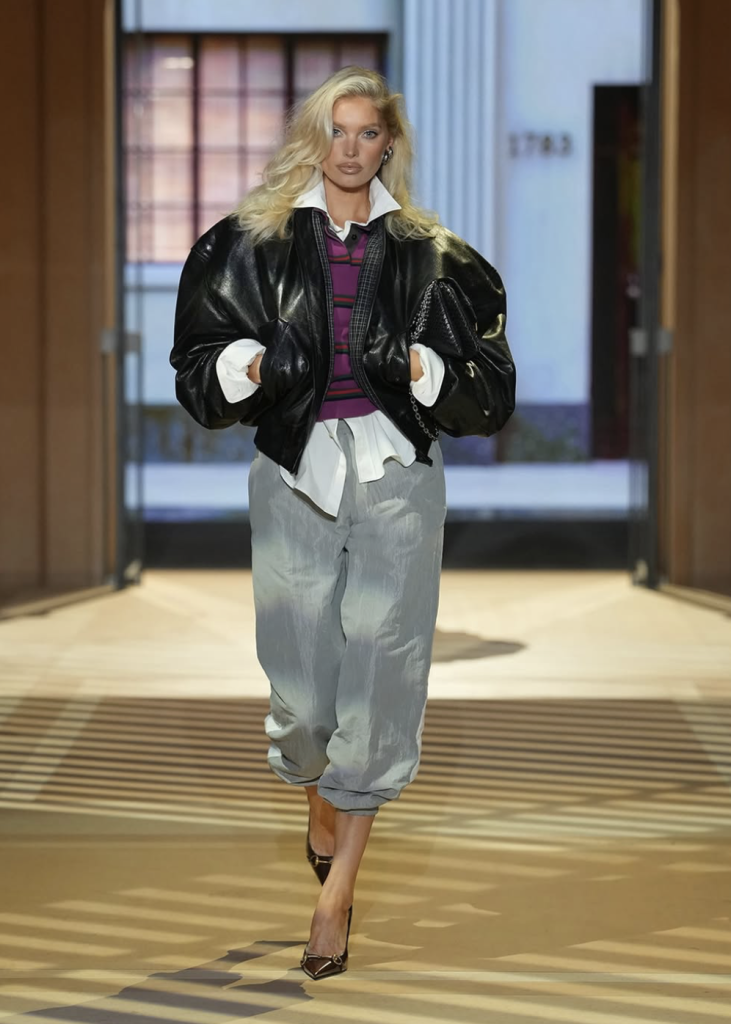
Photo via @gucci on Instagram
Looking back across the whole thing, there is a Versace feeling running through both ends of this collection that is hard to ignore once you notice it, in the boldness of the silhouettes and in a kind of glamour that felt bigger and less restrained than what Gucci has usually stood for on its own.
Fabrics and Accessories
A lot of the reason the show’s different moods felt connected comes down to the materials underneath them. The equestrian and tailored womenswear leaned on stonewashed wool and crisp cotton poplin, softened enough through processing that the pagoda shoulders running through the riding jackets and cropped blazers could be shaped with careful dart work and internal canvas instead of heavy padding, which kept those pieces sharp without ever looking stiff. Authentic Scottish tartan, woven in traditional weights and pressed into deep pleats, gave real weight to the kilts and wrap skirts and grounded them against the sheer and lace layered underneath. Leather ran through the collection constantly, soft plongé lambskin and python turning up on skirts, coats, and bags, glossy enough that pieces like the oversized bombers could hold their shape without looking heavy, and the fur, cheetah and leopard printed, brought in the exaggerated bulk that defined the collection’s second half. Eveningwear moved into fluid viscose jersey and silk chiffon instead, chosen purely for how the fabric moved and draped, which is exactly why the counterweighted gown that closed the show worked as well as it did.
The accessories carried a lot of the commercial weight of the night, and you could tell how much thought went into them. Archival bags like the GG Marmont, the Ophidia canvas line, and the Lady Lunetta chain bag kept things familiar, while newer pieces like the Uptown Horsebit tote and a python bag shaped into a segmented bamboo stalk pushed in a more experimental direction, and the small top handle bags carried at the fingertips throughout the equestrian looks tied the whole opening section together. Belts came in exaggerated proportions throughout the night, triple Horsebit cummerbunds cinched tight over shirting, oversized low slung buckles anchoring skirts and kilts, layered under heavy chains and mismatched pearls that gave even the most polished looks a slightly undone finish by the time they reached the end of the runway. Footwear moved from knee high riding boots in the opening looks to sharp metal heeled stilettos and, later, a boudoir mule trailing long fabric tassels, tracking the same shift from formal to loose that ran through the clothes themselves.
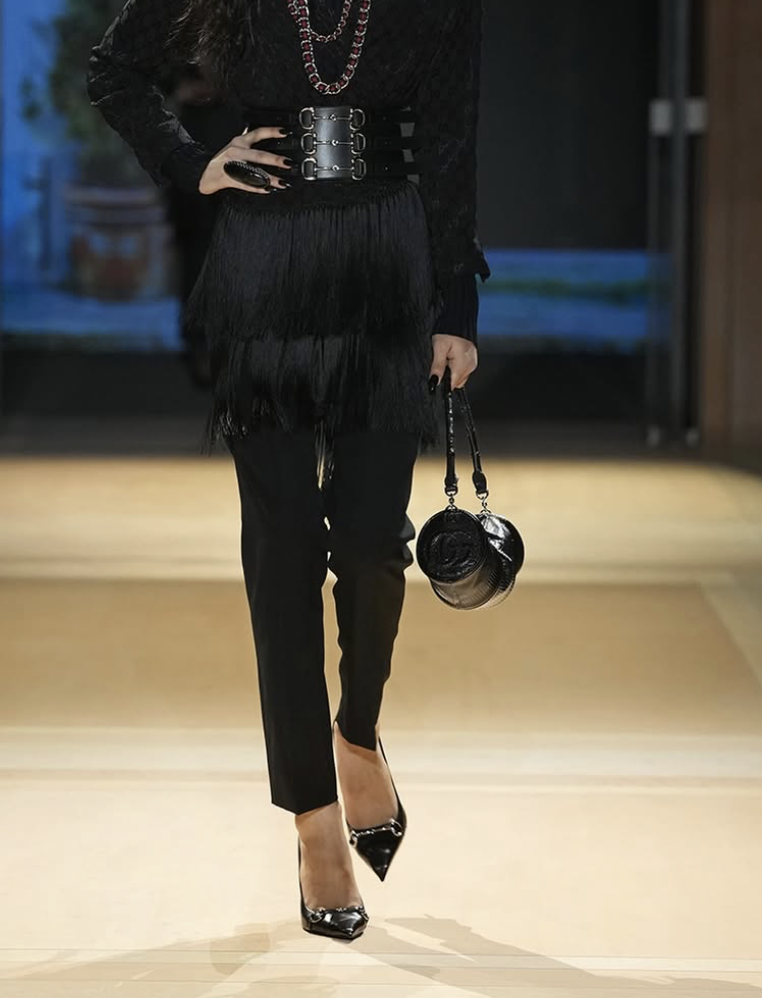
Photo via @gucci on Instagram
Reaction to the show split roughly along the same lines the collection itself was built on. Trade press liked how clearly the house had been organized around distinct characters and called out the final gravity gown as one of the more inventive pieces of eveningwear shown all week in Milan. Cultural writers were more skeptical, with some arguing that building an actual working store on the runway ended up celebrating commercial luxury more than commenting on it, drawing a comparison to Karl Lagerfeld’s satirical Chanel supermarket show back in 2014. Fashion forums were rougher still, calling the exposed midriffs and lace closer to early 2000s provocation than to the kind of refined Italian tailoring people associate with the house.
A Few Thoughts on the Direction
Every designer who steps into a house this size inherits a version of Gucci shaped entirely by whoever came before them, and Gucci in particular has been through more of those shifts than almost any other major label, from Tom Ford’s disciplined sensuality through Frida Giannini’s polish and into Alessandro Michele’s maximalism, each era basically a full reinvention of what the house meant to people. Demna’s version leans toward restraint and character work, and taken on its own terms it is a well made, carefully considered collection. What it did not fully give me, at least, was the specific kind of extravagance I have always liked best from this house, the version Tom Ford built, bold and specific. This felt more calibrated toward wide appeal, which isn’t the same as being wrong, just different from the Gucci I personally respond to most.
It’s worth remembering that Matthieu Blazy faced real skepticism early on before his work went on to become some of the most talked about in the industry, and no designer is judged fairly off one collection twelve months into a new job. Still, how much context Demna gave ahead of the show, walking press through the reasoning behind almost every decision, is worth mentioning. When a designer explains a vision that thoroughly before anyone has even seen it, it can start to feel less like confidence and more like preparing an answer in case the response isn’t what he hoped for. None of that takes anything away from what was, by any real measure, a beautifully made and genuinely well constructed collection, and it will be worth watching where Demna takes the house from here.