
By Gabriela Afanador
Thursday 24, September 2026
Etro showed Halo during Milan Fashion Week on September 23, staged inside Piazza Lina Bo Bardi in the city’s Porta Nuova district. Rather than building a conventional runway, the house turned the space into an open, sunbaked field, the floor laid in natural wheat-toned carpet and bordered on both sides by tall, dried wild grasses and weathered stalks of wheat, the kind of late-summer countryside Etro has always drawn from without ever showing quite this literally before. The lighting moved through the whole show the way actual daylight would, starting cool and diffuse to suggest early morning haze, warming gradually into amber and gold through the middle of the show, then settling into deep dusk by the final stretch, with focused spotlights picking out the darkest, most saturated looks against the shadowed grass behind them. The soundtrack stayed warm and unhurried throughout, analog synth drones layered under soft rhythmic loops and the faint sound of birds and wind, letting the models walk at a natural, easy pace rather than anything clipped or performative. Hair was left loose and wind-brushed, as if air-dried outdoors, and makeup stayed close to bare skin, luminous and lightly warmed at the cheekbone, keeping the whole beauty direction as unforced as the clothes themselves.
The Collection
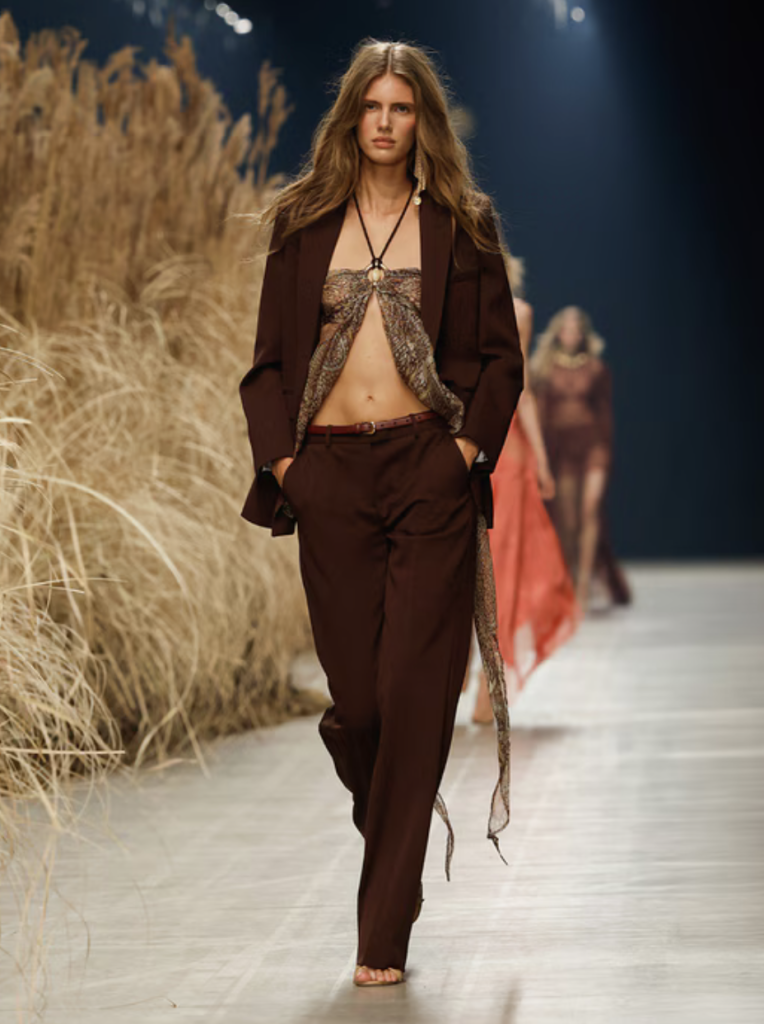
Photo via etro.com
This was the first womenswear collection from Etro’s internal design studio since creative director Marco De Vincenzo departed the house in March, and it landed during a real period of transition, following the founding Etro family’s sale of their remaining stake in the company and a difficult financial year. Rather than bringing in an outside name to force a dramatic reinvention, the in-house team chose to lighten the house’s codes instead of abandoning them, pulling back from the dense, maximalist knitwear and saturated color clashes that defined the De Vincenzo years in favor of something airier and more fluid.
The collection takes its title, Halo, from two overlapping ideas, the optical haze that rises off the ground in high summer heat, and the soft, glowing aura a piece of fabric or print can seem to carry when it moves loosely around the body. The whole show traces the arc of a single Italian summer day, from pale, hazy morning light through the full heat of midday into the deepening color of dusk, and the palette, fabric weight, and silhouette shift of the collection all move along that same timeline. At the center of the whole concept sits Etro’s signature paisley motif, known more precisely as boteh, the teardrop-shaped pattern with its small internal decoration and surrounding dotwork that originally came out of seventeenth century Persian and Kashmiri shawls before becoming Etro’s own defining print after its introduction to the house in 1981. For this collection, the studio took that normally dense, multicolored motif and pulled it apart, enlarging individual sections until the classic teardrop shape blurred into something closer to an abstract wash, desaturating the color until certain prints looked genuinely sun-bleached, as if the pattern itself had spent a whole summer out in that same field the show was staged in.
The Clothes
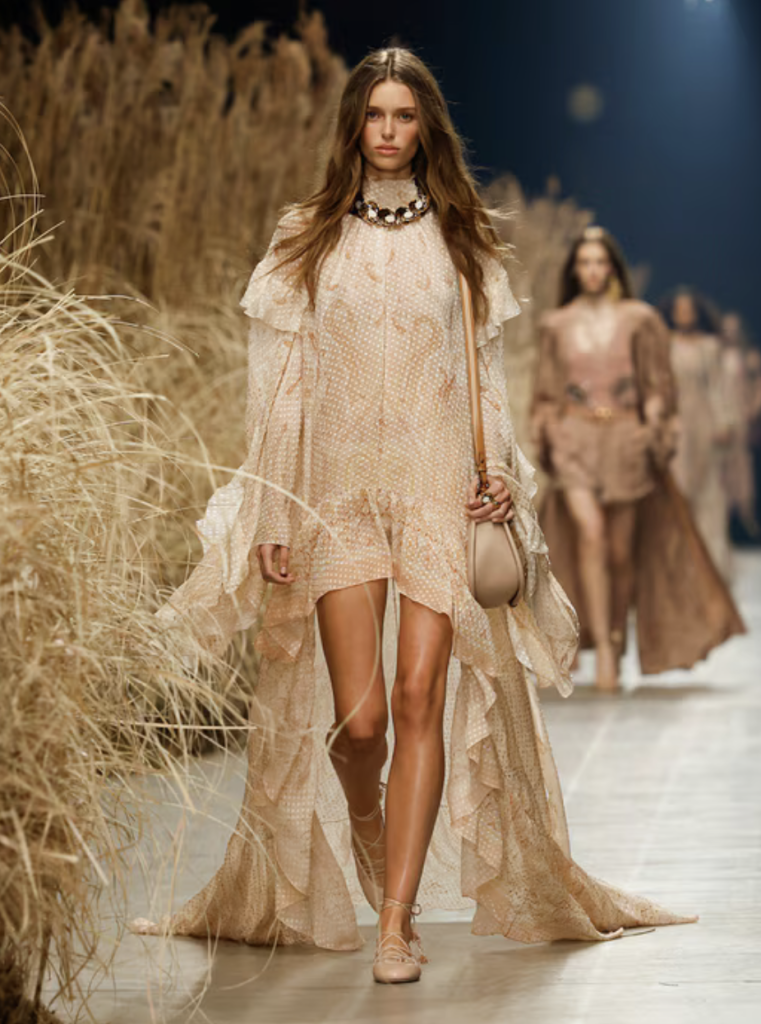
Photo via etro.com
Look 1 opened the show, and it was a striking place to begin, a pale, cream and light coral toned dress built from a lightly dotted, faintly paisley-washed chiffon, finished with a dramatic, cascading train at the back and wide, tiered ruffled sleeves that fell in soft, layered flounces from the shoulder all the way down. The neckline sat high and gathered, almost monastic against how much movement the rest of the dress carried, and that contrast, something so restrained at the throat against sleeves this theatrical, set the tone for the whole collection’s opening stretch, pale, hazy, and dreamlike, the kind of early morning light the whole show was built to trace.
From there the collection moved through its cooler, paler opening phase, almond, ivory, champagne, and sand carrying the first run of looks, paisley appearing here in its most faded, nearly invisible state, watermarked faintly onto sheer crepon blouses and chiffon hems rather than leading with any bold graphic statement. Lace reappeared throughout this stretch too, worked into dresses alongside soft, unlined silk, the two fabrics paired so the structure of the lace sat against the fluid drape of the silk underneath it, giving even the simplest slip dresses real textural depth. Tailoring ran through this section as real structural backbone, elongated double-breasted blazers and crisp linen dusters, their shoulders set slightly dropped and broad, framing the sheer, floating layers worn beneath them and keeping the whole opening stretch from reading as pure resortwear.
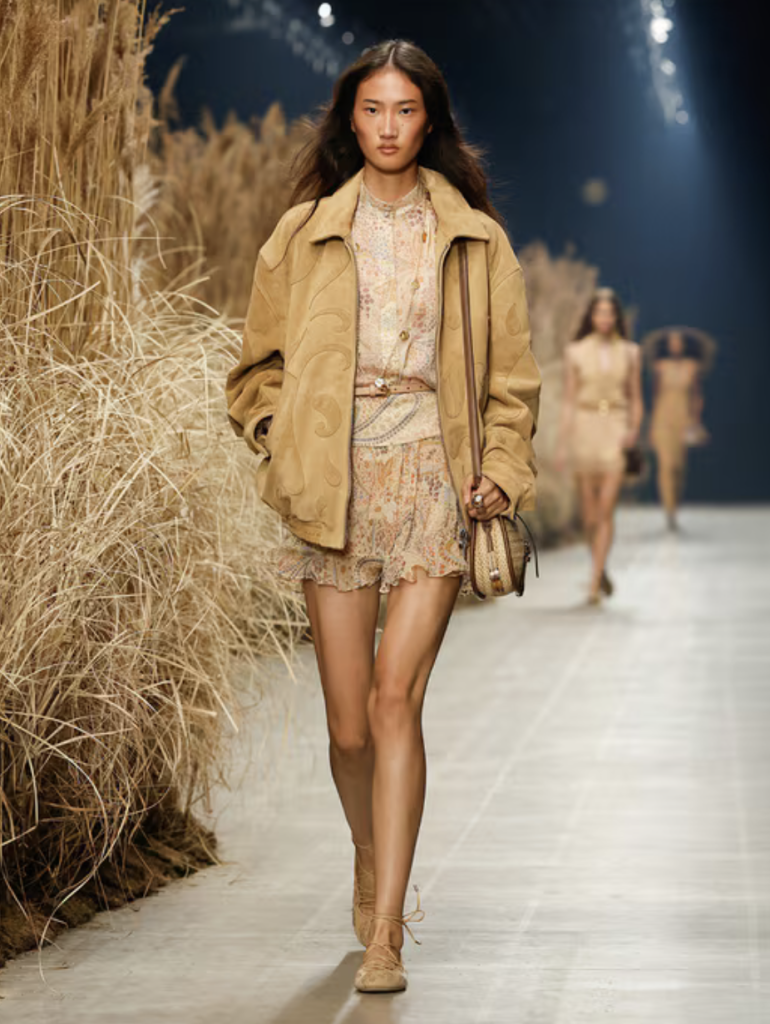
Photo via etro.com
Look 10 is a genuine standout in this early run, an oversized tan suede jacket, blind-tooled with an embossed paisley relief worked directly into the nap of the leather so the pattern reads through shadow and texture rather than color, worn open over a soft floral print shirt and matching ruffled mini skirt in the same faded, washed tone. The styling pairs that substantial jacket with strappy, delicate ballet flats and a woven straw shoulder bag, and the balance in that pairing is really the whole point, the suede carrying real weight and presence on top while the fluid skirt and the soft, unstructured shoe underneath keep the look from tipping into anything heavy or stiff. That embossed suede technique recurs shortly after in a denim jacket worked in the same patchwork, paisley-relief pattern, a clever way of carrying that same tactile, blind-tooled treatment from one grounded material into another.
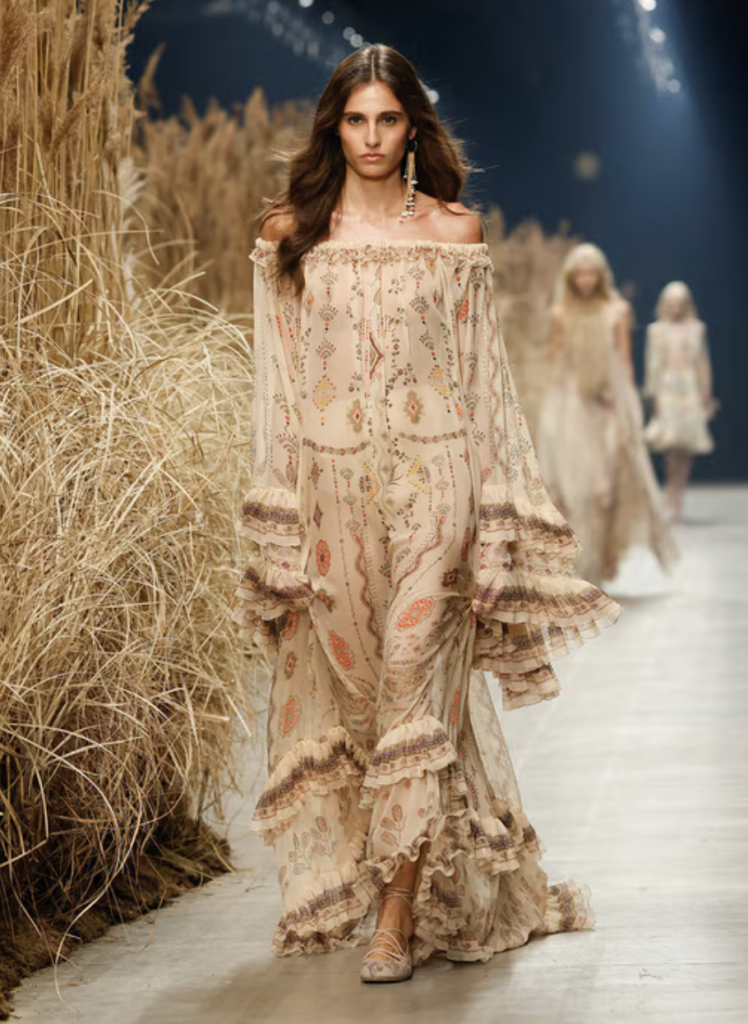
Photo via etro.com
Look 15 arrives as one of the clearest high points in the whole show, an off-the-shoulder gown in a soft, multicolor paisley print, long bell sleeves finished in deep, tiered ruffles that widen dramatically at the cuff, the same ruffled treatment repeating down the full length of the hem. The fabric itself is beautifully handled here, a fine, almost weightless silk chiffon that lets every one of those ruffle tiers fall with real softness rather than any stiffness, and the off-the-shoulder neckline, gathered and elasticated, gives the whole dress a relaxed, unstructured ease despite how elaborate the ruffle work actually is.
As the show moved into its warmer, middle stretch, the palette shifted into camel, mustard, terracotta, and dusty rose, and knitwear took on a much bigger role here, crochet and open-weave knit dresses and swim pieces appearing alongside the collection’s suede and patchwork denim. An orange tailored jacket appeared in this stretch worn open over a sheer, nearly transparent paisley-printed dress underneath, the structured orange shoulder framing the soft transparency beneath it in much the same contrast logic as the suede jacket look earlier in the show. Coral and salmon tones followed shortly after, a top and matching shorts in that same warm, sun-washed pink, a color that showed up across a lot of runways this whole season but reads here as genuinely grounded in the collection’s own daylight concept rather than simply following a trend. A yellow dress carrying the collection’s softened paisley print appeared around this same stretch, more knitwear moving through alongside it before the palette shifted again into a cooler blue.
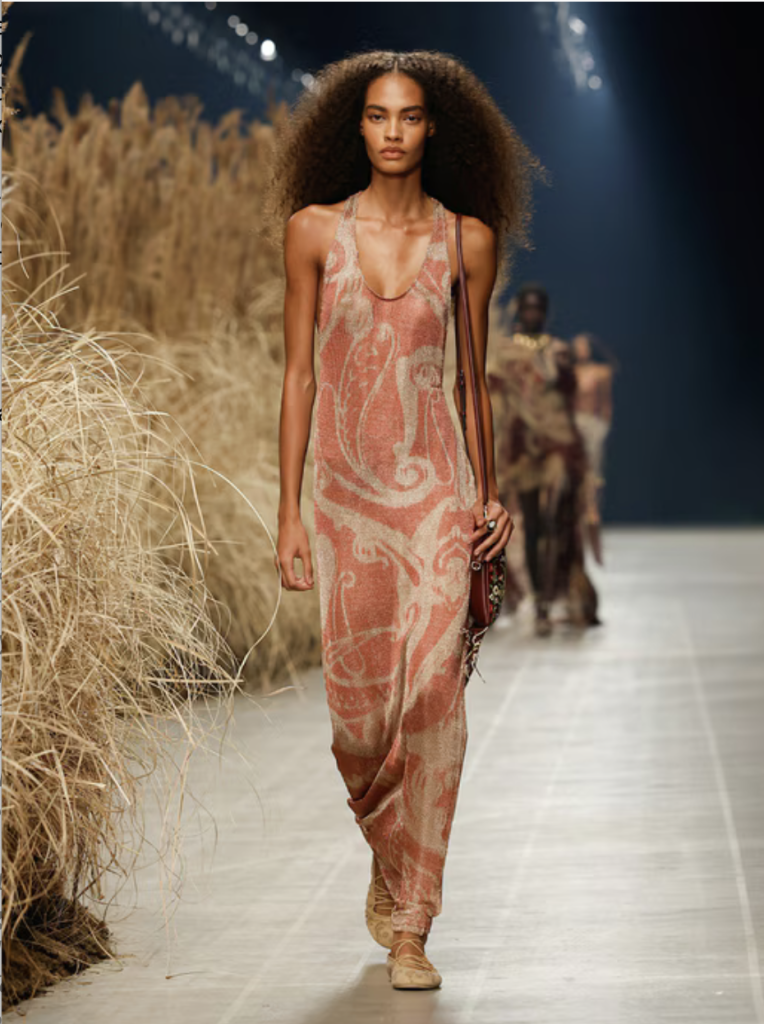
Photo via etro.com
One of the strongest evening-leaning pieces in this middle-to-late stretch is a long, trailing blue gown with a high neckline and delicate fringe detailing falling from the bodice at the front, the fringe swinging gently with every step the way so much of the collection’s trim was engineered to do. A simple metallic slip dress followed nearby, clean and quiet against the more elaborate pieces surrounding it, proof that the collection could hold a moment of real restraint even in its busier middle section. A fitted blue jacket appeared around here too, before the show moved into one of its more surprising pairings, a red jacket finished in a dense, trembling knit fringe, something that reads immediately as a western silhouette but sits comfortably inside a spring collection rather than feeling like it belongs to fall, proof that fringe and that kind of frontier-inspired texture can carry through warmer months just as easily as colder ones when the fabric itself stays light. A green jacket followed, paired with a flowing silk dress in the same tone, carrying the same silhouette logic through into a cooler, more botanical part of the palette.
Footwear throughout this stretch leaned into knee-high lace-up sandals, the straps winding all the way from the ankle up to just below the knee, a detail that showed up across several looks and tied the whole middle section together visually even as the colors kept shifting. More knitwear and pleating moved through this part of the show too, the salmon dress reappearing again in a slightly different cut, before the collection settled into its final, deepest stretch.
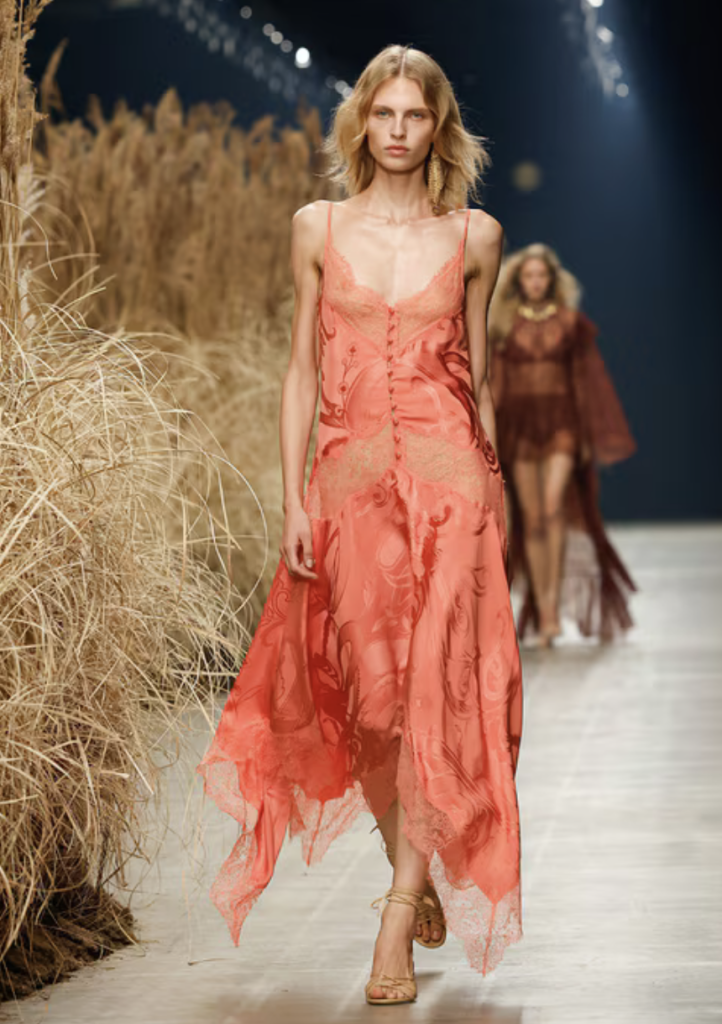
Photo via etro.com
The last movement of the show darkened into chocolate brown, aubergine, and espresso, tailoring falling away almost entirely in favor of bias-cut satin slips, sheer mesh gowns, and trailing chiffon trains finished with fine threads of lurex that caught the spotlight only in brief, deliberate flashes rather than any constant shine. A deep brown oversized blazer and matching wide-leg trouser set appeared in this closing stretch, worn open over a sheer paisley bra top and a sarong-style wrap tied loosely at the hip, the structure of that suiting against the softness underneath carrying the same contrast the whole collection had been building toward from its very first look. The final three looks closed the whole show on a genuinely cohesive note, tailored trousers paired with soft, draped tops, a coral slip dress finished in a scalloped lace hem and handkerchief-style points, the paisley print swirling across the fabric in that same faded, sun-washed wash running through the entire collection, and finally a brown lace dress to close, quiet and dark enough to read as true dusk after everything that came before it.
Accessories, Shoes, and Beauty
Accessories throughout the show stayed deliberately tactile and slouchy rather than polished or structured. Large, unlined suede shoulder bags were carried folded casually under the arm, alongside smaller shearling top-handle bags and a leopard-print velvet carryall that introduced a different kind of texture against all that blurred paisley. Jewelry carried real sculptural weight against the sheerer fabrics, oversized tribal-inspired collar necklaces in burnished metal, wide cuffs, and long feather drop earrings that framed the face and sat right at the collarbone. Several looks carried tinted sunglasses in translucent shades, functioning almost like colored filters over the whole presentation, reinforcing that sun-drenched concept running through the entire show.
Footwear stayed flat and grounded throughout, lace-up gladiator sandals winding up the shin, soft leather ballet flats, and minimal flat sandals, all chosen specifically so the floor-length gowns and trains never tipped into formal eveningwear territory. That choice kept even the most elaborate dresses feeling walkable and easy rather than precious, which lines up with how relaxed the whole collection felt from its first look to its last.
The Close
Etro has always had a particular way of making maximalism feel personal rather than overwhelming, and this collection proves that quality survives even with an entirely new team steering it. What makes Halo work so well is how disciplined the actual execution is underneath all that softness, the paisley never abandoned, only reworked, embossed into suede, faded into near-invisible watermarks on chiffon, or lit up with lurex in the darkest evening pieces. Every single phase of the show ties back to that single idea of tracking one day’s light from morning into night, and the fact that something this conceptually tight can still feel this wearable, this easy to actually imagine putting on, says a great deal about how carefully the in-house team thought this whole collection through.
There is something genuinely moving about watching a house find its footing again after this much institutional change, a departed creative director, a family stepping away from the brand they built, a difficult financial year, and still produce a collection this confident and this fully itself. Etro has always occupied a very specific, very personal place in how some people experience fashion, somewhere between pure visual pleasure and something closer to emotional connection, and this collection earns that feeling honestly, through real craft rather than nostalgia alone. From that very first ruffled, high-necked gown through to the final brown lace look closing out the night, this is a house that still feels true to itself and I absolutely adore it.