
By Gabriela Afanador
Sunday 27, September 2026
Domenico Dolce and Stefano Gabbana showed Stravaganza Siciliana on September 26 in Milan, staged inside the Metropol on Viale Piave, the historic cinema the house has used as its permanent venue since 2005. Rather than building a physical set, the production wrapped the entire room in massive LED screens projecting the interiors of a grand Sicilian palazzo, frescoed ceilings, gilded stucco, heavy damask curtains, crystal chandeliers, so the former cinema became an aristocratic salon entirely through light and image rather than built architecture. Before any music played, the show opened with a deadpan spoken word monologue describing women digging through generations of inherited wardrobes, closing on the line that became the collection’s thesis: today, true extravagance is to be unrepeatable. From there the soundtrack moved into orchestral passages with classical motifs running through it, layered against Mediterranean percussion, tracking the show’s own movement from solemn family inheritance toward something looser and more street facing by the end.
The Collection
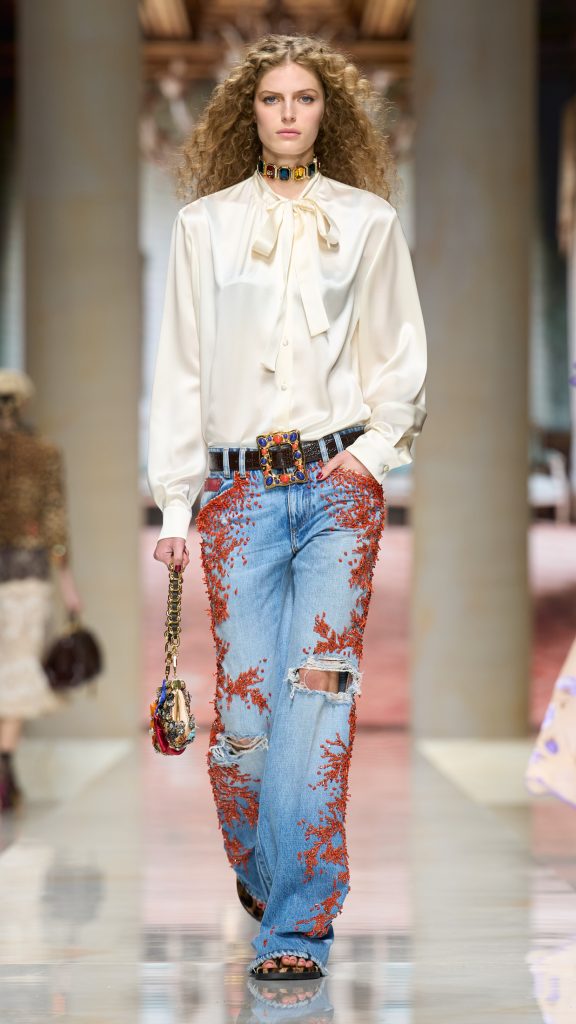
Photo via dolcegabbana.com
The whole collection is built around a single literary reference, Giuseppe Tomasi di Lampedusa’s 1958 novel The Leopard, and specifically its most famous line, that if things are to stay as they are, things will have to change. Dolce and Gabbana used that paradox as an actual working method rather than a loose theme. Preserving the house’s own canonical codes, black lace, corsetry, leopard print, sharp Mediterranean tailoring, meant stripping them of their usual reverence and letting them be handled roughly, mixed, and reworn the way an actual family passes clothes down across generations rather than preserving them behind glass.
The structure they built imagines one shared wardrobe passed down through four generations of women, each contributing a different material layer rather than a separate, isolated look. The great-grandmother supplies the dowry chest, turn of the century trousseau linens, eyelet cutwork, hand worked bobbin lace. The grandmother contributes post-war furnishing damask, passementerie trim, and structured suiting pulled from an aristocratic household rather than a dressmaker. The mother brings 1970s flares, rose printed chiffon, and glamorous fur trimmed outerwear. And the daughter disrupts all of it with distressed denim, visible logo underwear, and a general attitude of not caring too much, layering her own grandmother’s lace over a pair of jeans without asking permission first. That layering logic runs through literally every look in the show, which is why so much of the collection reads as personally assembled rather than designed in the traditional sense.
The Clothes
The eighty-one look show moved through four clear acts, and each one carries its own distinct material identity even as the generational mixing continues throughout. Act One opened the show on trousseau whites and deconstructed denim, establishing the whole premise immediately. Look one came down the runway in a sleeveless ivory tunic built from heirloom bobbin lace, cut with geometric openwork panels and floral rosettes, worn over sheer underwear with flat embroidered velvet slippers and stacked turquoise amulets, immediately setting the tone of unstudied, inherited dressing rather than anything polished or deliberate looking. From there the section moved into pieces like a pale denim jacket scattered with embroidered floral sprays, worn over an eyelet embroidered white linen circle skirt and anchored with a wide leather belt finished in a lapis lazuli and gold filigree buckle, the kind of belt buckle treatment that recurs across the whole show as a connecting thread.
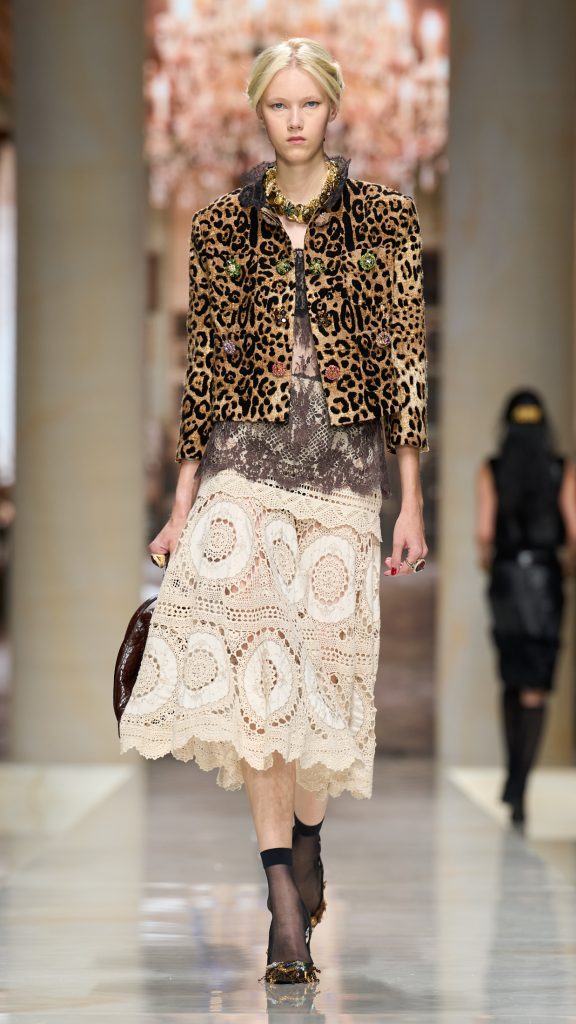
Photo via dolcegabbana.com
That same belt logic shows up again in a white eyelet cutwork midi skirt paired with a sheer black and gold polka dot blouse, its oversized pussy bow collar and bishop sleeves cinched at the waist with a thick crocodile embossed belt set with a turquoise and lapis jeweled buckle. The skirt’s cutwork is genuinely intricate, scrolling floral openwork cut directly into crisp white linen rather than appliquéd on top of it, giving the whole lower half real movement and transparency against the structured, high necked blouse above it. Sheer black hosiery and gold jeweled sandals finish the look, and the whole combination captures exactly what Act One was doing, pairing a genuinely antique textile technique against a blouse that reads almost contemporary in its proportions.
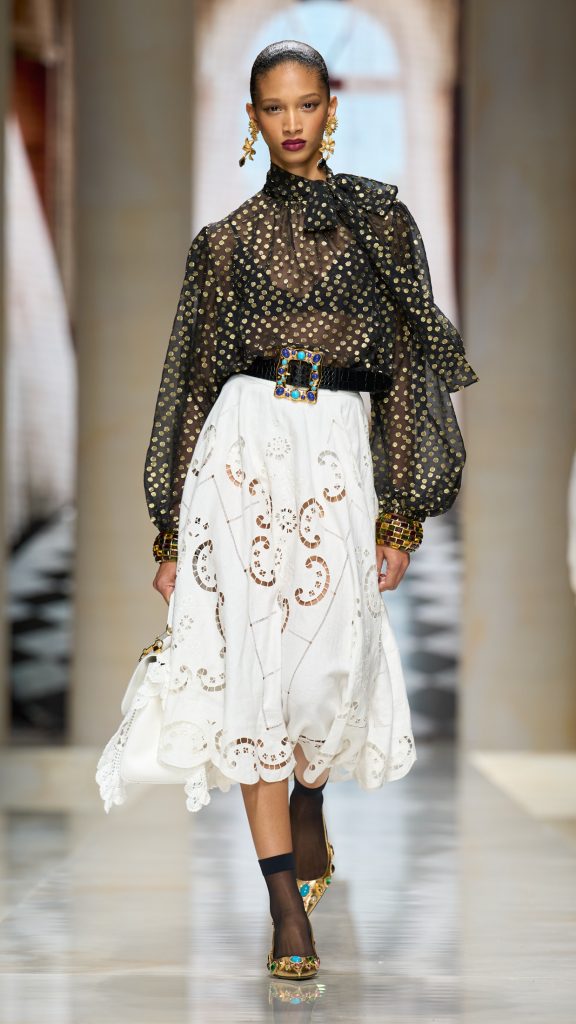
Photo via dolcegabbana.com
Act Two brought in color, pattern mixing, and the collection’s handcrafted crochet work, which became one of its most technically impressive threads. Short shift dresses built entirely from three dimensional, multicolored crochet flowers appeared here, alongside cream crochet cardigans cropped short and worn over black lace bras. The denim in this section carried the show’s most elaborate embellishment. One look pairs a cream silk blouse, its pussy bow tied loosely at the throat, with wide leg, light wash jeans scattered with clusters of hand embroidered red glass coral beadwork climbing up one thigh and across the hip, the beading dense enough in places to read almost like coral growing directly out of the denim. A jeweled crocodile belt with a square lapis and coral buckle cinches the waist, and the whole look carries a small, beaded evening bag that looks almost like a piece of jewelry in its own right. This is really where the collection’s central idea shows up most clearly in a single garment, since denim, the most ordinary fabric imaginable, gets treated with the same hand embroidery technique usually reserved for couture eveningwear.
Act Three moved the whole show into its most opulent stretch, built around heavy furnishing textiles and the house’s signature leopard print. Damasks and passementerie braiding were tailored directly into blazers, capes, and pencil skirts here, treating upholstery fabric as something to be worn rather than draped over furniture. One cropped leopard velvet jacket from this section is finished with jewel toned buttons in green, pink, and amber, each one set like a small brooch down the front placket, worn over a lace and crochet midi skirt built from concentric circular lace medallions stitched into a scalloped hem, with a deep plum lace camisole visible underneath. A gold statement necklace, sheer black hosiery, and crystal embellished pumps finish the look, and the combination of that structured, jeweled jacket against such a soft, open work skirt captures the generational mixing at the heart of the whole collection almost perfectly, grandmother’s upholstery meeting great-grandmother’s lace in one outfit.
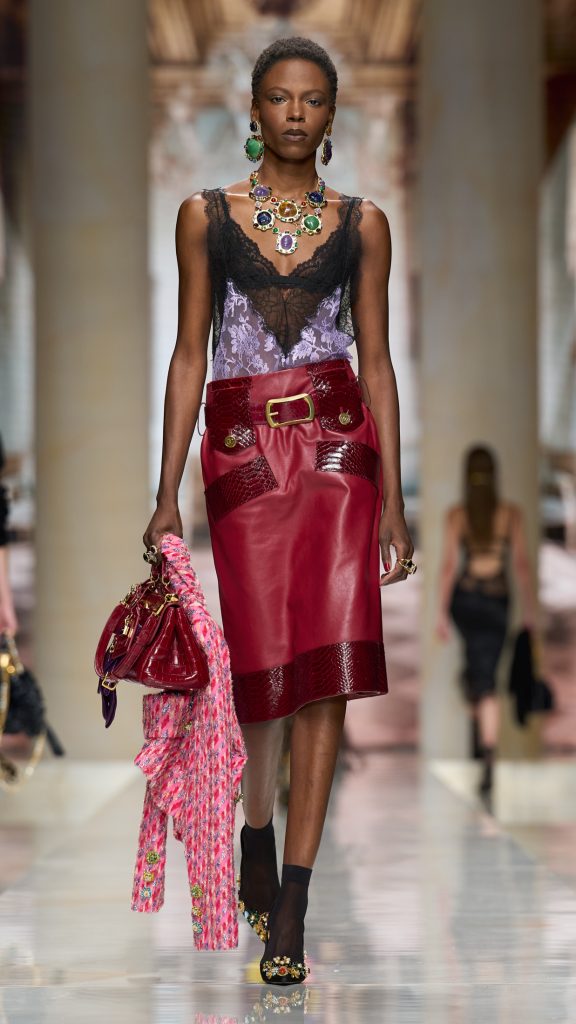
Photo via dolcegabbana.com
Elsewhere in this same act, a burgundy leather pencil skirt panelled in deep red python appears, cinched with a thick snakeskin belt and a sculptural gold buckle, worn with a lavender floral lace and black lace layered camisole underneath, styled with a stack of jewel toned statement necklaces in amethyst, emerald, and amber, oversized gold and gemstone drop earrings, and a cherry red crocodile handbag carried alongside a pink tweed jacket simply draped over the arm rather than worn. That jacket left unworn is a small detail, but it reinforces the whole premise of the show, clothes treated as an accumulated personal collection rather than a single coordinated outfit, something picked up and carried rather than formally put on.
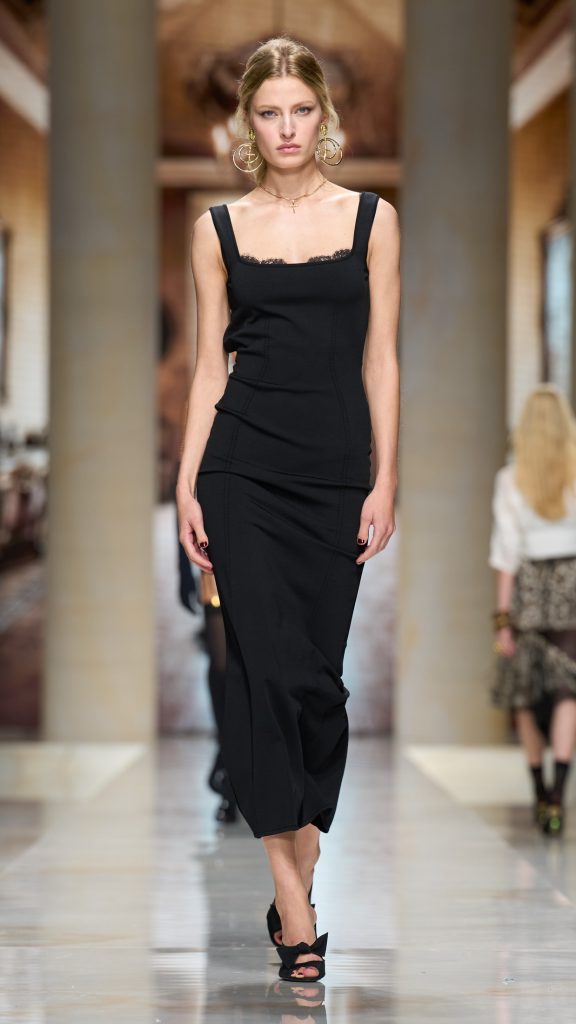
Photo via dolcegabbana.com
Act Four closed the show on a full return to black, interpreting traditional Sicilian mourning dress through sheer, contemporary layering rather than anything somber or literal. Chiffon tea dresses printed with crimson roses and sheer black organza scattered with white peonies moved through this closing section, before the show resolved into its final black exits. One of the cleanest looks in this stretch is a simple black sheath dress, square necked with a narrow lace trim along the bust, fitted close through the body with visible seaming down the torso and a slit opening at the hem, worn with gold double hoop earrings and a delicate gold cross necklace. After the elaborate embroidery, beading, and layering running through the rest of the show, a look this restrained reads as a genuine pause, proof that the collection’s central black still works at its most stripped back, without any of the ornamentation carrying the rest of the show. The finale look closed the whole presentation in gossamer Chantilly and macramé lace, finished with a devotional rosary belt built from cast metal ex-voto hearts and cascading pearls, a direct, literal callback to the religious iconography that had been running underneath the whole collection from the very first look.
Throughout all four acts, the tailoring itself underwent real technical change. The house’s signature jacket was rebuilt from the inside out, stripped of its horsehair canvas and internal padding so it moved with the ease of an unlined shirt rather than holding a fixed shape, the hourglass waist now achieved purely through cutting and dart placement rather than internal boning. Trousers shifted away from the brand’s usual narrow cigarette cut into genuine 1970s flares and wide leg denim, giving the whole lower half of the show a much looser, more relaxed silhouette than Dolce & Gabbana has typically shown. Lingerie moved outward too, worn over tailoring rather than hidden beneath it throughout the whole collection, visible bra straps and branded waistbands treated as structural parts of a daytime outfit rather than something private.
Footwear and jewelry followed the same layered, personal logic as everything else. Flat embroidered velvet slippers and soft satin ballet flats grounded even the most elaborate evening looks, while leopard print kitten heels covered in crocheted floral rosettes and jeweled slingbacks mixed freely with practical red leather ankle boots throughout the show, nothing treated as too precious to pair with something casual. Jewelry leaned heavily on church and palazzo iconography, layered gold filigree chains, carved coral branches, chandelier style drop earrings, and devotional belts fitted with ex-voto sacred hearts.
The Close
What makes this collection work as a whole is how thoroughly the construction supports the story being told, since this is not a collection where heritage sits only on the surface. The jacket’s internal rebuild, the hand embroidery on actual denim, the real antique lace mixed against real upholstery damask, all of it is doing the same work the styling is doing, making the idea of inherited clothing feel structurally true rather than just stated in a program note. The four act structure gives the whole show real pacing too, moving from the quiet trousseau whites of the opening through color and crochet, into the richest, most jeweled stretch of the collection, before resolving back into black by the end, so the whole eighty-one look presentation reads like one continuous story rather than four disconnected moods stitched together.
What stays with me most is how much genuine craft sits inside even the smallest details, the coral beadwork climbing up a pair of jeans, the circular lace medallions on that midi skirt, the cast metal rosary belt closing the whole show. This is a collection that trusts its own history enough to let it get a little messy, lace worn with denim, upholstery worn as outerwear, a tweed jacket simply carried instead of worn, and that trust is really what makes the whole thing feel alive rather than like a careful museum recreation of what Dolce & Gabbana has always been.