
By Gabriela Afanador
Friday 2, April 2026
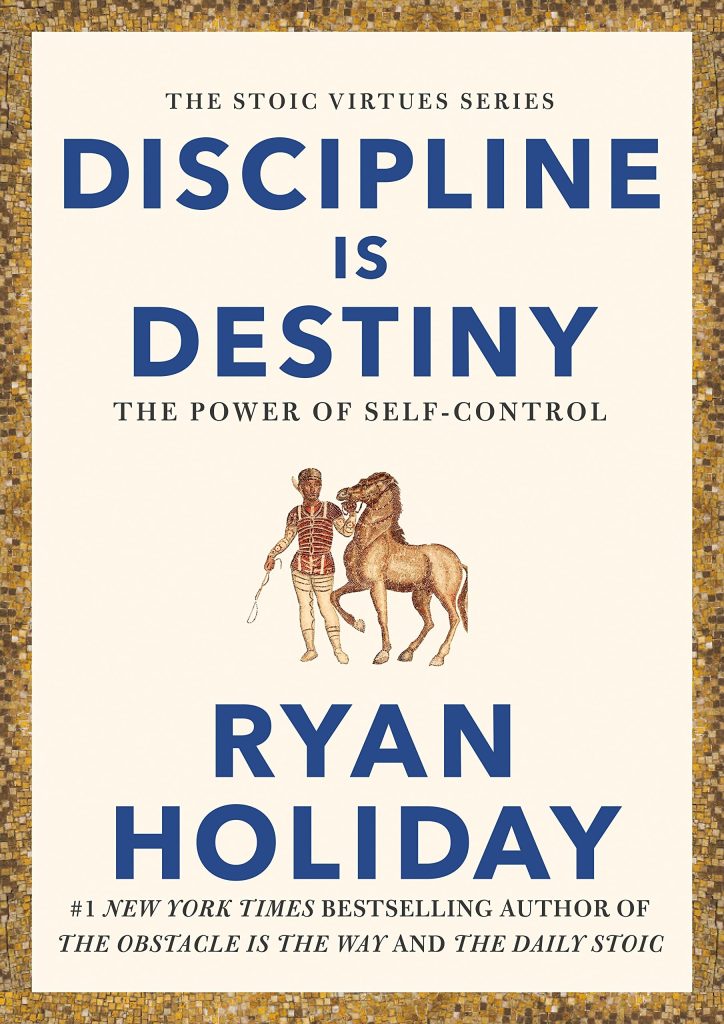
I started Discipline Is Destiny at a time when my days felt full in the modern way, full of notifications, full of movement, full of small tasks, full of input, and yet strangely thin when it came to the kind of depth that actually changes you, because it is possible to be busy and still feel like you are not truly directing your own life. That was the question sitting under everything for me while I read, not a dramatic question, but a quiet one that keeps showing up when you are honest with yourself, because you can know exactly what would improve your life and still struggle to do it consistently, and you can want discipline while also living in an environment designed to dissolve it.
Ryan Holiday does not approach discipline as a trend or a personality type, and he does not treat it like a mood you either have or you do not have, because the book insists that discipline is a virtue, and a virtue is something you practice until it becomes part of your character, which is exactly why the book is structured around three layers of a person. He begins with the body because the body is where your choices become visible and measurable, then he moves into temperament because temperament is where most people lose themselves in the heat of a moment, and finally he ends with what he calls the soul because there is a level of discipline that goes beyond productivity and touches the way you carry yourself when nobody is watching and when life is not cooperating.
The body as the foundation of self control
The first part is the section people often misunderstand because when they hear discipline and body they assume it is a shallow conversation, but Holiday makes it clear that the body is not about appearance, the body is about capacity, and capacity is what determines whether your intentions can become reality, because an exhausted person with chaotic habits is not just tired, that person is also more reactive, more impatient, more impulsive, and more likely to betray their own standards without even realizing they are doing it. In other words, a life that feels undisciplined is often a life built on an unstable foundation, where sleep, nutrition, movement, and routine are inconsistent, and then the person tries to solve it with motivation even though motivation is fragile when the system underneath is broken.
One of the most effective choices Holiday makes early in the book is bringing in Lou Gehrig, not because the story is glamorous, but because it carries a kind of seriousness that forces the reader to stop romanticizing discipline. Gehrig became a legend for his consistency, for his reliability, for being the person who showed up and delivered again and again, and the weight of his story increases when you remember that his body eventually failed him and that his strength was not something he could hold forever. The lesson is not fear and the lesson is not panic, the lesson is clarity, because if the body is the instrument through which you live, then caring for it is not vanity, it is respect for your own future, and it is a recognition that your ability to execute, to endure, and to stay clear under pressure is something you build, protect, and cannot take for granted.
That foundation leads naturally into the idea of mornings, and the book uses Toni Morrison in a way that feels grounded rather than performative, because Morrison did not wake early as a branding decision, she woke early because those hours gave her a rare kind of freedom, the freedom of having a mind that was not yet being pulled by other people’s needs, other people’s expectations, and other people’s urgency. This matters because so many people live without a single part of the day that belongs to them, and when your day begins in reaction, the rest of the day usually stays reactive, while a day that begins with ownership tends to carry a different texture, a slightly calmer focus, and a stronger sense of direction.
Holiday also spends time on what he calls the superfluous, and this is where the book becomes unexpectedly modern, because he is describing the psychological vulnerability created by wanting more than you need, since excess trains dependency and dependency makes you fragile. When comfort becomes non negotiable, discomfort starts to feel like danger, and when stimulation becomes constant, silence starts to feel unbearable, so the reader is pushed to question not only what they consume physically, but also what they consume mentally, because clutter is not only on a desk or in a room, clutter also lives in open tabs, unfinished decisions, and constant input that prevents deep thought from forming.
The examples in this section work best when you read them as symbols rather than as trivia, because when Holiday brings up a figure like Robert Moses, the point is not to admire him as a person, the point is to highlight a certain operational discipline, which is the discipline of not letting tasks pile up until they become psychological weight, and the discipline of addressing what arrives rather than collecting chaos and calling it normal. This connects to the broader idea that discipline is often the removal of friction, because the less you delay decisions and the less you allow clutter to grow, the more mental capacity you recover for the work and relationships that actually matter.
The first part also includes the kind of discipline that feels unglamorous but quietly decisive, which is the discipline of pace, because urgency without control becomes sloppiness, and sloppiness creates rework, frustration, injury, and wasted time, while a measured intensity tends to last longer and produce cleaner results. That is why the book keeps returning to practice, not practice as inspiration, but practice as repetition that turns effort into second nature, and that repetition is what eventually produces fluency and competence, which are far more reliable than motivation.
This section ends on a point that I think more discipline books should emphasize, which is that rest and sleep are not a reward for discipline, they are part of discipline, because sleep protects your judgment, your patience, your emotional regulation, and your ability to choose well when you are stressed, and that ability is exactly what discipline is meant to strengthen. If you consistently deprive yourself of sleep and recovery, you might still call yourself disciplined, but you are slowly removing the very capacity that makes disciplined choices possible.
The second part is where the book becomes deeply applicable to modern life, because it deals with what happens inside you when discomfort appears, when someone provokes you, when your ego gets touched, when pain shows up, when pleasure invites you to abandon your standards, and when your nervous system wants the quickest exit from feeling anything unpleasant. Holiday treats pain and pleasure as two tests of the same skill, because pain can become information rather than identity, and pleasure can become something you enjoy without allowing it to control you, but both require the same inner mechanism, which is the ability to pause long enough to choose a response that you can respect later.
Temperament and the discipline of the pause
This is also where Holiday’s writing feels most truthful, because the biggest mistakes people make are rarely the result of not knowing better, they are the result of losing themselves for a few seconds, and those few seconds can change relationships, careers, reputations, and self respect. The pause is what interrupts the reflex to react, defend, attack, overshare, and escalate, and the pause is what allows your higher standards to arrive before your lower impulses take the wheel. In a culture trained to perform emotions instantly, the pause becomes a form of power, because it refuses to trade dignity for a moment of release.
Silence appears here as a discipline that many people underestimate, because silence is not only restraint, silence is also strategy, and silence is often the difference between a conflict that grows and a conflict that dissolves. The book pushes the reader to recognize that speaking quickly is often driven by anxiety rather than truth, and that the disciplined person is not the one who always has something to say, but the one who can hold their center while other people attempt to pull them out of it.
Holiday also connects discipline to time and money in a way that feels psychologically accurate, because money decisions are rarely purely rational, they often involve fear, validation, control, shame, or temporary comfort, while time is the most honest currency because time is the substance your life is made of. When you spend time carelessly, you are not merely wasting minutes, you are trading portions of your life for things that do not deserve that price, and the book encourages a kind of seriousness about attention, because attention is what shapes who you become.
By the end of this section, discipline feels less like self denial and more like self governance, because it becomes clear that if you do not decide what matters, the world will decide for you, and you will wake up one day with a life built out of other people’s priorities, other people’s urgency, and other people’s noise.
The soul and the difference between discipline and harshness
The third part shifts from self control as a tool to discipline as character, which is where the book becomes quietly intense, because character is what remains when the environment stops rewarding you, when the results take longer than expected, when people misunderstand you, when there is pressure, and when nobody is clapping. Holiday leans into the idea that discipline is not only private, it becomes visible in how you treat others, how you handle responsibility, and how you carry your standards under stress, and he returns to stoic examples to show that true steadiness is calm, not performative, and strong, not loud.
One of the most important ideas here is the balance between being strict with yourself and patient with others, because many people turn discipline into a weapon, either against themselves through harsh self talk, or against others through judgment and rigidity, and Holiday makes room for a more mature version of discipline, where the standard stays high but the cruelty disappears. This is where kindness toward yourself becomes essential, because if your inner voice is tyrannical, discipline becomes brittle and eventually collapses, while a stable inner voice can correct, adjust, and return to the standard without needing shame as fuel.
The book also treats retreat and flexibility as disciplines, because wisdom includes knowing when persistence has turned into pride, and strength includes adapting without losing principles. Flexibility is not the opposite of discipline, flexibility is often what allows discipline to survive across changing seasons, changing responsibilities, and changing circumstances, because a rigid person breaks when reality shifts, while a disciplined person adjusts and continues.
What I took from the book and what I think is worth applying
When I finished Discipline Is Destiny, I was left with a different way of evaluating myself, because the book slowly turns discipline into a single question, which is whether I can rely on myself. That question becomes real in the smallest moments, when you decide whether to scroll or to sleep, whether to react or to pause, whether to indulge or to stop, whether to delay or to act, whether to continue negotiating with your own standards or to finally hold them.
The most practical way to apply the book is to choose one small non negotiable and treat it as a daily vote for the person you want to be, because discipline grows through consistency, not intensity, and one non negotiable creates a ripple effect that strengthens everything else. For some people that might mean protecting sleep, because sleep protects judgment, and judgment protects character. For others it might mean reclaiming the morning, because a day that begins with ownership tends to carry more clarity. For others it might mean practicing the pause before responding, because the pause prevents you from turning emotion into damage. For others it might mean removing one superfluous habit that has more power over them than they want to admit, because freedom begins when nothing external can command you.
Holiday’s tone stays calm throughout the book, and that calm is part of the persuasion, because he is not shouting at the reader, he is reminding the reader, and reminders are often what people need when they are living in a culture that constantly invites them to forget. Discipline is not about becoming extreme, it is about becoming steady, and steadiness is what makes a life feel intentional instead of accidental.
If you enjoyed this article, I genuinely recommend reading the book in full, because there is something different about meeting the ideas directly on the page and letting them shape the way you make choices, especially in the moments where your impulse and your standards collide