
By Gabriela Afanador
Friday 10, July 2026
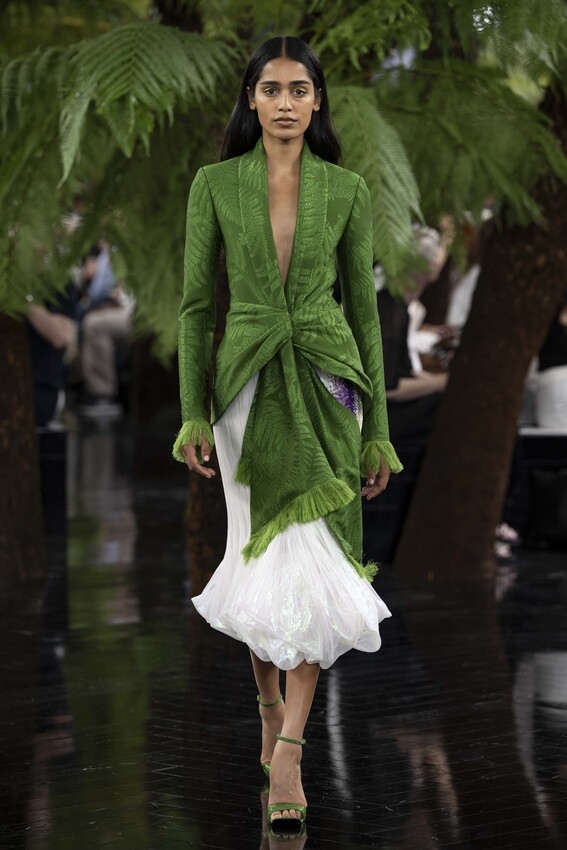
Photo: firstVIEW
Jonathan Anderson arrived at the Musée Rodin on July 7th with his second haute couture collection for Dior and immediately made it clear that he had no intention of coasting on the considerable goodwill the house had generated in the preceding seventy-two hours. Three days before the show, Anderson had dressed both Taylor Swift and Travis Kelce in custom Dior haute couture for their wedding, a commission that generated fifteen million dollars in media impact value over the July Fourth weekend according to Launchmetrics and that had the entire industry talking about romance and bridal and the particular kind of cultural moment that only a Taylor Swift wedding can produce. Asked about it backstage before the show, Anderson said only that it had been a big honor and a joy, that they had become very good friends, and that it was an emotional thing to dress someone for their wedding. Then he steered the conversation back to where his attention actually was, the personal obsessions that had been feeding into the collection for months, and which had nothing to do with romance or fairy tales or anything the internet had spent the previous week projecting onto the house. The collection he presented that afternoon was cerebral and material and rigorously conceptual, a deliberate pivot toward something considerably more demanding, and it was one of the more confident statements of creative independence a designer has made from within a major couture house in recent memory.
The invitation arrived in a white Dior box containing an anonymous black fan, which in the heat of a Paris summer could have been read as a practical gesture and turned out to be the conceptual key to the entire collection. The show was staged inside a black-lacquered wooden pavilion built in the gardens of the Musée Rodin, surrounded by deep green foliage and oversized ferns that transformed the space into a lush, dense, almost tropical environment, guests including Sabrina Carpenter, Pharrell, and Naomi Watts seated inside while paper fans moved through the July heat before the first model appeared. The fan proved to be one of the collection’s most persistent structural ideas, a piece of engineering that turns a flat plane into a three-dimensional gesture, which is also what a pleat does and what a knot does and what couture at its most fundamental level does to fabric, and Anderson used that connection as the conceptual architecture of everything that followed. The black lacquer of the pavilion against the intense green of the surrounding gardens created a stark, almost theatrical contrast that set the visual tone before the clothes arrived, the environment suggesting that something both natural and constructed was happening simultaneously, which is a precise description of what couture is.
The starting point was American sculptor Lynda Benglis, whose work Anderson has been drawn to for years and with whom he worked extensively during his Loewe tenure, commissioning a jewelry collection, a campaign, and featuring her metal sculptures on that house’s runway. Benglis has spent five decades collapsing the distance between material and form, beginning with flat planes of latex, beeswax, porcelain, or metallic fabric and transforming them through knotting, pouring, pleating, and moulding into objects that retain the memory of their original flatness while existing as genuinely three-dimensional structures. At Dior the collaboration deepened considerably, with Benglis contributing several bags shown in the collection and the exhibition Grammar of Forms, which ran at the Musée Rodin from July 7th through the 12th, bringing together pieces from the new collection alongside Dior archive pieces and Benglis artworks, some of which were being shown in France for the first time. Rather than dismantling the show set after the presentation, Dior converted it into a gallery where the sculptor’s works and the couture that answered them occupied the same space, the two bodies of work visible together making the translation between them a subject in its own right rather than simply a backstory. It was a telling gesture about how Anderson understands the relationship between art and fashion, not as inspiration and response but as genuine dialogue, the couture and the sculpture in conversation rather than one serving the other.
Benglis described her own studio practice as a laboratory, a place where she is deeply involved in making things and where form is not simply reproduced but discovered, and Anderson borrowed that framework directly, positioning the Dior atelier as the same kind of place for this collection. It is an interesting and demanding reframing of what a couture house is, not a workshop for producing beautiful clothes according to established standards but a space where the fundamental questions about how clothing acquires form are being asked from the beginning every season. The 66 looks that emerged from that framework were among the most intellectually serious and materially sophisticated of the couture season, and they were also genuinely beautiful, which is the hardest combination to achieve and the one Anderson is consistently managing to find.
The Clothes
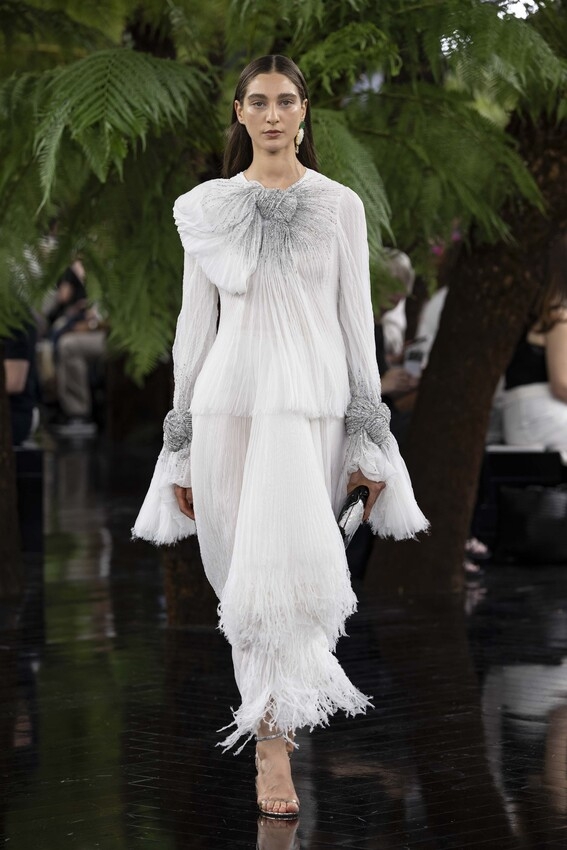
Photo: firstVIEW
The translation between Benglis’s work and the clothes was precise and sometimes remarkably direct, each major body of her work finding a specific material equivalent in the collection. Her pleated metallic Goliath sculpture, a compressed and folded mass of lamé that looks almost like something spilled and then frozen in motion, was rendered as a silver lamé dress draped and gathered into an enormous bow, the tension of the original material translated into the tension of a garment holding its own weight in a different form. The bow was enormous and architectural, the lamé catching the light of the afternoon in shifting silver and gray tones, and the silhouette it produced was genuinely unlike anything in the Dior archive while still reading as a Dior garment, the couture vocabulary present in the construction and the scale even as the specific gesture was entirely new.
Her Sparkle Knots and chicken wire sculptures, abstract constructions built from wire shaped into organic forms, became skirts made from soft silver netting patched with metallic fabric and layers of chiffon, the industrial material of the original replaced by something that moved and caught light in a way the wire never could while preserving the structural logic of the original entirely. These silver netting skirts were among the collection’s most immediately arresting pieces, the surface neither fully opaque nor fully transparent, the metallic patches catching the light differently from the netting and the chiffon, the whole thing shifting and alive as the models walked through the garden pavilion. Worn with tailored jackets or structured tops they created combinations that sat at exactly the point where sculpture and clothing become difficult to distinguish from each other, which is where Anderson was working throughout the collection and which is where Benglis has spent her career.
The Bar jacket, Dior’s most enduring and recognizable silhouette, ran through the collection as a deliberate leitmotif, and the versions Anderson produced of it were among the season’s most compelling individual pieces. A fern green tweed iteration with fringe running along its edges and paired with a long white skirt was the look that arrived closest to what the house’s tailoring tradition has always been about and simultaneously the furthest from it in spirit, the green specific and unusual and deeply considered, the fringe adding kinetic movement to a silhouette that in its classic form is entirely still, and the white skirt beneath it providing the kind of clean contrast that allows a jacket to be read as completely as possible. It was the combination most directly referencing the house’s own codes while feeling entirely free of nostalgia, the Bar jacket as something a woman would actually want to wear right now rather than something the house is preserving for its historical significance. The green was the particular fern green of the surrounding foliage, connecting the garment to the environment it was shown in and making the relationship between the clothes and the garden space feel deliberate rather than incidental.
Another Bar jacket variant appeared in a speckled TV static gray that dissolved at its lower hem into a vaporous white chiffon, the tailored upper half giving way to something almost weightless at the base, the transition between the two registers happening so gradually that the garment appeared to dematerialise as it moved. Standing collars fanned out behind the neck on several versions, the collar doing what the invitation’s fan had promised, turning a flat plane into a three-dimensional gesture directly at the most visible point of the garment. A featherweight knitted Bar jacket with a matching skirt was one of the collection’s most understated and wearable pieces, the knit giving the classic silhouette a softness and ease that the tailored versions cannot provide and that shifted the jacket from an architectural object into something more intimate and everyday. Threads of chiffon fell from tailored hems throughout the lineup. Fluted jackets moved above narrow trousers and skirts. The silhouettes were consistent without being repetitive, each iteration of the same basic structure arriving at something new through the choice of material or the handling of the hem or the treatment of the collar.
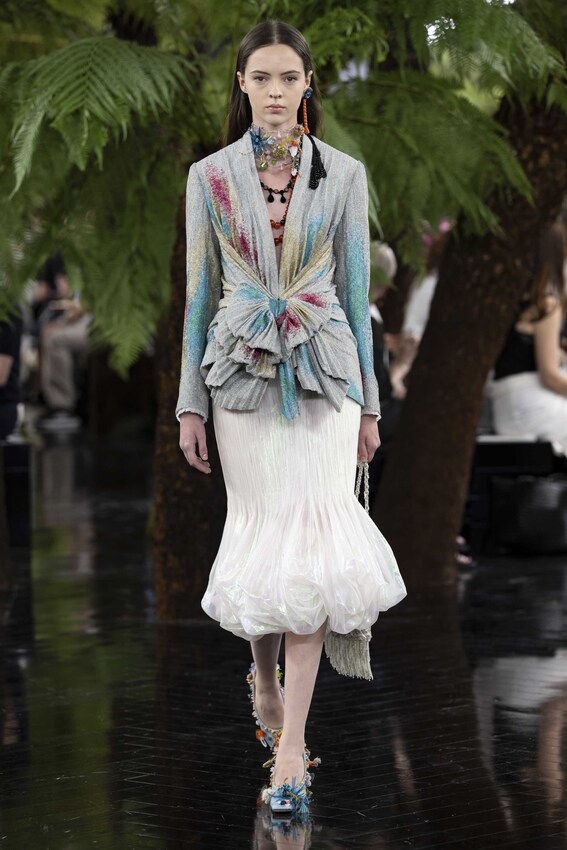
Photo: firstVIEW
Her Zanzidae Peacock series, fan-shaped works that reference her deep connection to India and to the country’s textile and craft traditions, returned as fan-shaped tulle stitched onto dresses and completed with embroidery and carefully arranged colors that mirrored the original pieces, beaded ornaments placed across silk dresses and at the hip in compositions that carried the same formal logic as the sculptures without copying their specific shapes. The relationship between Benglis and India informed some of the collection’s richest material decisions, fragments of eighteenth-century Indian chintz appearing across several pieces and bringing with them a completely different textural and historical register than the metallic and synthetic materials elsewhere in the collection. The chintz arrived not as a decorative surface but as a structural element, its pattern and weight contributing to the behavior of the garment in a way that made the historical material feel entirely contemporary rather than archival.
Checked suiting appeared in lightened and twisted forms that had almost forgotten their menswear origins, the pattern familiar enough to read immediately and the construction strange enough to make you look twice. Body-skimming silk satin gowns moved through the evening section of the lineup alongside blousons and skirt separates built with delicate layers of ruffles that bounced as the models walked. Silver pleats burst from the body in sharp fan-like arcs on several pieces, the geometry precise and the movement unpredictable, the pleats holding their shape until they caught a breeze from the garden and shifted into something completely different. Molten-looking lamé gowns in both silver and copper moved with the models in a way that made the fabric appear liquid rather than woven, the surface catching and releasing light as though it were actually in motion regardless of whether the wearer was moving or still. Metallic surfaces throughout the collection appeared hammered or crumpled, the finish irregular and alive, recalling the compressed metal of Benglis’s sculpture without imitating it directly. Paper-like textiles held their shape with a dry, irregular quality that made them read as objects that had been forced into three dimensions against their nature.
The Archival Conversation
Anderson opened a conversation within the collection not just between himself and Benglis but between Benglis and Christian Dior himself, and it was one of the season’s more quietly interesting threads. Dior’s scarlet Arizona trapeze coat from 1948, one of the house’s most iconic postwar silhouettes, was given the pleating treatment, the coat’s original clean architectural lines opened up and multiplied through fold after fold until the garment carried a completely different energy while remaining legible as the thing it had always been. The red was the original’s red, the volume was the original’s volume, and everything else was new. The shared love of nature between Benglis and the founder, Monsieur Dior’s famous devotion to flowers and gardens finding an echo in the artist’s own sustained engagement with organic and botanical form, produced some of the collection’s most textural pieces, dresses and coats surfaced with wildflower meadow embroidery that read from a distance as pattern and revealed themselves on closer inspection as genuinely three-dimensional, the embroidery building outward from the fabric rather than sitting flat against it in a way that connected to the botanical overgrowth of the garden setting around them.
Benglis’s most notorious image, the 1974 Artforum advertisement in which she appeared nude, wearing white sunglasses and holding an oversize dildo between her thighs, an act of deliberate and effective provocation that remains as charged now as it was then, was rendered as a holographic outline on a beaded look Anderson titled Mirage. It is the kind of reference that requires confidence to include in a couture collection, the original image still sufficiently confrontational that translating it into fashion risks either defusing the provocation or amplifying it into something gratuitous, and Anderson walked that line precisely, the holographic rendering ghosting the image into the surface of the beadwork in a way that required the viewer to know what they were looking at, the reference visible to anyone who recognized it and invisible to anyone who did not. It is the kind of detail that separates a collection built on genuine intellectual engagement from one built on aesthetic borrowing, the difference between an artist whose work you understand and one whose images you find beautiful.
The Grammar of Forms
The exhibition that followed the show extended the collection’s conversation into a form that a runway presentation cannot fully achieve. Grammar of Forms brought together the new couture pieces, Dior archive pieces, and Benglis artworks in the same garden space where the show had been staged, the sculptures and the clothes sharing a room and making the translation between them visible in a way that the sequential experience of a runway show cannot. Several of the Benglis works had never been shown in France before, which meant the exhibition was also a genuine cultural event rather than simply a commercial extension of the show, the Musée Rodin gardens functioning as both fashion venue and art institution across the same week. The decision to present the collection and the exhibition together as a single connected project rather than as a show followed by promotional events is part of what makes Anderson’s approach to this house feel genuinely different from most creative director tenures, the thinking visible not just in the clothes but in the framework that surrounds them.
Anderson has now made two consecutive haute couture collections for Dior that hold to a standard of intellectual rigor and material seriousness without softening it for accessibility or commercial legibility. The collection’s intelligence does not prevent the clothes from being genuinely desirable, the fern green Bar jacket and white skirt, the silver lamé bow dress, the peacock-referencing beaded pieces, the silver netting skirts, are all objects that people will want to own and wear, but it does mean that the wanting comes from a more interesting place than the wanting that a more conventionally beautiful collection produces. What Anderson is building at this house is becoming clearer with each collection, a Dior defined by the intelligence of its making and the seriousness of its cultural engagement rather than by the romance of its history, and the second couture collection is a more confident and more complete expression of that vision than the first. The house has not felt this alive as a creative institution in a long time, and the collection made that case without having to announce it.