
By Gabriela Afanador
Thursday 26, March 2026
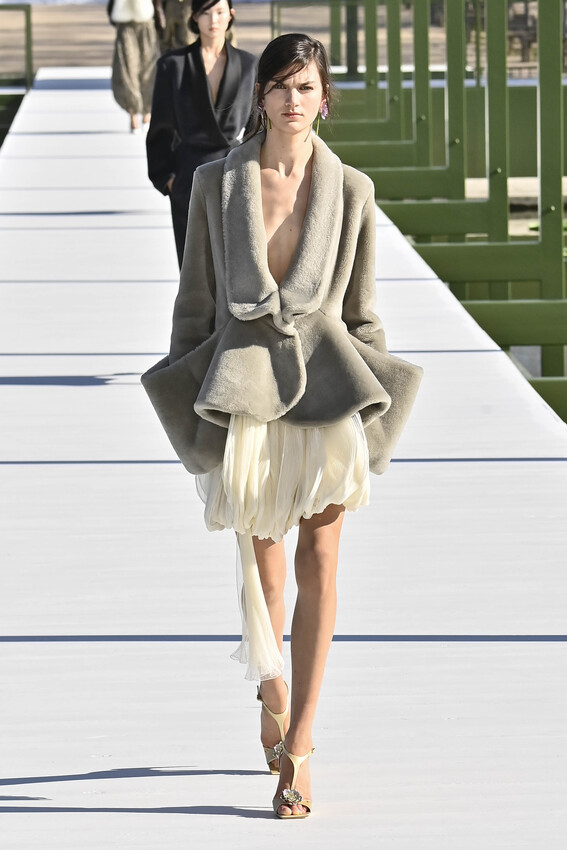
Photo: firstVIEW
Jonathan Anderson’s Dior for Autumn Winter 2026 did not arrive as a lecture or a slogan. It arrived as a scene. A woman walking through Paris, not trying to disappear, not asking to be understood, simply moving with the kind of certainty that makes strangers look twice. The collection treated clothing as public language, the kind you speak with your posture, your pace, and the way fabric reacts when you change direction. Dior has always been about silhouette and presence, but this season the idea felt more psychological. It was not only about what the clothes were, but about what they did when the body entered a space and claimed it.
The show took place in the Jardin des Tuileries, with a structure that felt like an airy greenhouse built around water. The setting was a park inside a park, familiar yet slightly unreal. Guests sat on miniature versions of the iconic green Paris chairs, which immediately grounded the fantasy in a real civic ritual. The runway crossed reflective surfaces and passed artificial water lilies that looked intentionally fabricated, almost too perfect, like nature rebuilt by a human hand. That choice mattered because it clarified the collection’s thesis. Dior is not trying to imitate nature. It is trying to engineer its effect. The light in the space did the rest. Daylight streamed through glass, bounced off water, hit satin and organza, and turned every movement into a small change in color. You could sense that Anderson designed for that exact lighting condition, for the way a garment looks when you catch it from the corner of your eye while walking.
Scenography aside, the clothes were the true architecture. The silhouettes were built with a firm core and soft edges, as if structure and air were negotiating in real time. There was a recurring contrast between tailored jackets and skirts that behaved like petals. The classic Dior idea of shaping the torso returned, but it was loosened. Instead of rigid control, the collection offered a controlled freedom. Peplums appeared again and again, but they did not feel like historical costumes. They curved outward like botanical forms, like orchids or calla lilies, creating volume that felt alive rather than sculpted into place. Even when a look looked precise, it moved.
The Bar jacket was present, but it was treated as a starting point rather than a shrine. One version read sharp and narrow with a high collar and a line of tiny buttons that turned the front into a kind of disciplined rhythm. Another was cropped and doubled, layered against soft clouds of tulle so the tailoring looked almost suspended. There were also moments where the Bar language was reduced into a satin mini suit, playful in proportion but still unmistakably Dior in posture. This is where Anderson’s approach felt most modern. He treated heritage as a material, not as a rule.
Fabric was the collection’s main tool for storytelling. Instead of winter heaviness, the materials felt lighter and brighter, as if the season was imagined through frost and morning air rather than through weight. Sheer organza appeared tied at the waist like transparent outerwear, catching light the way a thin layer of ice catches sun. Tulle came in cascades and fountains, sometimes short in the front and extended behind, creating a moving asymmetry that made the walk look choreographed without being theatrical. Brocades and jacquards shimmered like bark touched by light, giving the surface depth without relying on obvious shine. There were also moments of ruggedness that kept the collection from floating away. Tweed showed up as a grounding force, bringing a dry, tactile contrast to the airier materials and reminding you that this is still a wardrobe, not an installation.
Color followed the same logic as the set. The palette felt like a garden observed through changing perception. It was not saturated in a loud way. It was bright where it needed to be, then softened quickly. There were greys that read like stone, creams that read like light, and bursts of green that felt botanical rather than sporty. Pink and white appeared in a way that made volume feel fresh rather than sweet. When darker tones arrived, they did not turn the collection gothic. They acted like shadow in a landscape, giving depth so the lighter fabrics could look even more luminous.
The most provocative silhouette experiments were in the evening pieces and the way volume was handled. Bubble hems appeared, rounding the body into billowing shapes that flirted with excess but stayed controlled through proportion. Some skirts were shorter in front and longer behind, creating a tutu like trail that revealed shimmer at the hem when the model moved. A black and white tiered gown became a kind of climax, stacked in layers that looked geological, but still delicate because the edges and trims kept everything from turning heavy. This was volume designed to move, not volume designed to sit still.
Accessories carried the garden idea without becoming literal. Shoes became miniature sculptures. Heels and toes referenced lily pads and water lilies, but through construction rather than novelty. Satin petals appeared folded and painted, with small crystal details that suggested botanical anatomy without turning into costume jewelry. The heel shapes themselves felt engineered, sometimes convex, sometimes concave, giving the foot a slightly unfamiliar line that made the walk more noticeable. Boots stayed more classic, providing grounding against the more playful footwear moments.
Bags and accessories nodded to familiar Dior codes while shifting scale and attitude. The famous tote appeared in a smaller version with framed logos and a more graphic feel. There were playful objects too, including a frog shaped minaudiere that read like a wink at the pond setting without collapsing into gimmick. Hats and headpieces leaned refined, with berets, veils, and pearl details that framed faces like portraits, reinforcing the idea that the garden promenade is still a stage.
What made the collection convincing was its balance of the spectacular and the wearable. Anderson pulled formal Dior language into contact with more ordinary pieces and textures, like denim and practical outerwear shapes, not to be ironic but to make the couture heritage feel less distant. A great jacket paired with a worn in jean can be as Dior as a full skirt, if the line and the attitude are right. That was the underlying argument. Dior is not only for the grand entrance. Dior can be for the public walk, the everyday visibility, the moment you step outside and decide how you want to be read.
Autumn Winter 2026 did not feel like Dior trying to prove it was modern. It felt like Dior remembering that it has always been modern when it focuses on movement. A garden becomes a runway because people walk through it. Clothes become powerful because they change what a walk looks like. Anderson’s strongest move was to make the act of dressing feel like a form of choreography again. Not performance for the camera, but performance for real life.