
By Gabriela Afanador
Wednesday 7, October 2026
Matthieu Blazy showed his first anniversary collection for Chanel on October 5, staged at dusk beneath the glass and ironwork dome of the Grand Palais. The whole room was transformed into something closer to a sanctuary. Ninety five oversized golden bird sculptures, swifts, swallows, and wild geese caught mid-flight, hung suspended from the ceiling, lit from below so they glowed amber against the darkening sky visible through the glass roof above them. A massive illuminated moon hung over one end of the runway, and underfoot, the entire floor was surfaced in a multicolored stone mosaic designed to echo the village paths of Calabria in southern Italy, where Blazy spends his time between seasons. As the show moved forward, the light shifted with it, warm and golden at the start, deepening into a celestial indigo by the time the eveningwear came out, so the whole room moved through its own version of a day ending exactly the way the clothes did.
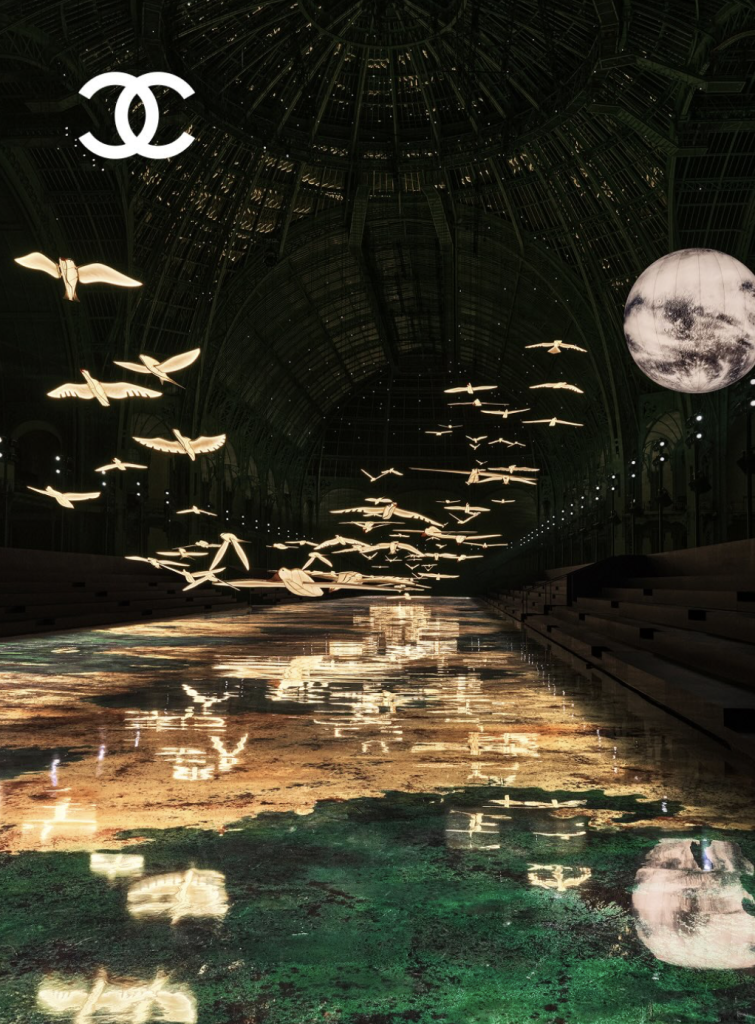
Photo via @Chanelofficial on Instagram
The sound mirrored that same arc. The show opened on ambient electronic textures layered under passages read aloud by Nicole Kidman from Virginia Woolf’s Orlando and To the Lighthouse, mixed with real birdsong and pieces of Camille Saint-Saëns’s The Carnival of the Animals. Partway through, the mood shifted entirely into a remix of a-ha’s Take On Me, before the whole thing closed on a mashup built around Britney Spears’s Gimme More, with Blazy running out onto the runway himself for his bow as it played. Models walked with a long, fast stride rather than anything stiff or composed, hands often pushed deep into skirt pockets, which kept every piece of fabric in constant motion rather than settling still. The same model, Dyanira Hurbuscher, opened and closed the whole show, carrying the exact same archival handbag in both looks, a small, deliberate way of closing the loop on everything that happened in between.
The Collection
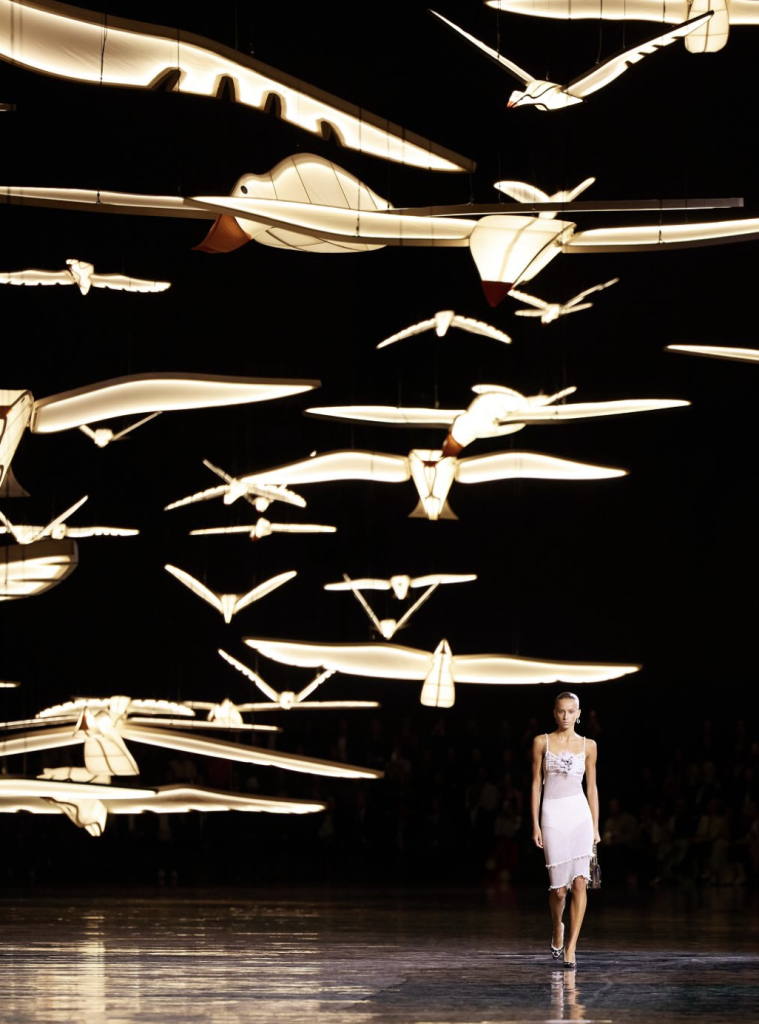
Photo via @Chanelofficial on Instagram
This show is the third chapter in what Blazy has been calling The Conversation, an ongoing dialogue he has built across his time at the house between himself and Gabrielle Chanel. Rather than treating her life as a fixed historical timeline to recreate, he frames it as a kind of wardrobe of different selves, the impoverished seamstress, the Edwardian era mistress borrowing clothes from the men around her, the modernist couturière, the postwar tailoring pioneer, all existing as versions of the same woman rather than separate chapters locked away from each other. In his own words, he compared the process to an exquisite corpse, the old drawing game where one person’s contribution unfolds directly into the next person’s without either fully controlling the whole, a way of describing how this show actually moves, one identity bleeding into the next rather than snapping between them.
The birds running through the whole presentation were never just a pretty motif. Blazy has spent real time in Calabria watching migratory birds pass overhead, and he used their efficiency, their instinct for survival, and their complete lack of attachment to any one place as an actual philosophical structure for the collection, every stage of Chanel’s own life read as a step toward a kind of freedom equivalent to flight. That idea runs straight into the Woolf references too, both Orlando, with its fluid, shifting sense of identity and gender across centuries, and the softer, impressionistic structure of To the Lighthouse, both used as literary proof that a single woman can genuinely contain multiple selves across one lifetime without any of them being less true than the others.
There is also a quote from Chanel herself sitting underneath a lot of this collection’s most celestial moments. She once said she wanted to cover women in constellations, originally talking about her 1932 high jewelry collection, the only one she ever personally designed, built around stars, comets, and the moon. Blazy pulls that same idea all the way through to the eveningwear here, gowns printed with actual cloudscapes and finished in gold foil constellations and crystal star clusters, taking a line Chanel once used about diamonds and translating it directly into fabric instead.
The Clothes
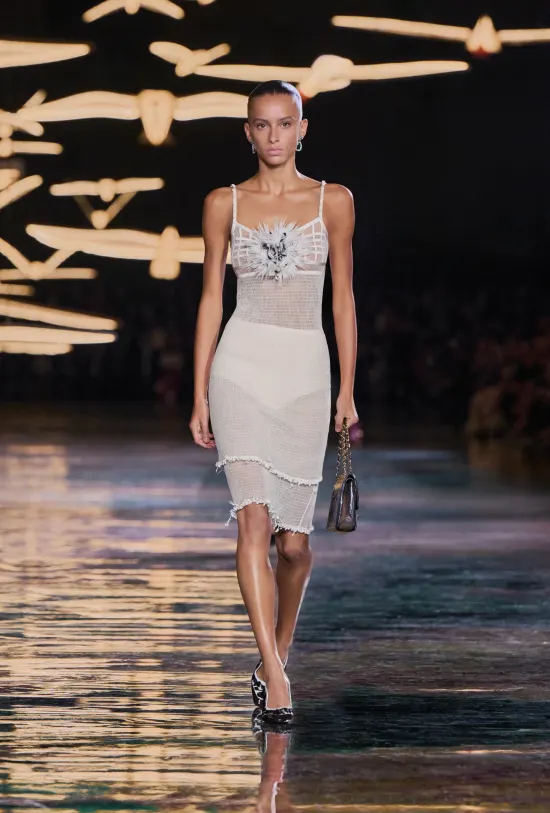
Photo via Chanel.com
The opening section of the show goes back to something genuinely foundational about Chanel’s own career, long before she was known for tailoring at all, she started as a seamstress working with intimate garments, jersey undergarments, and lingerie. Blazy opens the whole show there on purpose. Dyanira Hurbuscher walked Look 1 in a sheer, semi-transparent white knit slip dress with a feathered corsage at the bust, worn over visible tonal briefs, carrying Gabrielle Chanel’s own personal 2.55 bag from February 1955, borrowed directly from the house’s own archive. That handbag is a real object that belonged to the founder herself, not a replica, which gives the whole opening a kind of weight beyond just the clothes, the actual woman’s own history held physically in the hand of the woman closing the historical gap between them. This early stretch feels undone and underwear driven on purpose, built specifically around rigid Edwardian corsetry reimagined through what the house is calling shadow boning, soft topstitched ribbon channels and jersey piping that suggest the line of a corset without any of its actual restriction. Sheer camisoles and openwork knit dresses carried this logic through the first fifteen looks, building toward Look 10, Bhavitha Mandava’s asymmetrical black gown built entirely from hand molded, three dimensional rosettes connected by delicate cord bridges, with graphic cutouts carved directly across the torso, the house’s camellia motif reworked as actual garment construction rather than a simple embroidered flower.
From there the show moved into its jazz age stretch, pulling from Chanel’s own creative circle in Paris and her connection to Sergei Diaghilev’s Ballets Russes. Full ballerina petticoats appeared in soft, sugared almond tones, pale blue, peach, and ivory tulle, held at the waist with flexible, modern corsets rather than anything historically rigid, the silhouettes dropping into true 1920s waistlines, paired unexpectedly with casual racerback tanks underneath. Look 6 and Look 9 sit right in this stretch, built around that same dropped waist, bead heavy construction, the similarity between them deliberate rather than accidental. The piece worked with Maison Lesage in this section used thousands of individual glass beads arranged to catch movement exactly the way genuine 1920s beading did, each step sending light across the surface rather than the beading sitting flat and static. Harlequin collar details in bright orange and sky blue broke up the richer embroidery elsewhere in this stretch, giving the whole section a playful, slightly theatrical edge against the more serious bead work surrounding it.
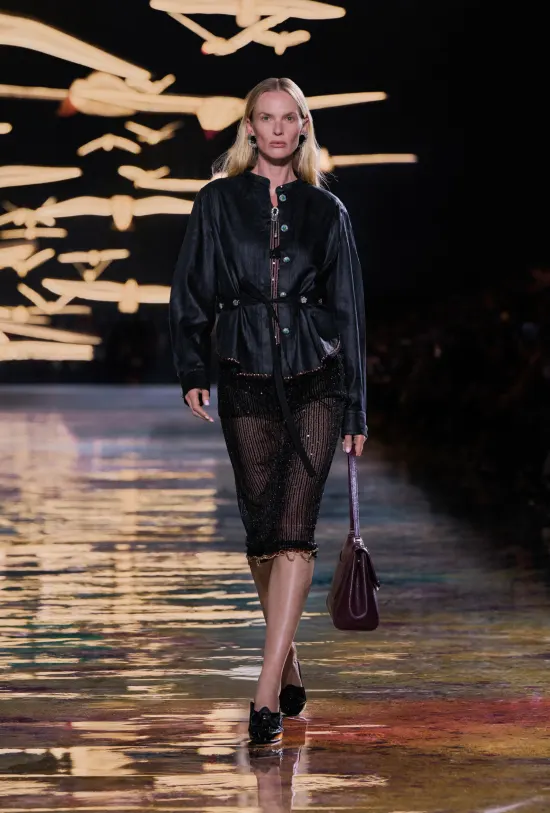
Photo via Chanel.com
Looks 14 through 17 carry that same energy into the house’s tweed, color and pattern pushed much further than Chanel’s usual restraint, bold red boucle jackets finished with fraying trim and little floral charms scattered across the surface, worn with the kind of sculptural, articulated jewelry running through the whole show. Look 17, with its graphic black and white floral jacket topped by a striking yellow and blue scalloped collar, shows how far Blazy pushed color and pattern mixing within a silhouette that still reads immediately as Chanel tailoring underneath all that surface noise.
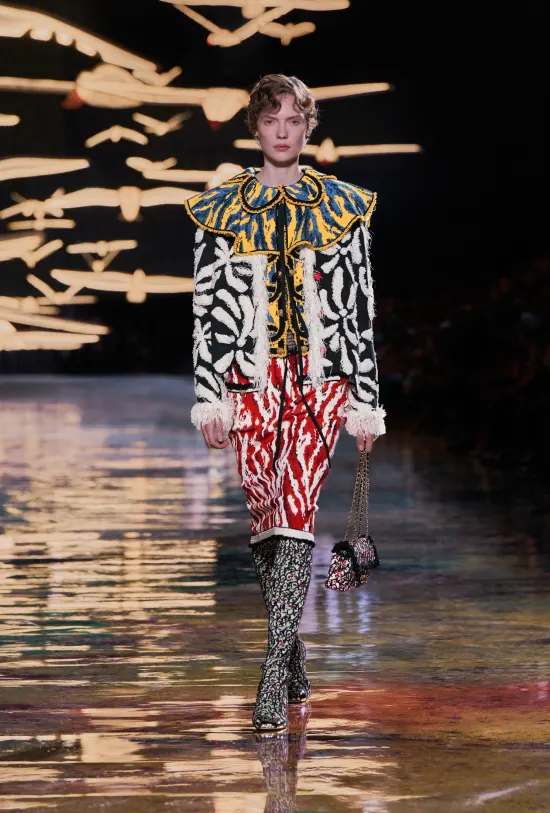
Photo via Chanel.com
The middle of the show moves into Chanel borrowing directly from the men in her own life, specifically Boy Capel and the Duke of Westminster, both of whom she took clothing from quite literally during her own lifetime. Looks 33 and 35 show this transition clearly, menswear tailcoats reworked in fluid black wool, worn over unbuttoned Charvet poplin shirts that expose sheer knit tanks underneath, formal waistcoats stripped of their linings and left with frayed, unfinished armholes. Look 22 sits within this stretch of the show too, and it carries real presence, one of the more extravagant looks in the whole presentation, mixing structured tailoring with a kind of deliberate roughness at the edges that keeps it from reading as too polished or costume like. Tiger print tweed and gingham outerwear appeared here as well, cinched with leather utility belts, a direct, almost playful disruption of the house’s most classic fabric. Look 26 and Look 27 both land in this same territory, structured pieces finished with that same raw, frayed hem treatment running through the whole middle section. Look 40 arrives as a real high point here too, a clear statement piece within the tailored section, showing how confidently Blazy was willing to disrupt the house’s most historically rigid category.
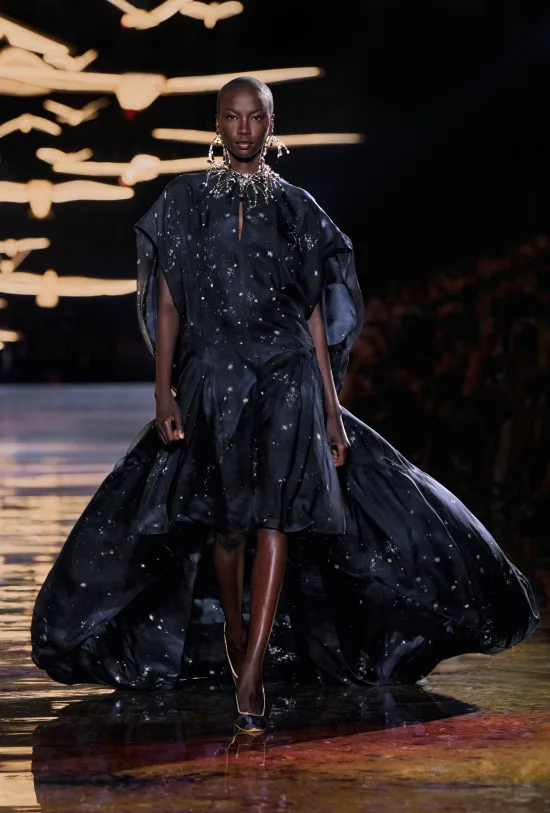
Photo via Chanel.com
The show then dissolves into pure silk flou for its most ethereal stretch, structured suiting giving way entirely to a sequence of gowns tracking the changing sky over Calabria from morning into golden hour and finally into full night. Tiers of cloud printed silk organza floated around the body in this section, opening with a pale blue caped gown finished in a wide collar of seed pearls, its train sweeping the floor behind it. Look 30 sits in this run, and the softness of that dress against the structure running through everything before it makes it one of the clearest transitions in the whole show. This sequence builds toward Look 55, the full constellation look, an indigo evening column dress printed with gold foil constellations and scattered with crystal star clusters, a direct, literal translation of Chanel’s own words about wanting to cover women in the night sky. That dress in motion is where the whole collection’s celestial thread resolves into one image, every bird, every piece of star jewelry, every cloud print building toward exactly this dress.
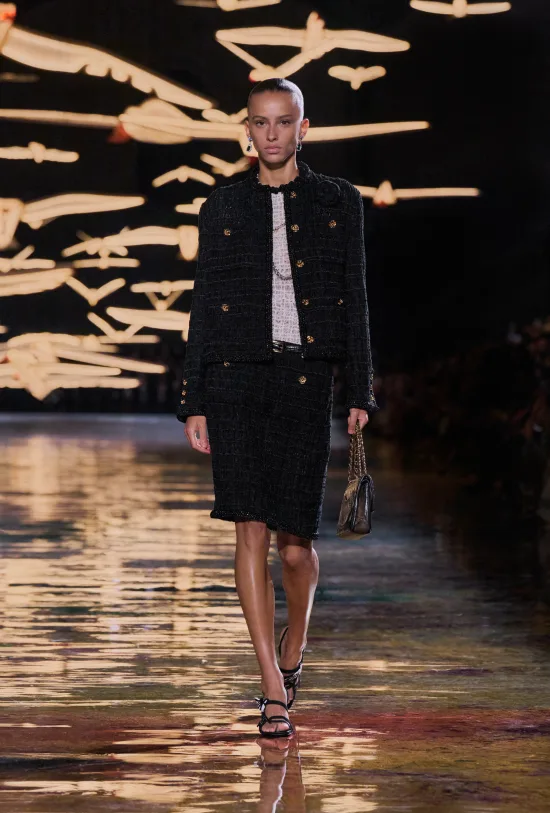
Photo via Chanel.com
The final stretch of the show pulls every earlier idea back together into something built for real, everyday movement. This is where the house’s new smocked tweed makes its full appearance, a fabric Blazy engineered specifically to solve a problem with how traditional Chanel boucle behaves. Classic tweed relies on dense, heavy yarns that need metal chain weights sewn into the hem just to hang correctly, which limits how a jacket can actually move on the body. Blazy reworked the yarn itself around a stretch elastomeric core, keeping the exact surface texture people recognize as Chanel tweed while giving it the actual tensile stretch of a sponge knit. Jackets built from this fabric need no internal canvas or shoulder padding at all, so they move with the same ease as sportswear while still looking, from a distance, exactly like a traditional Chanel suit. Look 61 shows this clearly, an unbuttoned pearl white silk blouse with chain hardware at the neck, paired with an apple green skirt finished in gold buttons and a classic tweed jacket layered over it, tailoring that has clearly absorbed every idea from earlier in the show without losing the house’s own silhouette. The whole collection closes on Look 83, Dyanira Hurbuscher returning in an ink black smocked tweed suit fastened with gold buttons over an open knit ivory top, holding that same 1955 handbag from the very first look, closing the entire story exactly where it started.
Accessories, Shoes, and Beauty
Chanel’s accessories have always carried as much weight as the clothes themselves, and this collection treated them that way throughout. The Classic Flap bag reappeared in bright primary red, dandelion yellow, and cobalt blue, alongside versions in zebra print calfskin and others finished with 3D printed hard frames and the same cloud embroidered micro beading used on the silk gowns, so certain bags functioned almost as a continuation of the dress they were carried with rather than a separate accessory entirely. Minaudières leaned directly into the show’s bird and flight concept too, several built as small gilded birdcages with their doors left open, a clear, almost literal image of escape held right in the model’s hand.
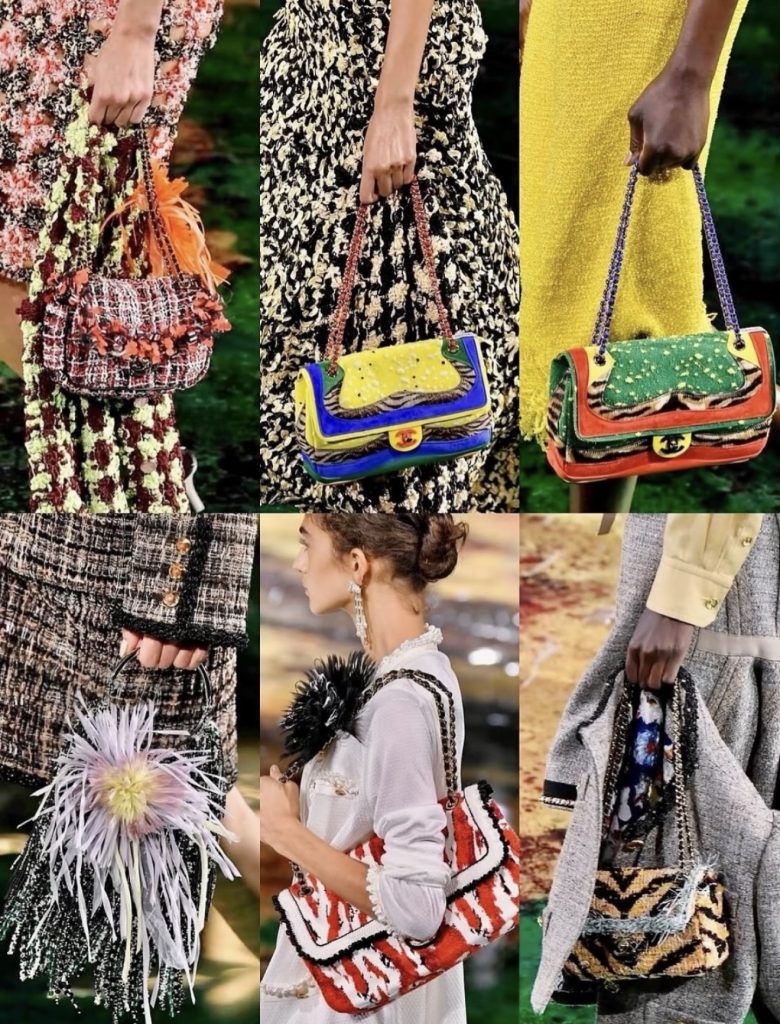
Photo via @refindeur on Instagram
Footwear carried its own real technical thought. The house’s classic two tone shoe was rebuilt with a higher cut vamp that lengthens the whole line of the foot, shown in patent and kidskin combinations, chocolate alligator with cream trim, and soft pastel leathers. For evening, block heels were replaced entirely with curved, flared Louis heels pulled from eighteenth century court shoe shapes and Gabrielle Chanel’s own 1920s footwear, angled specifically to tip the body forward and encourage a faster, more energetic stride, which lines up directly with how fast and loose the whole cast was moving down the runway. Those evening heels were finished in the same dense micro paillettes and Lesage seed beading as the gowns above them, carrying the celestial embroidery all the way down to the floor rather than letting it stop at the hem.
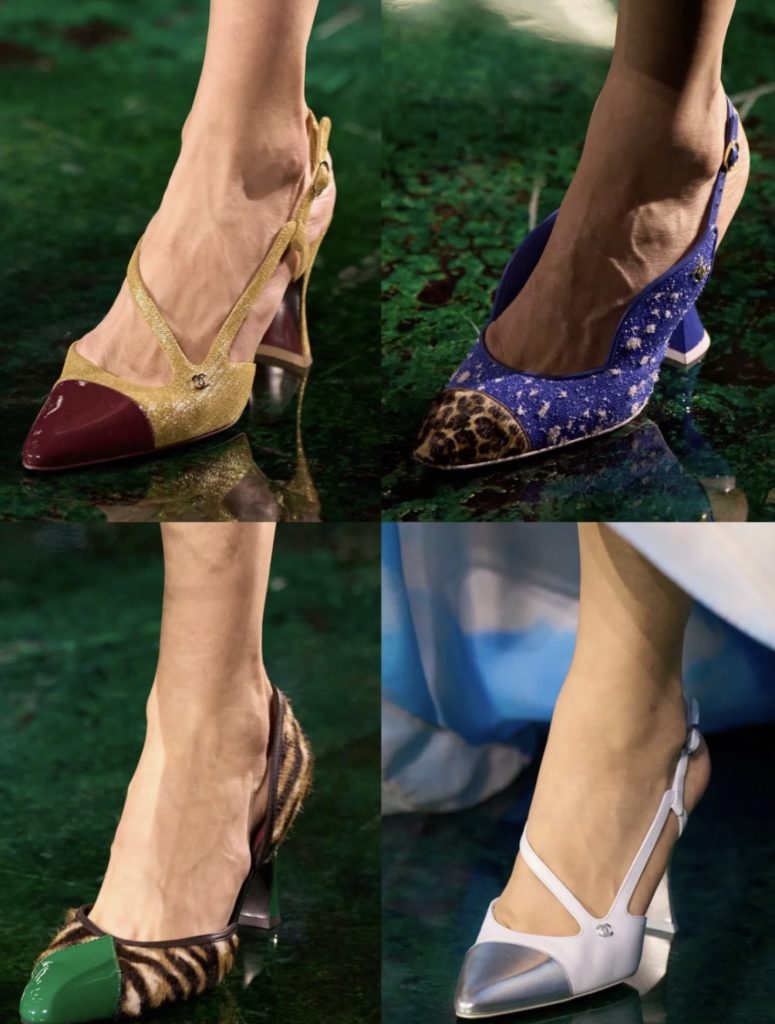
Photo via @refindeur on Instagram
Jewelry throughout leaned into real, kinetic metalwork rather than anything static, gold swifts and swallows worked directly into functional buttons, lapel brooches, and articulated ear cuffs that genuinely moved as the models walked. Pearls were handled with far less formality than Chanel traditionally shows them, no neat multi strand necklaces here, instead sculptural neck cuffs and loose, tiered collars that draped straight over bare collarbones or spilled out through an unbuttoned poplin shirt. Hair stayed consistent across the whole show, tight, sculptural buns the house called bird’s nest buns, a name that plays against how clean and aerodynamic the style actually looked, finished with small feather hairpins and delicate, trembling feather ear cuffs. Skin throughout stayed bare and radiant with almost no visible correction, soft brows, nude lips, letting the clothes and the jewelry carry all the visual drama rather than the makeup competing with it.
The Close
This is a collection that takes some real time to settle. On first look it can feel like a lot is happening at once, lingerie dressing, menswear tailoring, ballet petticoats, celestial eveningwear, a new engineered fabric, all inside one eighty three look show, and it would be easy to come away with the impression of a collection trying to say too many things. But sitting with it longer, the pieces actually lock into place. Every stretch of the show is tracking one specific identity Gabrielle Chanel passed through in her own life, and the sequence itself, lingerie into jazz age freedom into borrowed menswear into pure silk flou into engineered modern tailoring, follows her own biography closely enough that the complexity stops feeling scattered and starts feeling like an actual argument being built in real time.
What makes that argument land is how much real technical work sits underneath the concept. The smocked tweed is not a clever idea stated once and left alone, it shows up fully resolved in the final stretch of the show, genuinely solving a problem with how traditional Chanel boucle has always behaved. The shadow boning in the opening section does real structural work without a single piece of rigid steel. The birds are not decoration layered on top, they run through the lighting, the jewelry, and the actual narrative logic of the whole runway. Once all of that becomes visible, what first reads as a dense, almost academic collection starts to feel like something closer to a complete, carefully reasoned statement about what it actually means for one woman to contain that many different versions of herself across a lifetime.