
By Gabriela Afanador
Tuesday 8, July 2026

Photo via @Chanelofficial on Instagram
Matthieu Blazy titled his second haute couture collection for Chanel Gaby and the Beanstalk, and the title was more literal than it might initially have appeared. The starting point was a discovery made in Gabrielle Chanel’s personal library on Rue Cambon, a copy of Les Fées, Contes des Contes, a collection of classic French fairy tales by Charles Perrault that Coco had kept among her personal belongings, and which Blazy used as the backbone of the entire season. The first model out, Trinidad Castaño, carried a copy of that same book as she walked, which is the kind of detail that functions as a quiet key to everything that followed across 63 looks. The collection was built around the specific fairy tales found inside it, each one translated into a garment, an accessory, a detail hidden inside a lining or built into a heel, the entire show functioning as a wearable library of stories that Coco herself had read. It is the kind of concept that could easily read as precious or overworked and instead read as genuine, because the translation between the fairy tale source material and the physical objects Blazy and the ateliers produced was so specific and so surprising that it never felt like illustration but like genuine creative thinking.
The show took place on July 7th not in the vast central nave of the Grand Palais that has historically staged the house’s biggest productions, but in the Salon d’Honneur, an intimate first-floor exhibition space that Blazy chose deliberately and that changed everything about how the collection was experienced. The room was smaller, the audience was closer to the clothes, and the scale of the set felt domestic rather than spectacular in a way that served the fairy tale logic of the season perfectly. The space was designed in collaboration with French designer Martin Brûlé and styled after Coco’s wheat-colored apartment, complete with her gilded chairs and the accumulated objects of her private life, and then systematically overtaken by a botanical invasion. Giant beanstalks snaked toward a ceiling painted brilliant blue. Toxic lupins and parasol-scale poppies bloomed along the walls and snagged the chairs in their vines. Vases and mirrors were scaled up to enormous proportions, the domestic space distorted into something that sat between fairy tale and the 1990s film Jumanji, between the familiar and something considerably more unsettling. The set was making the same argument as the clothes, that fairy tales are not soft or reassuring things but complex ones, built from ambition and survival and transformation as much as from wonder, and that the domestic space they inhabit is not a place of pure comfort but one that can be overtaken at any moment by something wild and unexpected.

Photo via @Chanelofficial on Instagram
The Fairy Tales and Their Translations
The collection’s most remarkable achievement was the way each fairy tale from Coco’s library was given a specific and precise physical form somewhere in the show, and understanding which story lived where across the 63 looks transforms the experience of reading the collection into something considerably richer than it would otherwise be. Jack and the Beanstalk was the dominant narrative, its imagery running through the guipure lace engineered to mimic climbing bean fronds on the opening look, the giant botanical set itself, and most precisely in one of the collection’s most extraordinary accessory details, a classic Chanel slingback whose heel contained a miniature beanstalk vine with a tiny sculpted figure of Jack climbing underneath it. The heel is small enough that no one sitting in the front row could have seen it clearly during the show. It existed because Blazy and the artisans at Massaro believed it should exist, which is its own kind of statement about what the house values and what it considers worth spending time on.
The Goose That Laid the Golden Eggs appeared in the golden eggshells and gold-leaf pea pods built into other heels, miniature sculptural worlds of the same invisible order as the Jack figure, the logic of the fairy tale translated into something physical and specific and entirely hidden from anyone not holding the shoe directly in their hands. Goldilocks and the Three Bears arrived in the form of hard-case clutch bags molded into sleeping teddy bears, their surfaces sculpted in brass and enamel with a level of detail that made them genuinely charming rather than simply decorative, the sleeping bear resting in the palm of whoever was carrying it in a way that made the object feel genuinely alive. Other bags in the accessories program were molded into fat chickens and little red hens and polished enamel magic beans, each one a different story from the same library, the accessories functioning collectively as a cabinet of fairy tale curiosities.
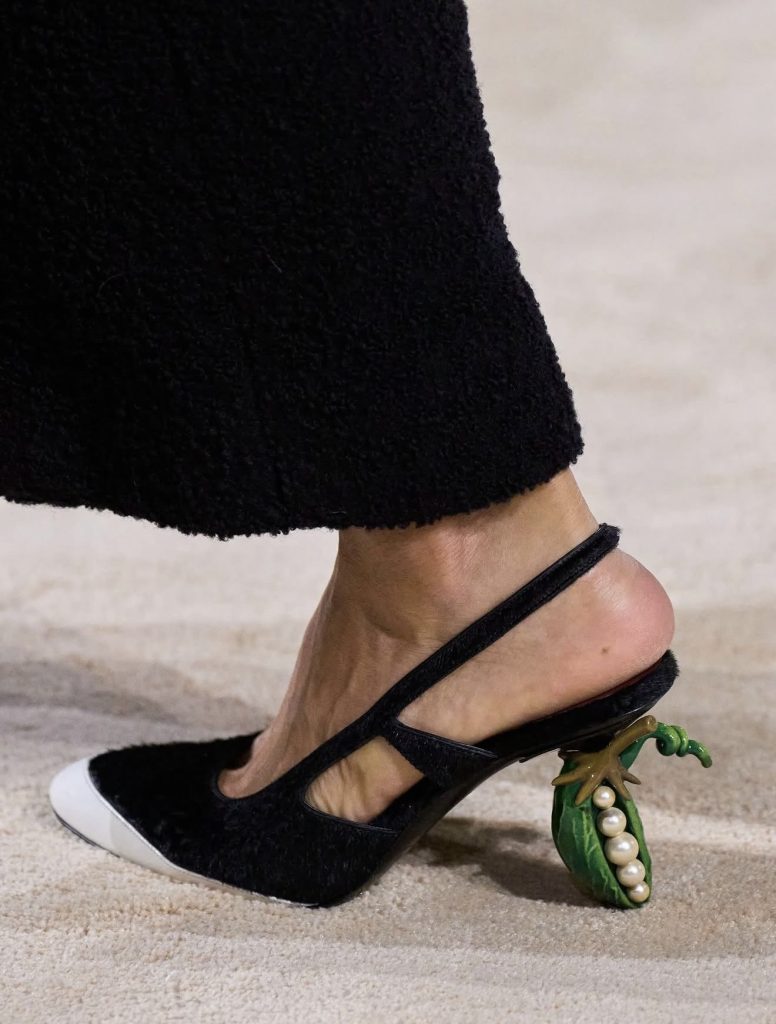
Photo via @Voguefrance on Instagram
Puss in Boots appeared inside the garments rather than on them, the silk linings of structured jackets and tailored coats hand-painted with detailed narrative scenes from the fairy tale, invisible to everyone except the woman wearing the coat and anyone she chose to show it to. The lining of one sharp black jacket was decorated by Maison Lesage with yellow silk squares hand-embroidered to look exactly like handwritten Post-it notes, routine domestic reminders and supermarket shopping lists executed in the most time-consuming embroidery technique the atelier possesses, the grandest craft applied to the most ordinary object of daily life. This particular detail is the clearest single expression of everything Blazy has been saying at Chanel since he arrived, that the extraordinary and the mundane are not opposites but the same thing approached from different distances, and that a woman’s daily life is worth the full attention of the most skilled hands in Paris.
The Ugly Duckling was translated across two of the collection’s most quietly affecting details. A series of functional buttons running down the spine of one dress transformed gradually from a yellow duckling at the top into a regal swan by the time they reached the hem, a transformation that takes the entirety of a garment to complete and that most people seeing the dress would have noticed without necessarily understanding what they were looking at, the story told so quietly that it rewarded attention without demanding it. The Swan Column Gown arrived later in the lineup, a sleek dark column dress embroidered with a detailed scene of baby swans and a single black swan in flight across the chest, the embroidery so precise and so sustained that it read from a distance as a painted image rather than a sewn one, the hours of atelier work disappearing into the surface of the garment in a way that is the exact opposite of the decorative embroidery that announces itself as labor. Here the labor became the image and the image became the story.
The Materials
The textile program that supported all of this was built through Chanel’s full network of Métiers d’art ateliers at Le19M, and the specific technical decisions Blazy made with each workshop were as considered as every other element of the collection. Maison Lesage developed a custom tweed bouclé woven with solid gold threads into structured coats that caught the light of the Salon d’Honneur differently with every movement, the gold integrated into the weave itself rather than applied as decoration, so that the shimmer was structural rather than surface-level. Ostrich feathers were processed by the specialized plumisserie ateliers and used not as decoration but as actual sewing thread, stitching together panels of gossamer organza in place of conventional thread, a construction decision that produces a seam of extraordinary delicacy and that requires the kind of patience and precision that simply cannot be rushed. The resulting organza pieces moved with the models in a way that conventional construction could not replicate, the feather-stitched seams giving the fabric a quality of suspension rather than attachment.
Sheer silk mousseline appeared in lilac and cornflower blue layered into fluid skirts and bias-cut gowns throughout the middle section of the collection, the lightness of the fabric making the clothes feel weightless in a way that contrasted deliberately with the botanical heaviness of the set around them. Raffia straw, rough and weathered and entirely ordinary as a material, was woven into structured cropped jackets and oversized hats for the Scarecrow looks, paired over frayed tartan and beaded trousers designed to mimic relaxed denim, the juxtaposition of the roughest material available and the most refined tailoring executed with a confidence that made it feel not like a conceptual gesture but like the most natural possible combination. Custom guipure lace was engineered to mimic the geometric patterns of classic Chanel tweed bouclé while being light enough to billow rather than structure, forming the primary surface of the sheer opening suits in a way that honored the house’s most recognizable textile while completely remaking what it could do on the body.
The 63 looks prioritized ease throughout, replacing restrictive corsetry with drop-waist cuts, slashed seams, and relaxed tailoring that allowed the clothes to move with the women wearing them rather than holding them in a fixed silhouette. Trinidad Castaño opened in the translucent lilac guipure vest and skirt set layered over silk mousseline, the beaded neckline and bean frond embroidery establishing the botanical palette immediately. Bhavitha Mandava wore the Petal Midi Dress, a warm-toned beige and orange garment with hand-cut layered fabric panels resembling flower petals with exposed decorative seams, each petal cut individually by hand and positioned so that the construction of the garment was also its decoration. Lakshmi Menon appeared in a flowing lavender gown in ultra-lightweight silk mousseline with a sculptural collar and feather embellishments that gave the look a quality of something belonging to another world without removing it from this one. Anok Yai wore a wispy one-shoulder periwinkle and lilac gown with a long floating trail worn over sheer lace boxers, a combination that landed exactly at the intersection of haute couture and real life that the entire collection was navigating, the most formal possible fabric worn with the most casual possible undergarment in a pairing that felt entirely right.

Photo via @Chanelofficial on Instagram
Secret Luxury and the Hidden Interior
One of the defining aspects of Blazy’s work at Chanel has been his commitment to what he calls secret luxury, detail and craftsmanship designed entirely for the private pleasure of the wearer rather than for any external audience or any camera. The fairy tale linings were the fullest expression of this idea the house has yet produced under his direction, the hand-painted Puss in Boots scenes visible only to the woman putting on the coat in the morning and anyone she chose to share it with. This is a fundamentally different relationship between a garment and its wearer than the one that dominates most of contemporary fashion, where the visible surface is everything and the interior exists only to support it. Here the interior was the point, the place where the most extraordinary work was happening, and the exterior was simply the container.
Personal trinkets, keys, handwritten letters, and good luck charms were tucked into hidden interior pockets or suspended from the gold-metal chains Chanel historically sews into jacket hems to ensure perfect drape, the internal architecture of the garments transformed into something personal and talismanic, the equivalent of the objects a woman carries in her bag or keeps in the drawer of her bedside table. This accumulation of daily bric-a-brac dangling inside the hem of a couture jacket is either the most Chanel thing Blazy has done or the most anti-Chanel thing, depending on how you read the house’s history, and the fact that both interpretations are available says something about how well he understands where he is working.
The accessories carried the storybook logic all the way to the smallest detail and in some cases beyond it. Alongside the fairy tale heels and the sleeping bear clutches, buttons throughout the collection were shaped like foxes and little boots and the gradually transforming duck-to-swan sequence. The jewelry, which the collection called Magpie Jewelry, consisted of tangled gold chains, pearls, and mismatched charms styled to look as though they had been pulled hurriedly from a messy jewelry box rather than selected and arranged, the most deliberately imperfect thing in a collection made by some of the most skilled craftspeople working anywhere in the world, and the contrast between the care that went into the making and the casual disorder of the result was precisely the point.

Photo via @Voguefrance on Instagram
The Bridal Look, the Finale, and the Room
The bridal look arrived thirteen exits before the finale rather than as its closing statement, which is an unusual structural decision and one that placed it within the flow of the collection as something lived rather than something ceremonial. A drop-waist lace shirt with mother-of-pearl floral buttons worn with a flouncy ankle-grazing mermaid-style skirt, a traditional lace veil, and casual mesh shoes was the bridal look as something a real woman might actually choose to wear on one of the most important days of her life, functional and romantic and entirely human rather than sculptural or untouchable. Placing it thirteen looks before the end meant that the collection continued after the bride walked, that the story did not conclude with marriage but kept going, which is the right way for a Chanel collection to think about a woman’s life.
The collection ended with Carla Ciffoni in a sleek off-the-shoulder black cocktail dress with an open back and delicate latex-textured black floral embellishments, the hourglass silhouette bringing the entire fairy tale sequence back to the Little Black Dress, the most fundamental object in the house’s history and the one Coco invented by taking the most ordinary garment a working woman in Paris could own and making it into something that changed how women dressed entirely. It was a precise and generous closing gesture, the fairy tale ending in the simplest and most powerful image available to the house, a reminder that the story Blazy has been telling across these two couture collections is ultimately about Gabrielle Chanel herself, a woman who built one of the most significant creative legacies in the history of fashion out of resourcefulness and imagination and a clear-eyed understanding of what women actually needed.
French artist Joël Blanc sat front row and painted the show live in watercolors as it unfolded, a gesture that connected to the house’s own history with artists who documented women’s lives as they actually were. In 1923, Gabrielle Chanel commissioned Marie Laurencin to paint her portrait, and Laurencin’s way of depicting women with vitality and clarity rather than as decorative objects is the lineage Blazy was working within by inviting Blanc to capture the collection in real time rather than through digital imagery. The soundtrack moved from Bag End from The Lord of the Rings through Kiss Me by Sixpence None the Richer and Dolly Parton, running beneath a spoken-word voiceover by Belgian artist Jeanna Criscitiello reciting mundane daily errands and supermarket checklists, the most ordinary possible text placed at the center of the most extraordinary possible context, the contrast between the two making both feel more alive.
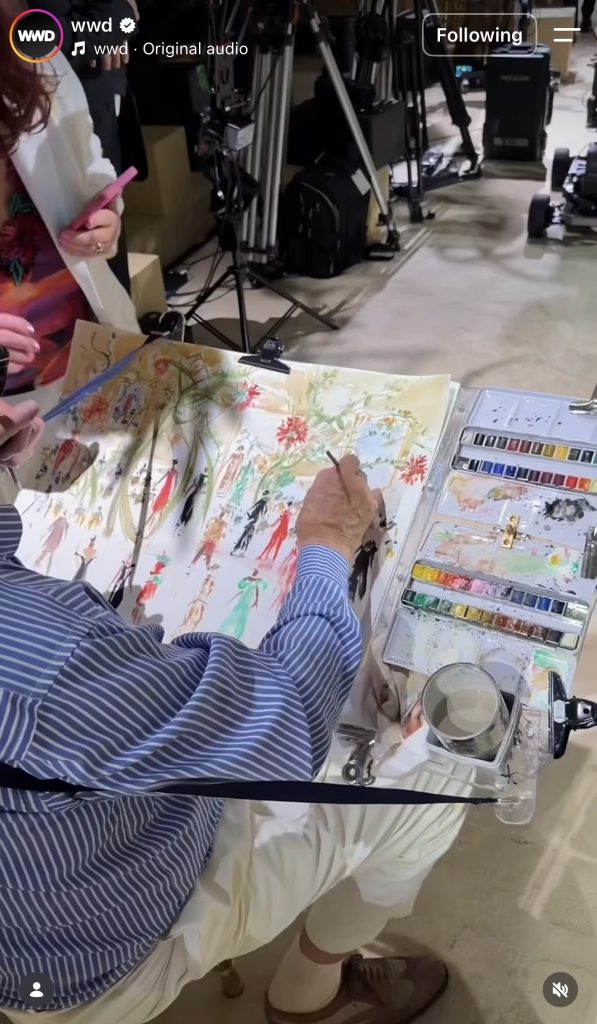
Photo via @wwd on Instagram
The front row included Charlotte Casiraghi in low-rise dark-wash denim and a pinstriped button-down anchored by a fuchsia red croc-embossed calfskin tote, the unexpected color doing exactly what Blazy’s clothes ask their wearers to do, which is to bring something of themselves to what they are wearing rather than disappearing inside it. Ananya Panday, Chanel’s first brand ambassador from India, wore coordinated light-blue quilted denim. Lux Pascal wore a white drop-waist shift dress alongside her brother and fellow Chanel ambassador Pedro Pascal. Tilda Swinton, Catherine Deneuve, Lupita Nyong’o, Vanessa Paradis, Alexa Demie, Elizabeth Debicki, Olympic boxer Imane Khelif, and legendary figure skater Surya Bonaly completed a room that felt, more than most couture audiences do, like it actually reflected the breadth of the world Blazy is dressing and the range of women he is thinking about when he makes these clothes. Chanel recently topped the Lyst index as the hottest brand in global fashion for the first time, which suggests that what he is building is resonating well beyond the room. The fairy tale, it turns out, is working.