
By Gabriela Afanador
Tuesday 10, March 2026
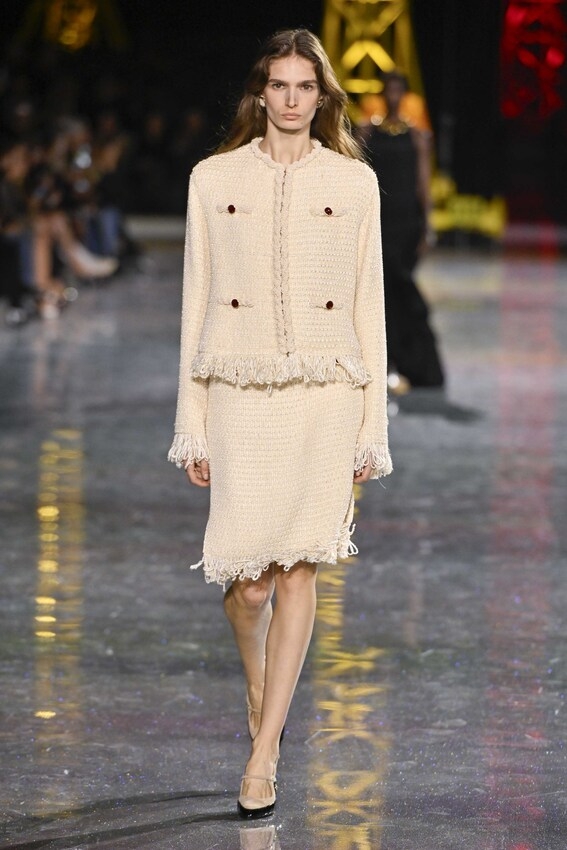
Photo: firstVIEW
Chanel Fall 2026 opened inside the Grand Palais with the house’s most familiar setting turned deliberately unfamiliar. Construction cranes and scaffolding rose through the space in bright primary colors, like a playful interruption inside a monument. It set the tone immediately. This was not a show built on nostalgia or softness. It was a show about process, structure, and the idea that a heritage house stays alive by staying in motion.
The set was not background. It shaped the way the collection read. Models appeared and disappeared behind colored beams, sometimes framed like moving portraits, sometimes partially obscured as if the clothes were being revealed in chapters. A high shine floor caught the light and scattered it back upward, making the room feel kinetic even when it was still. The sound design reinforced the sensation, part industrial and part melodic, like a worksite that still has room for romance. You could sense that Blazy wanted the audience to feel the house as something built rather than something simply displayed.
That idea carried into the first section of the collection, which was intentionally grounded. The opening looks treated Chanel codes like a base layer rather than a finale. The silhouettes nodded to workwear and commuting, not in a literal uniform sense, but in the way the clothes behaved. Boxy overshirts, zip knits, blouson style tweed jackets, and shirts cut with ease came first. The point was not to make daywear dramatic. The point was to make it exact. Even when shapes ran oversized, they stayed controlled. Shoulders were clear, collars held, and the garments kept their line without looking rigid. Branding was not the point. Cut was the point. Fabric was the point.
From there, the collection began to shift in a way that felt gradual rather than theatrical. Proportions started to change. Waistlines dropped lower, belts settled further down the hip, and skirts began where a classic tailored jacket would usually end. This elongation of the torso subtly recalibrated what we think of as “Chanel balance.” It made the silhouette feel cooler, less polite, and slightly off in a way that reads modern. The effect was not a costume reference. It was a structural decision. It also carried a quiet confidence. A house like Chanel does not need to chase novelty. It needs to adjust the axis of its codes just enough that the clothes feel current on the body.
Fabric was where the collection became most persuasive. Tweed was not treated as a polite archive reference. It was treated as a living material that can be reworked, lightened, amplified, and made strange. Some surfaces looked dry and matte, others carried a faint metallic glow, and others felt almost iridescent under the lighting. Traditional bouclé grids were pushed through new textures so the tweed behaved less like a uniform and more like a surface experiment. Fraying appeared at hems and edges, not as distressing but as finish, as if the garment was allowed to breathe. The overall impression was that the atelier work was being shown as invention rather than as heritage.
As the show moved forward, the palette and the textures began to open up. Early looks leaned darker and more restrained, then gradually allowed more saturation and shine to enter. Instead of one sharp switch from day to night, the show built a slow rise in intensity. The clothes became more fluid, more reflective, more decorative. Yet it never felt disconnected from the opening section, because the base remained the same. The tailoring logic stayed present. The silhouettes stayed disciplined. The glamour did not arrive as a separate story. It arrived as an evolution of the first one.
Details carried that same logic. Floral elements appeared, but not as sweetness. They were sculptural and sometimes slightly wild, like small bursts on a surface rather than neat motifs placed for prettiness. It felt less like “romance” and more like growth. Hardware remained a major part of the Chanel language, but it worked structurally rather than as branding. Buttons, chains, clasps, and closures were integrated as points of emphasis, the way a seam can define a silhouette. The accessories continued the theme of proportion. Bags appeared in shapes that played with softness and structure at the same time. Some felt plush and compressible, others more architectural. Many were scaled for real use, which matters because it keeps the collection anchored in lived life even when the clothes become more fantastical.
Footwear carried the same message. Rather than relying on one obvious statement shoe, the styling supported the silhouettes. The shoes felt designed to hold the line of the outfit, to ground long coats and low waists, to keep proportions clean. It was another example of how the collection refused to treat “accessory” as an afterthought. Everything was built to reinforce the story.
By the final section, the collection leaned fully into its lighter, more luminous mood. The textures caught more light, the silhouettes moved more, and the overall energy shifted toward the idea of flight. Yet the show never abandoned the discipline that made it convincing. Even at its most decorative, it kept the logic of Chanel tailoring underneath. This is what made the metamorphosis feel intelligent rather than theatrical. It was not a costume change. It was a transformation through material, proportion, and finish.
The construction site setting could have been a gimmick. Instead, it worked because it accurately reflected what the clothes were doing. Chanel Fall 2026 was not trying to prove that the house can reinvent itself overnight. It was showing that evolution happens through the quiet work. Adjusting waistlines. Recalibrating volume. Reengineering tweed. Introducing shine in a way that still feels wearable. Letting classic codes remain visible, but moving them slightly out of their usual positions so they feel newly alive.
Ultimately, the collection offered a wardrobe that understands contradiction. Clothes that can carry you through the day with restraint, then shift toward evening without changing who you are. The most modern version of Chanel here was not a reinvention through shock. It was a recalibration through cut, proportion, and materials, with the confidence to let the process show.