
By Gabriela Afanador
Friday 29, May 2026
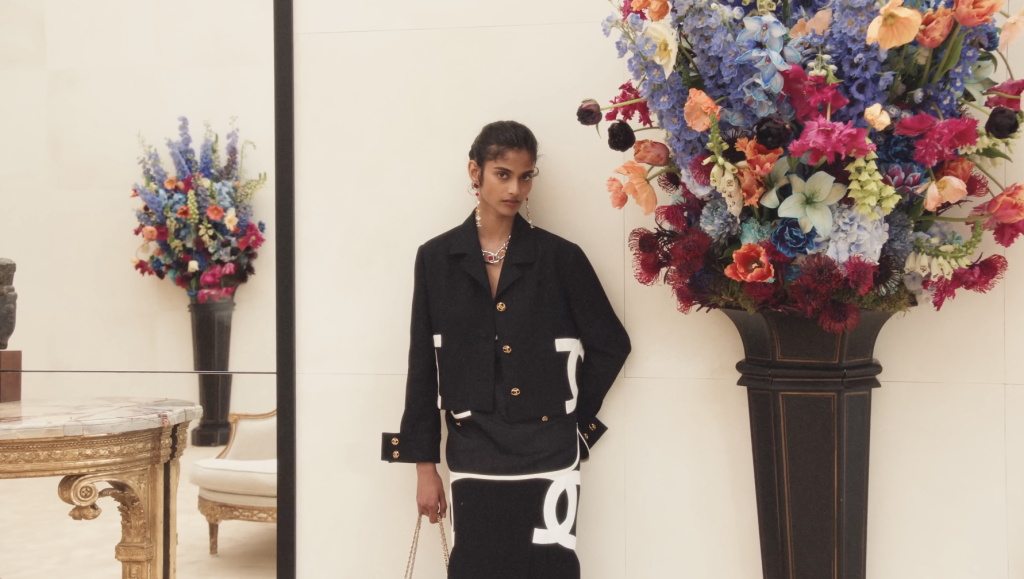
CHANEL Cruise 2026/27 Show — CHANEL Shows
Credit : CHANEL on Youtube
Matthieu Blazy chose Biarritz for his debut resort collection at Chanel, and the choice was not arbitrary. It was in Biarritz in 1915 that Gabrielle Chanel established her first couture house at the Villa de Larralde, unifying her workshops, boutique, and private apartment under a single roof on the Basque coast, far from the rigid social codes of the Parisian salons, and it was there that the relaxed and modern Chanel style first took shape. By titling the presentation Sous le salon, la plage, underneath the salon, the beach, Blazy framed the entire collection as an excavation rather than a tribute, not a nostalgic return to what the house once was but a structural argument for what it was always built on. The show was staged inside the Art Deco interior of Le Casino Municipal, a building perched directly on the Biarritz shoreline, where a custom-built mirrored salon jutted out like a promontory over the Atlantic, framing the 79 looks against crashing waves and a maritime horizon. Outside, local surfers rode the gray Atlantic swells on black surfboards stamped with the interlocking double-C logo. The message was clear and it was delivered without announcement: this is a house that began at the water’s edge, and the clothes should move accordingly.
The collection opened with Look 1, a drop-waist little black dress traced with contrasting white topstitching, designed as a direct tribute to the 100th anniversary of Gabrielle Chanel’s original 1926 LBD. The oversized bow that appeared on the back of the 1926 design was removed and transformed into a functional bow clutch, modernizing the archival reference by turning its most decorative element into something you could carry, and the look was grounded with flat masculine leather loafers that nodded to Gabrielle Chanel’s personal preference for borrowed menswear. From that opening the collection moved through a sequence of what Blazy described as blasts from the past, archival pieces reproduced directly from 1920s sketches because their construction was already modern enough to require no updating, among them a pleated skirt with the double-C logo curled over each hip before releasing into deep pleats, and a series of designs from 1929 where the interlocking Chanel emblems were integrated structurally into jacket constructions, cuffs, and dress bodices rather than applied as surface decoration. The logo as architecture rather than branding is a distinction that runs through Blazy’s entire approach to the house and it reads here with particular clarity.
The Clothes and Their Materials
The textile logic of the collection moves from rigid and hard-wearing to fluid and water-friendly, and the specific materials Blazy chose to make that journey are where the collection’s intelligence is most visible. The classic Chanel tweed suit, which has spent decades functioning as an almost architectural monument, was executed in ultra-lightweight carré silk developed in collaboration with the ACT3 workshop in the nearby city of Pau, allowing the jackets and coats to billow with the coastal wind rather than holding their shape against it. The chain-weighted hems that have always been sewn inside Chanel jackets to ensure perfect hang were reactivated in these lightweight silk versions, giving the coats a dramatic, swinging movement that the heavier tweeds could never produce and that felt entirely new while being entirely rooted in the house’s own technical history. Silk satin fabrics reissued from the archives of Mantero, a silk specialist and partner of the house for over fifty years, appeared in handkerchief-hem dresses and fluid layered pieces that carried the weight of archival continuity without any of the stiffness.
Against these fluid silks, Blazy introduced a range of utilitarian fabrics that carried the collection’s class subversion argument most directly. French chore coats in cotton ticking and washed drill, sailor trousers, and khaki skirt suits arrived with a subtle lived-in patina, elevated through couture gold buttons and hand-braided collars that placed the language of artisanal craft against the language of regional labor in combinations that felt genuinely considered rather than conceptually forced. Striped marinière sweaters with quarter-zips brought an athletic ease to the daywear section, while Basque-striped foulard dresses in sheer silk layers tied loosely at the waist connected the collection physically to the regional textile heritage surrounding it. Denim appeared covered in tiny sequin paillettes that gave it a subtle wet-looking shimmer, a material transformation that is both simple and completely effective at shifting what denim is allowed to mean in a Chanel context.
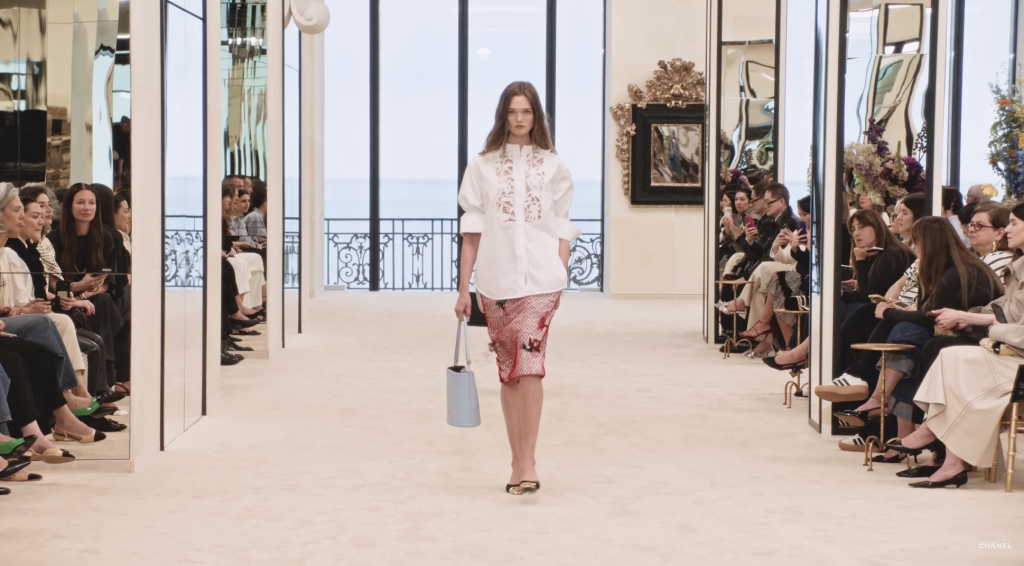
CHANEL Cruise 2026/27 Show — CHANEL Shows
Credit : CHANEL on Youtube
The tactile range of the collection was exceptional. Heavy tufted beach toweling appeared in cuddly wraps and relaxed outerwear that absorbed light rather than reflecting it, sitting in direct contrast to the scale-like paillettes of the evening pieces. A cashmere and raffia skirt produced a gentle audible rustle as the model walked, a detail that brought the sound of Biarritz’s iconic striped parasols into the room in a way that no visual element could have replicated. The macramé and crochet pieces that bridged the daywear and eveningwear sections were tangled with gilded metallic flotsam, seashells, and sea-glass beads in a way that made them feel genuinely found rather than constructed, and a standout lace dress that moved like coral across the body achieved what all the best evening pieces in a resort collection should, something that belongs equally at a beach and at a dinner table without requiring any justification in either context.
The Evening and the Finale
What runs beneath the collection’s surface, and what gives it its cultural weight beyond the beauty of the individual garments, is Blazy’s sustained engagement with the class histories embedded in the clothes he is working with. The little black dress that opened the show was not merely a centennial tribute but a reminder of its actual origin: in the 1920s, plain black dresses were the standard uniform of shop assistants, governesses, and domestic workers, and Gabrielle Chanel’s decision to adopt and elevate that humble garment was an act of deliberate social disruption. Blazy extends that tradition throughout the collection with complete seriousness, the chore coats and maritime canvas weaves and raw denims arriving not as ironic winks at workwear but as genuine investigations of what happens when the craft of a couture atelier is applied to the materials of physical labor. A striped marinière top paired with a silk-raffia skirt in direct reference to Pablo Picasso’s personal style, one of the many artists who historically frequented the Basque coast, brought that cultural and intellectual history into the collection without making a performance of it. The collection’s soundtrack, curated by sound director Michel Gaubert, traced the same arc from the hydrophone field recording of whale song that opened the show through Pyrenean folk choral music and Ravel’s impressionist piano to Orbital and Angelo Badalamenti’s ambient electronics for the mermaid finale and Charles Aznavour’s Emmenez-moi to close, a progression that moved from the deep natural world to the regional to the romantic in a way that mirrored the collection’s own journey through the same territories.
The collection’s finale delivered the season’s most purely theatrical moment. Two iridescent gowns, embroidered by Maison Lesage in shades of azure blue, aquamarine, and koi orange, were covered in scale-like paillettes and finished with fin-like ruffles along the neckline, worn by models Noor Khan and Josephen Akuei with hair kept damp and brushed back in a shipwreck aesthetic that was as literal as it needed to be. These gowns had originally been designed for the January Haute Couture collection before Blazy shifted that show’s direction toward extreme lightness, and their reassignment to the resort lineup was one of the more interesting behind-the-scenes decisions of the collection, giving the Cruise show an evening register it would not otherwise have had and giving the gowns an audience that suited them better than a strictly couture context would have.
The accessories throughout the collection functioned as symbolic souvenirs of the seaside world Blazy had built. The bow clutch that opened the show by transforming the 1926 dress’s signature detail into a functional object set the tone for an accessories program built on conceptual transformation: a classic flap bag executed in transparent sea-blue resin lattice-work that was described as fully waterproof, a shell-shaped minaudière resting on its own gilded coral display stand, large striped raffia beach baskets referencing Karl Lagerfeld’s giant hula-hoop bags from 2013 updated with the restraint the current creative direction requires. The jewelry moved through natural ocean motifs, whole seashells worn as ear-cuffs, gilded seahorse charms, sea urchin hair clips, and multi-strand gold necklaces hung with small charms shaped like red Espelette peppers in direct tribute to the Basque region. The footwear registered the collection’s range most completely, from flat leather loafers with the tailored archival pieces to thigh-high rubber fisherman’s waders with the swimwear to the collection’s quietest and most precise invention, a minimalist sandal consisting only of a flat back heel and a delicate leather strap tied at the ankle with a bow, designed to leave the sole of the foot bare and allow the models to walk with their toes sinking directly into the sand-colored runway carpet. It was a detail so specific and so right that it summarized the entire collection in a single object.