
By Gabriela Afanador
Tuesday 15, September 2026
Carolina Herrera marked forty five years since its founder staged her very first show at the Metropolitan Club back in April 1981, and for the anniversary, Wes Gordon brought the collection home to New York after several seasons spent showing in Madrid, Mexico City, and Rio de Janeiro. The house staged the show along the promenade of the David H. Koch Theater at Lincoln Center, a building designed by Philip Johnson and the longtime home of the New York City Ballet, an institution Gordon has designed costumes for in the past, with the theater’s own large marble sculptures standing on either side. Down the center of the runway, the production planted nearly twenty nine thousand yellow tulips, turning the whole space into a kind of floral version of Park Avenue in full spring bloom, dense enough that it shaped how the models could even move through the space. After the show, every single tulip was donated and repurposed as mulch across the city’s public parks, a small civic gesture that tied the spectacle back to the city it was celebrating, and Gordon quietly pulled aside a couple of stems for his own children before the flowers went anywhere else, a small personal detail behind such a massive production.
The runway followed the arc of a single day in the life of the Herrera woman, opening with crisp, structured morning tailoring and moving gradually toward looser, lighter pieces by afternoon before closing on full evening drama. Gordon has talked about wanting to capture the actual rhythm of a day spent moving through the city, uptown properness giving way to downtown ease, and that idea shaped the whole pacing of the show, tailoring at the start slowly loosening into slips and sheer layers before tightening back into full bodied gowns by the close. It is a structure that let the collection hold two very different energies at once without ever feeling disjointed, something sharp and something soft, moving through the same twenty four hours the way an actual woman would move through her own day.
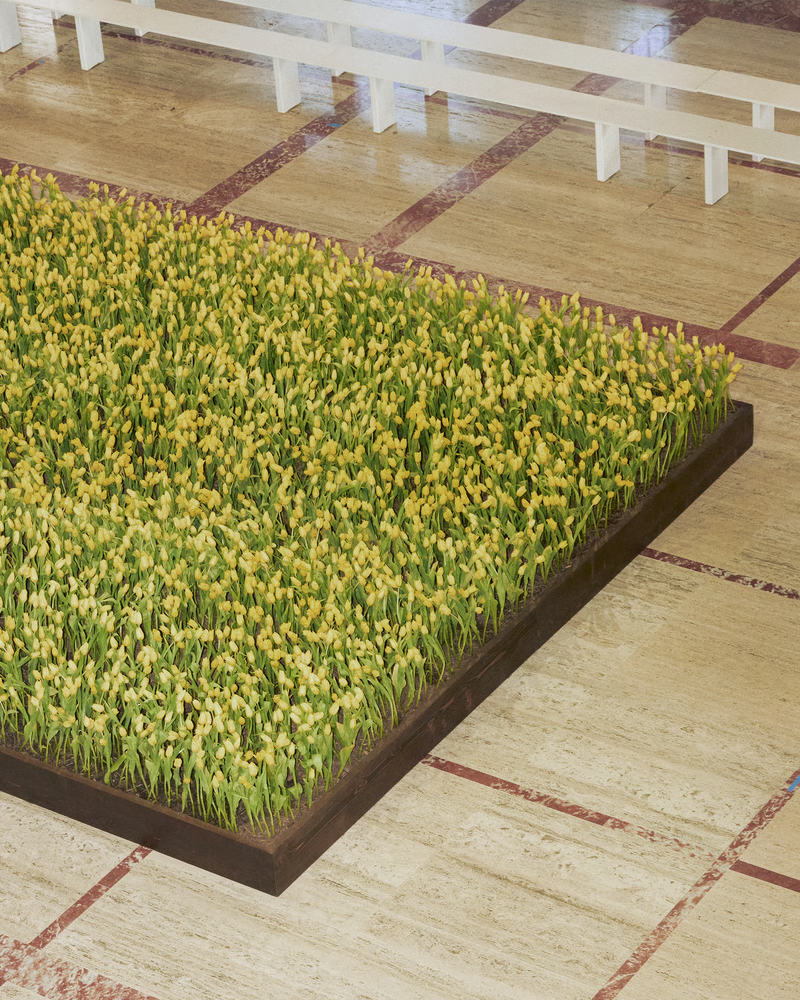
Photo via carolinaherrera.com
The Clothes
What made this collection work so well was how closely it stayed connected to the house’s own history while still feeling completely current. Carolina Herrera has always meant a certain kind of elegance, crisp white poplin shirts, a red so specific it has become shorthand for the brand, a woman who dresses with intention rather than following trends, and this show leaned fully into those signatures instead of trying to reinvent them. The poplin shirt showed up again and again throughout the show, tailored into sharp daywear with silver toned buttons and long cuffs, restructured into halter necklines built with internal support so they held their shape without collapsing, even extended into floor sweeping evening shirtdresses with pleated cummerbunds that flowed into dramatic train panels, mixing something almost menswear in its formality with the scale of proper eveningwear. There was a clear thread connecting back to the visual identity the brand has carried since its Good Girl fragrance became such a defining part of its image, and the taxi cab yellow from the tulips outside carried straight through into the beadwork, the separates, and even the footwear on the runway.
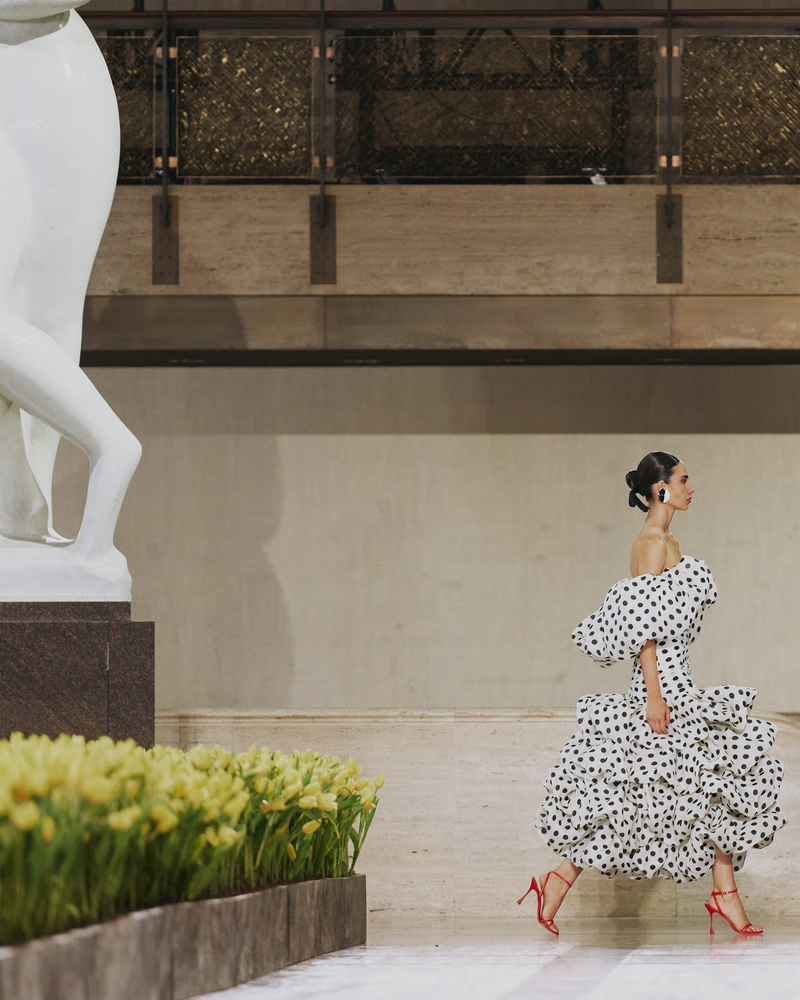
Photo via carolinaherrera.com
The tailoring itself leaned long and lean throughout the morning portion of the show, blazers cut with high armholes and clean shoulders extending past the hip before releasing into a gentle flare, worn over cigarette trousers and paired with the reworked poplin shirts. As the day progressed on the runway, those structured pieces gave way to lighter weights and softer movement, tailored silhouettes relaxing into lingerie inspired slip dresses and sheer floral lace layered over simpler foundations, with small slivers of midriff appearing between cropped jackets and pencil skirts that gave the whole middle stretch of the show a younger, looser energy than the crisp tailoring that opened it.
Polka dots ran through the collection at every scale, tiny prints on sheer daytime chiffon, bold graphic dots on a drop waist trumpet skirt that opened the entire show, dimensional woven dots worked directly into the fabric of an evening gown, and while the print has become almost overused across fashion lately, here it felt considered rather than trend driven, elegant rather than loud. Alongside it there was a distinctly Caribbean warmth running through the color palette and the silhouettes, in fringe detailing that moved with every step, in dresses built from ruffled florals and frayed edges that drifted like confetti as the models walked, in a looseness to certain silhouettes that felt sun soaked rather than strictly structured. It gave the whole collection a kind of joy that matched Herrera’s own roots in Caracas before New York ever entered the picture, and watching it as a fellow Latin American, there was something genuinely moving about seeing that heritage carried so visibly into one of the most storied houses in American fashion.
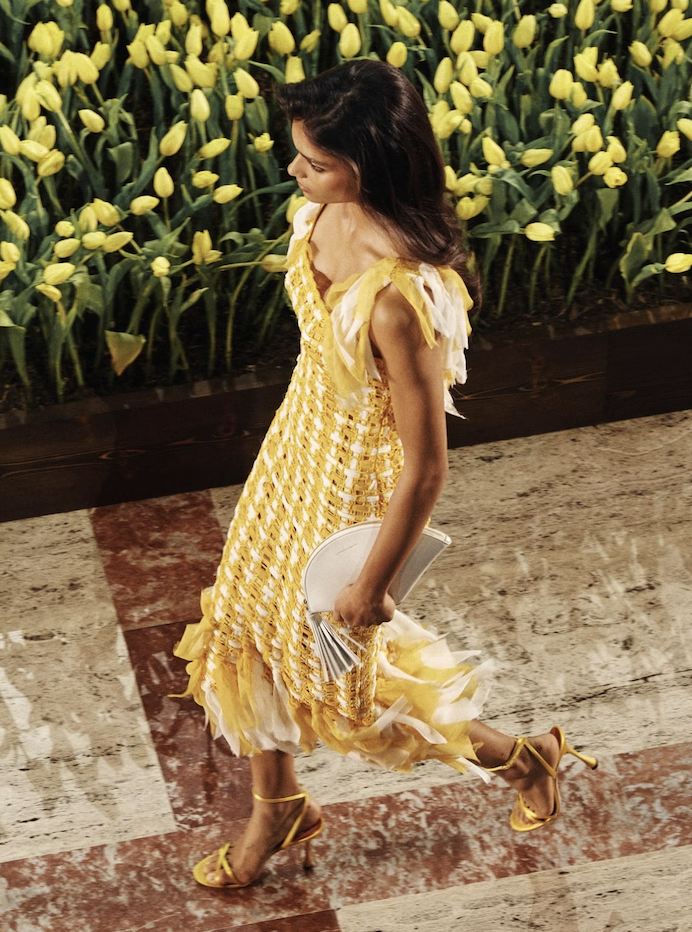
Photo via carolinaherrera.com
Underneath all of it there was real skill holding the collection together. The ruffles that showed up across collars, cuffs, and hems were not built from simple gathered fabric the way ruffles usually are, but from hundreds of individually cut strips of silk organza, hand stitched into tiered clusters that held their shape under the theater lighting while still moving naturally with the body, so that a single collar or sleeve looked almost sculptural rather than purely decorative. Evening fabrics leaned into fil coupé, a technique where decorative threads are clipped by hand to create raised floral patterns across sheer fabric, giving certain gowns a layered look that photographed beautifully under the theater’s gold ceiling.
Three collaborations gave the anniversary show real emotional weight, each one tracing back to an actual friendship or milestone in the house’s own history rather than being chosen simply for effect. One look reproduced, in delicate hand embroidery, the cover of the April 27, 1981 issue of The New Yorker, the exact newsstand date of Herrera’s very first show, its Manhattan skyline stitched in fine black and charcoal thread across a sunshine yellow silk slip dress edged in scalloped lace. Another translated Andy Warhol’s 1979 silkscreen portrait of Herrera herself onto a yellow evening mini dress, worked in metallic thread, bugle beads, and crystal, finished with long fringe that swayed with every step down the runway, a tribute to a friendship between designer and artist that dates back to the Studio 54 era, one that famously began when Herrera traded an evening bag for the finished portrait itself. Fine jewelry designer James de Givenchy of Taffin contributed sculptural pieces built from deep purple amethyst set into bright ceramic, jumbo garnet stones framed in soft pink petal shapes, and hammered gold spheres, adding another layer of craft to the night’s most decorated looks.
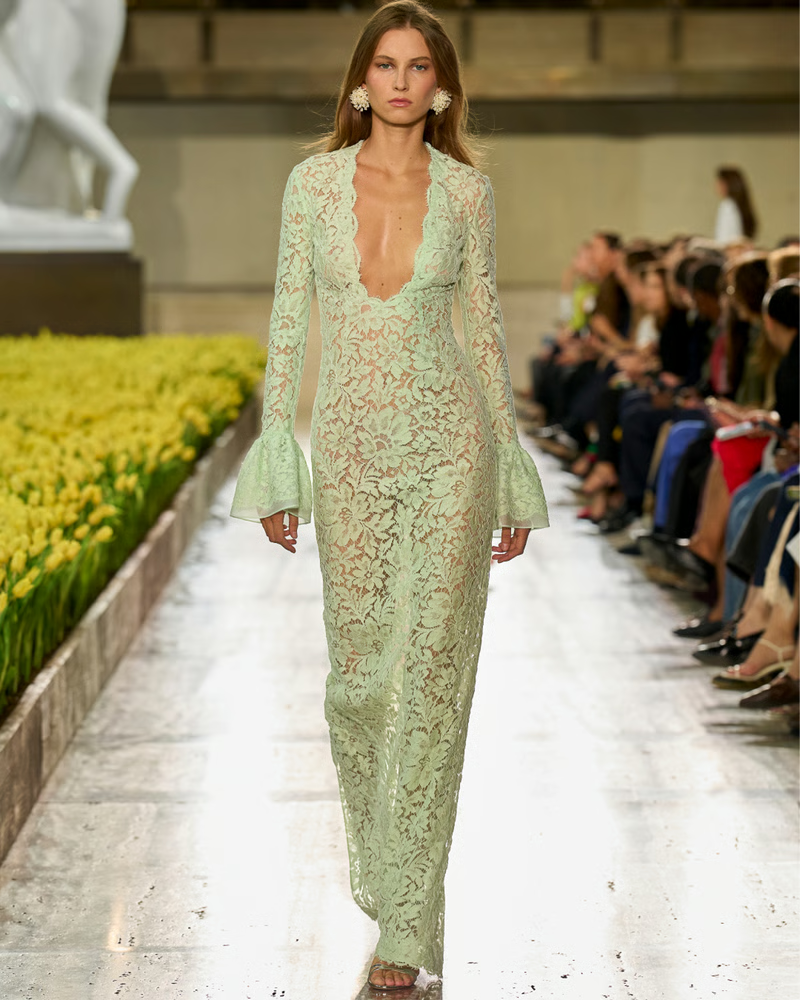
Photo via carolinaherrera.com
My favorite look of the whole night was a pale seafoam lace gown with a deep V neckline. Lace head to toe can tip into looking busy very easily, but here the color did the work, a soft, almost watery blue green that kept the dress feeling calm rather than chaotic, and the neckline was cut with enough restraint that it read as quietly confident rather than overtly sexy. It is easy to see why this became one of the standout pieces of the whole night, drama without excess, femininity without trying too hard.
The accessories carried their own personality throughout. The house’s signature Mimi bag turned up in glossy satin dotted with tiny cast gold frogs, a playful nod to La Grenouille, the storied French restaurant that has hosted generations of Park Avenue society, the same frog motif reappearing as oversized enamel brooches elsewhere in the collection. Other jewelry leaned into the same kind of New York specific humor, earrings and brooches shaped like the city’s classic black and white cookies sitting alongside more traditional pavé pieces, a sign Gordon was clearly having fun with the anniversary rather than treating it purely as a tribute. Hair, styled by Jimmy Paul, stayed swept back into clean, high chignons and soft French twists all night, a direct nod to Herrera’s own signature look, giving the runway a consistent through line even as the clothes themselves moved through such different moods. Makeup by James Kaliardos leaned into radiant, glowing skin rather than the powdered finish more associated with the house’s early eighties heyday, paired with warm bronze and gold across the eyes and soft, neutral lips that let the more decorated looks carry the drama on their own.
The Close
The show ended with Karlie Kloss in a structured black evening gown, its dramatic ruffled neckline sweeping around the collarbones as a nod to Nan Kempner and the society women who inspired the house’s earliest years, paired with striking high jewelry that gave the finale real weight without tipping into spectacle. Herrera herself, eighty seven years old, sat front row in an archival white shirt from her original 1981 collection, a quiet full circle moment that framed the entire evening. She was joined by a front row that mixed old guard and new, including Fran Lebowitz, Pamela Anderson, and a handful of fellow designers, Tory Burch, Gabriela Hearst, and Conner Ives, who came out specifically to support the milestone, along with celebrity faces like Charli D’Amelio, Alexa Chung, and Princess Maria Olympia of Greece further along the row. Hundreds of fashion students and members of the Herrera atelier itself filled the balconies above, invited by Gordon to watch the collection they had helped build come down the runway.
Industry response afterward was overwhelmingly warm. Critics praised how thoroughly Gordon managed to honor the house’s foundational codes without ever tipping into pure nostalgia, and there was real recognition for how naturally the collection balanced wearable daytime pieces against genuine showstoppers, along with plenty of attention paid to the craft behind the embroidery and construction work. I do not have much to critique here, honestly. This was one of those shows where every piece felt intentional, and where forty five years of history actually showed up on the runway instead of just being mentioned in a press note. Between the tulips, the Caribbean warmth in the fabrics and colors, and the collaborations tying everything back to the house’s real history, this felt like a collection that knew exactly what it wanted to say and said it with total confidence. Forty five years in, Carolina Herrera did not need to reinvent itself to feel relevant, it just needed to remember, clearly and beautifully, what it has always been.