
By Gabriela Afanador
Friday 9, January 2026
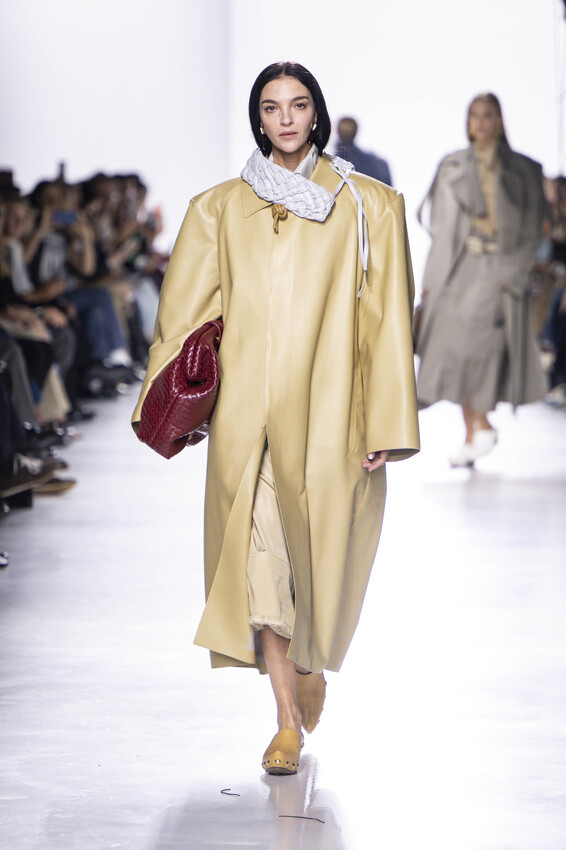
Photo: firstVIEW
Opening the Door
Bottega Veneta’s new chapter under Louise Trotter doesn’t arrive with fireworks; it opens the door and lets you walk right up to the workbench. Appointed at the end of 2024 and in the studio from early 2025, Trotter has steered the brand back toward its workshop heart—objects built slowly and worn easily—while easing the silhouette into something rounder, calmer, more lived-in. The room told you as much: no spectacle, just stools the color of boiled sweets in Murano glass and a quiet insistence that your eyes stay on cut, hand, and pace.
The first exits set the register. A knee-length trench carried all the familiar signals—storm flap, belt, deep pockets—but none of the stiffness; the fabric moved at the hem like a page turning. Trousers underneath fell in a cool, straight column, wide without slouch. Then came a leather slip with one strap nudged off the shoulder, cut in a dark petrol blue that held its edge like good parchment. You felt the house shifting from leather as armor to leather as drape, a small adjustment with big consequences for how the body reads.
Trotter favors volume you can steer. Blazers arrive overscaled but rounded at the shoulder so they don’t lord over the wearer; crisp white shirts sharpen that breadth without bullying it. Dresses take up space through surface rather than bulk—fringe that has been engineered in tiers so it trembles instead of thrashes, long-pile yarns laced with a whisper of shine so movement produces a low glint rather than a glare. When the collection slips into washed blue suede—the shirt and trouser you noticed, finished with a tonal bag—the nap softens the outline until even generous proportions look composed. Later, coats appear that read as fur at first glance and then unravel into something smarter: a shag knit threaded with metallic filaments, more glimmer than gloss, more air than weight.
No house code is handled with more care than intrecciato. Trotter narrows the leather strips so the weave becomes fine-grained and luminous, closer to the kind of proportion you’d find on an old wallet quietly burnished in a pocket. That scale lets the technique migrate: a camel coat with woven channels running down the sleeves and across the back, not pasted on but mapped to the garment’s anatomy; a sweater that looks like knit from three rows away and resolves into micro-strips up close; even a T-shirt built from tiny glossy bands, a feat of control disguised as effortlessness. There’s wit, too—a bandana cut in intrecciato, folded flat against the throat like a pouch unstitched. Nothing shouts; everything asks you to lean in.
Palette, Texture, Pace
Color stays disciplined. Petrol and navy, oat and camel, the soft fog of paper-hand cotton—tones that hum rather than sing so texture can do the talking. The show makes room for the theatrical without sacrificing sense. One look pairs a fringed leather skirt with a tailored jacket and a belt you can feel across the room; the hem animates the line, not the other way around. Another builds a navy leather slip with a round, lowered neckline and sets it against an off-kilter skirt in pale grey-blue with the faintest rib. The materials have presence; the attitude stays measured.
Accessories aren’t decoration; they’re the metronome. A Bottega runway puts bags on almost every exit not to push product but to fix proportion. A structured tote tethers a wide pant; a soft pouch relaxes a neat coat; a tonal match between bag and look lets surface lead the conversation. You can trace the same thought in the shoes and jewelry: nothing jangly, everything scaled to hold a line steady.
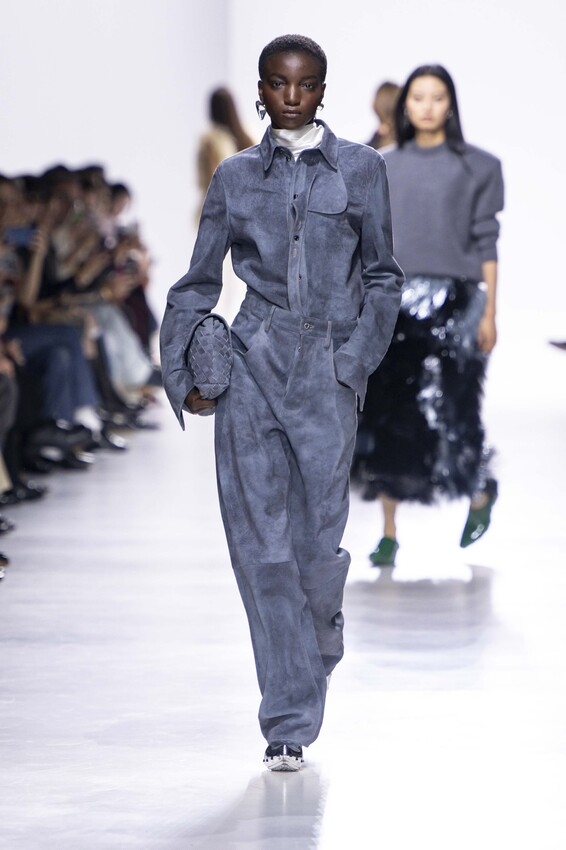
Photo: firstVIEW
What’s Shifted
Compared with recent years, the shift is less about silhouette than state of mind. The big coats remain, the wide trousers, the plain white shirts; what changes is the temperature. Corners are rounded, the ribcage gets space, the waist isn’t trapped, hems are built to breathe. If older Bottega sometimes dressed like a shield, Trotter dresses like a secret—craft you feel at the wrist, on the shoulder, where the hand lands. Heritage isn’t a museum label here; it’s a material fact. Intrecciato isn’t treated as a logo but as a language the clothes can speak fluently, from coats to knits to that sly little scarf.
By the finale, the collection lets itself enjoy a flourish. A red dress and an ivory twin arrive with backs folded and tacked into bow-like structures that read as architecture rather than trim. They’re precise, not precious—sculpture solved with fabric. It’s a fitting coda for a season that treats excitement as something you earn up close: the nap of suede brushed against the grain, the slight lift of a fringe row as a model turns, the way a woven channel catches light along a sleeve.
What Trotter is building at Bottega is not a new personality but a clearer voice. The clothes look minimal from across the room and become astonishing at conversation distance. They move, they bend, they hold. They invite the wearer to bring the story the last few inches. In a moment that rewards speed and noise, that invitation feels rare—and exactly right for a house whose greatest luxury has always been the quiet certainty of how something is made.