
By Gabriela Afanador
Sunday 4, October 2026
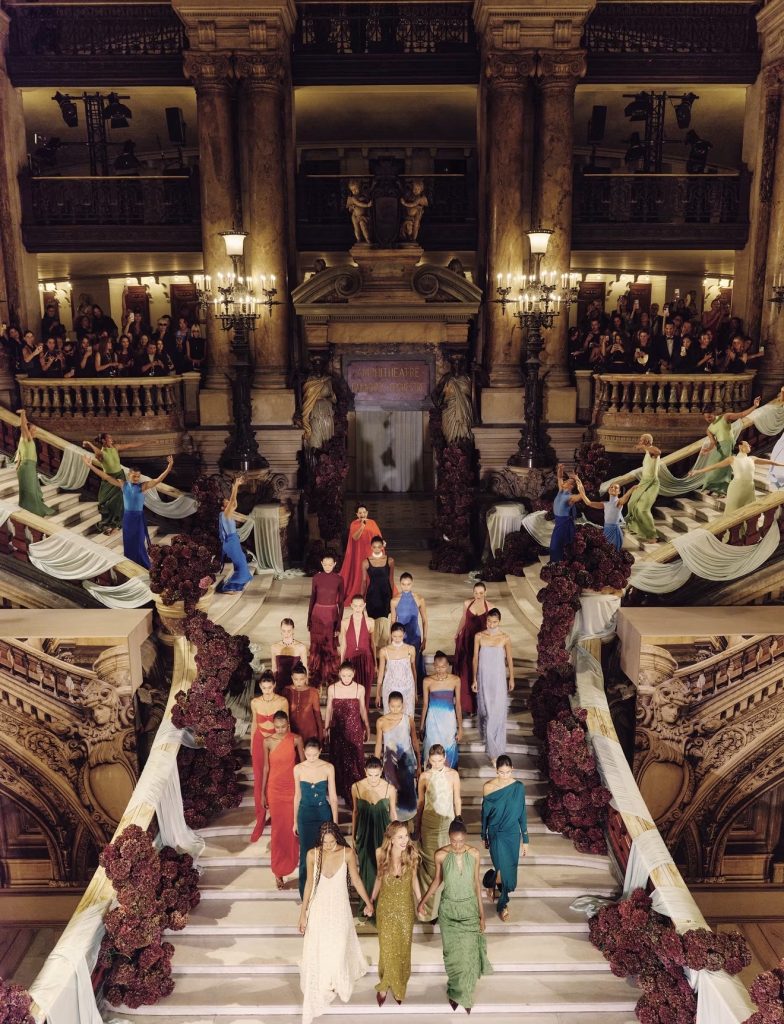
Photo via @Baobab on Instagram
On October 2, during Paris Fashion Week, Colombian fashion house Baobab staged its Resort 2027 presentation inside the Palais Garnier, the Paris Opera house commissioned by Napoleon III and designed by architect Charles Garnier in the mid-nineteenth century. For three centuries this building has kept its runway collaborations almost entirely within European luxury, having only ever formally partnered with Chanel and Rolex. This show marked the first time in the opera house’s history that it opened its doors to a Latin American fashion house for an official collaboration, and that single fact says a great deal about how significant this night was before a single garment ever came down the staircase.
The invitation came from the Paris Opera itself, part of a deliberate institutional effort to build real cultural dialogue with Latin America rather than simply gesture toward it. Rather than reaching for an established name out of Brazil, Mexico, or Argentina, larger markets with longer histories on the international stage, the opera’s own curators chose Baobab, a house founded in Bogotá by designer Isabella Espinosa while she was still studying law at Universidad de los Andes. They were drawn specifically to how she has built entire past collections around extraordinary, culturally loaded landscapes, staging shows in Madagascar’s Avenue of the Baobabs, in the Swiss Alps, in Dubai, in India, each one treating location as a core part of the storytelling rather than simply a backdrop. When the invitation came through, Espinosa set her own terms for what this show would become. Every performer, dancer, vocalist, musician, and production lead involved had to be Colombian, drawn from across the country’s own regions, rather than outsourced to the usual local Parisian production agencies most international shows rely on. That single decision turned the presentation from a standard runway booking into something closer to a full cultural takeover of one of France’s most carefully guarded cultural institutions, built entirely by Colombian hands from the ground up.
The Concept
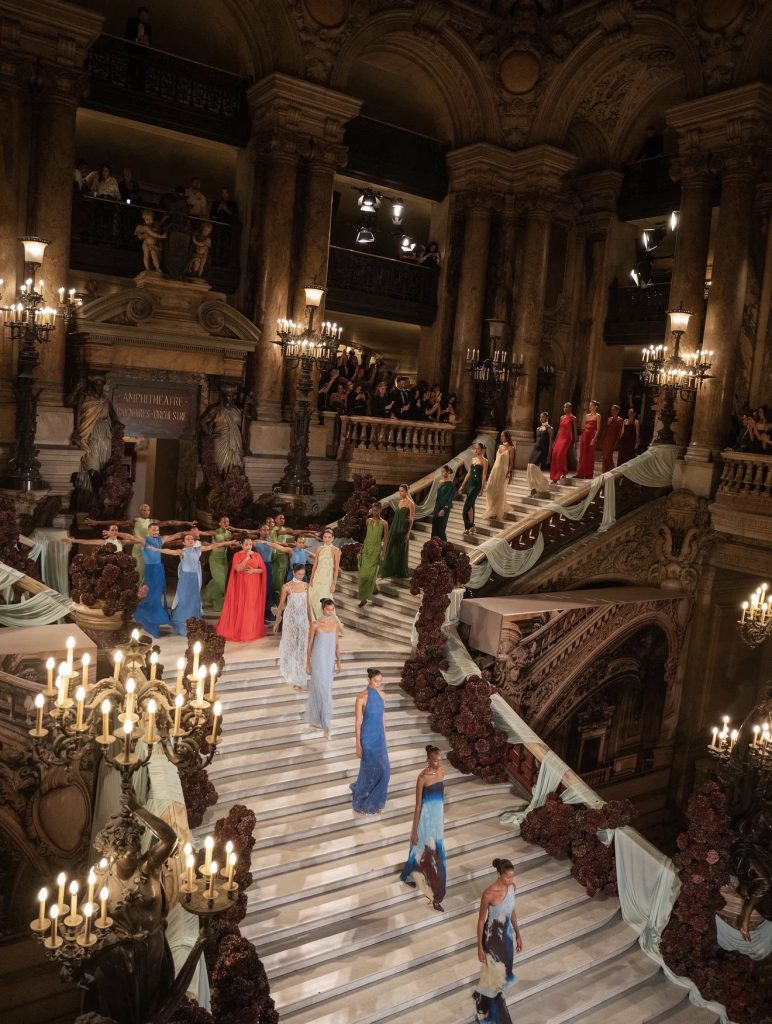
Photo via @Baobab on Instagram
The whole night was framed under the title Love in the Time of the Opéra, built around the collection itself, titled Symphony of the Tropics. The name is a direct nod to Gabriel García Márquez’s 1985 novel Love in the Time of Cholera, and the reference runs deeper than the title alone. In 1955, García Márquez left Barranquilla for Paris and carried the oral traditions and magical realism of the Colombian Caribbean into French literary life with him, a migration that quietly reshaped how the world understood Latin American storytelling. Seventy-one years later, Baobab staged something like the reverse journey, bringing the sound, material, and sensory memory of Colombia’s Caribbean and Pacific coasts directly into the architectural center of Parisian high culture, closing a loop that had been left open for seven decades.
There is a real intention behind that choice that goes beyond simple homage. Fashion houses coming out of the Global South are so often expected to soften themselves, to adapt into quieter, more restrained European codes in order to be taken seriously on a stage like this one, trading their own visual language for something more easily digestible abroad. Espinosa did the opposite, consistently, across every single decision she made for this show. She never tried to imitate nineteenth century French operatic costume or make Colombian design more palatable for a European room. She placed Colombian coastal identity directly inside French neoclassicism and let the two exist side by side as equals, treating the opera house not as an authority she needed to please but as a canvas she had every right to reshape on her own terms.
The Show
The whole presentation centered on the Grand Escalier, Garnier’s own marble staircase, built from polychrome Italian marble, Swedish red porphyry, and French serpentine stone, one of the building’s most recognizable architectural features. The production team draped the balustrades in light, aquamarine fabric that mimicked sea water moving against the cold stone, and lined every step of the staircase in fresh wine red flowers, so the entire runway path was framed in jewel tones from the very top of the staircase down to the floor. The lighting stayed warm throughout the evening, lit by the opera house’s own historic candelabras and bronze chandeliers, catching against the gilded ceiling overhead and giving the whole space an amber glow rather than the harsher white light typical of most runway shows. A Bogotá based artist was commissioned to paint live throughout the presentation, capturing the staircase in motion in real time, a finished canvas that now exists as its own physical record of an evening that otherwise only lived for the few hours it actually took place.
The show opened with a vocal performance from Barranquilla born singer Lido Pimienta, who entered through a silk draped corridor and used the building’s own natural acoustics to perform reinterpretations of traditional Caribbean chants, her voice alone setting the emotional register of the room before a single model had appeared. From there the runway proper began, fifty-two models descending the Grand Escalier together with contemporary dancers from Cartagena’s Cuerpo de Indias moving alongside them, trading the rigid verticality of classical ballet for something looser and more grounded, closer in feeling to the actual movement of coastal water than to anything typically associated with a Paris Opera stage. The show was led by actress Laura Sofía Grueso, known professionally as Akima, recognized internationally for playing young Rebeca in Netflix’s adaptation of One Hundred Years of Solitude, which drew an immediate, living connection between García Márquez’s own fictional world and this very real staircase in Paris, the literary reference made physical the moment she took her first step down.
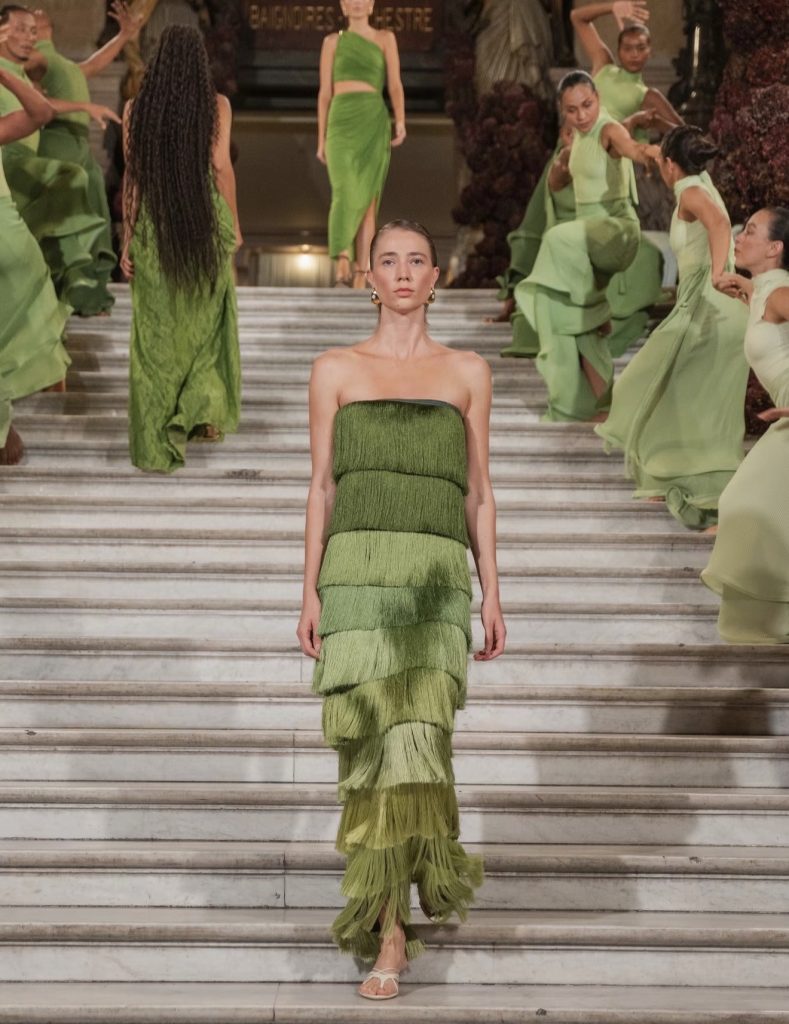
Photo via @Baobab on Instagram
The whole cast gathered together at the base of the staircase for the finale, arms raised in unison, a wall of blues, deep reds, and soft neutrals spread out against the white marble behind them, and Espinosa herself took her bow from the Amphithéâtre doorway, surrounded by dancers and models together rather than standing apart from them. From there the night turned into something closer to a full celebration than a conventional fashion show. Grupo Niche, the salsa orchestra out of Cali, performed live in the Grand Foyer, marking the first time a salsa band has played inside the Palais Garnier in its entire history, before the evening moved into an afterparty hosted by a Medellín nightclub, carrying the night forward from Afro-Indigenous chant through salsa and on into the early morning hours.
The Collection
Symphony of the Tropics marks a real shift for Baobab, moving the house beyond the resort swimwear it originally built its name on and into full evening and formal cruise silhouettes for the first time at this scale. The construction throughout balances that same beachwear lightness against the internal structure evening dressmaking genuinely requires. Several of the asymmetric gowns suspend their entire silhouette from a single shoulder point using custom cast metal hardware, pieces that function as both structural stress points and visible jewelry at once, gathering fabric across the chest before letting it release into deep cutaways at the waist and hip. Strapless, sweetheart necked gowns elsewhere in the collection rely instead on flexible internal boning built into fully lined, double layered bodices, anchoring the structure firmly around the ribcage while still allowing the skirt beneath to fall loose and move freely all the way down to the floor. Halter silhouettes take a looser approach entirely, using long self tied straps that loop across an open back and let each wearer adjust her own fit and train length by hand rather than relying on a fixed construction underneath.
The textiles were developed specifically in partnership with the Colombian manufacturer Sutex, blending sustainable synthetic fibers with genuinely fine finishing techniques rather than treating sustainable material as a compromise on quality. A two way stretch lycra runs through the swim and body conscious pieces, fully lined for a supportive, opaque fit against the body, while several of the gowns use a micro sequin knit engineered specifically to catch candlelight without ever stiffening the fabric’s natural movement, a detail that matters enormously in a collection built entirely around descending a staircase in front of a seated audience. The color story moves across three distinct registers throughout the collection. Soft neutrals pull from coastal limestone and mineral tones found along the Colombian coast. Cool aquatic blues echo both ocean water and the particular blue found running through French royal tapestry, a deliberate point of contact between the two cultures the show was built to connect. And a run of deep theatrical reds bridges equatorial floral color with the opera house’s own historic velvet drapery, a palette built specifically to belong inside that particular room rather than simply stand apart from it.
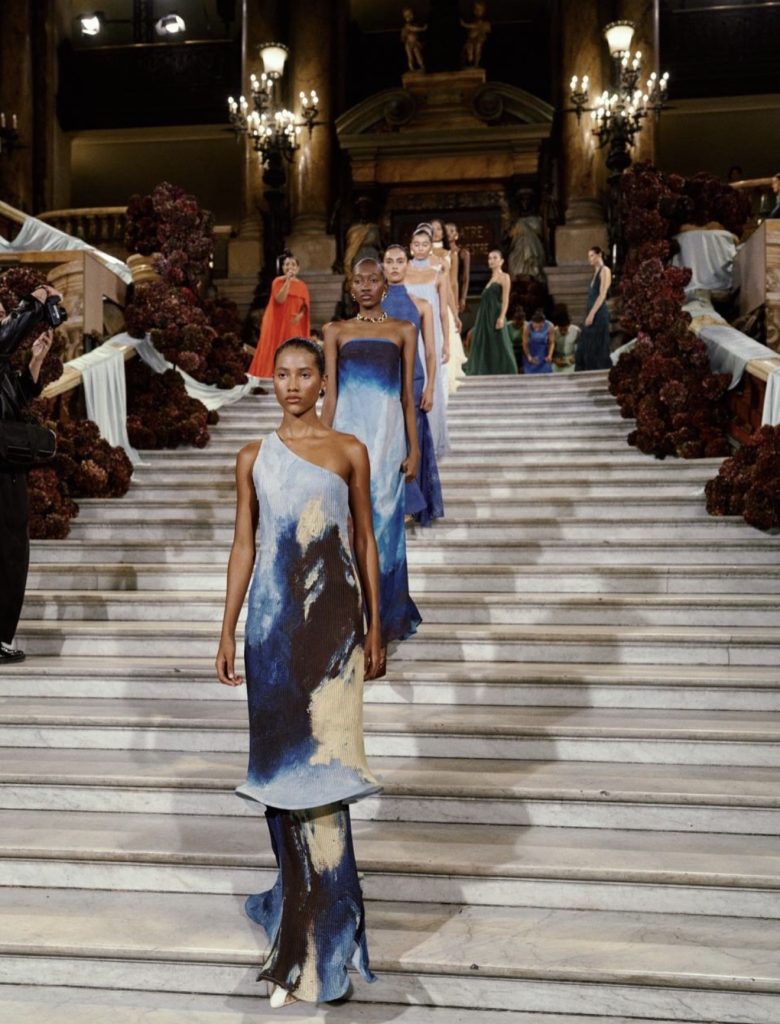
Photo via @Baobab on Instagram
Footwear came from an exclusive partnership with Colombian designer Daniela Amaya of the label Damaya, developed specifically to keep models steady on genuinely steep, centuries old marble steps that were never designed with runway footwear in mind. The collection included open toe heels in wine red leather with long cords tied up the calf, and flat, low heeled sandals built from tubular metallic gold leather straps, giving the whole cast a barefoot, beachside look while still providing the grip the staircase actually demanded. Beauty came from the Medellín based house Atenea Profesional, who built their entire concept around what they called tropical luminosity, hydrated, glowing skin and soft, natural bronzing rather than the heavier contouring more typical of a European runway, a choice that let the genuine range of skin tones across the Colombian cast read on its own terms rather than being flattened under one uniform standard of makeup.
Beyond the clothes themselves, the evening extended into a seven course dinner served in the Grand Foyer for roughly four hundred guests, led by Barranquilla chef Manuel Mendoza, whose restaurant Manuel ranks among Latin America’s best. The menu, titled Barranquilla, Mon Amour, moved through the Indigenous, Afro-descendant, European, and Middle Eastern influences that shaped the port city itself, green plantain paired with coconut, native corn with roasted cashew, tamarind glazes, and gentle Levantine touches of sesame and toasted cumin, turning the meal itself into another layer of the same story the runway was already telling.
The Close
As a Colombian myself, I find it genuinely difficult to put into words what it meant to watch this show unfold. This was not a brand borrowing Colombian imagery to sell an idea of the tropics to a European audience from a safe distance. This was an entirely Colombian team, Colombian dancers, a Colombian singer, a Colombian chef, Colombian textile manufacturers and shoemakers, walking into one of the most carefully guarded, historically European institutions in the fashion calendar and being met there as equals rather than as guests expected to adjust themselves to fit the room they were standing in. Three centuries of history at that opera house, and a Colombian house was the first from the entire region to stand on that staircase and be received on its own terms.
What moves me most, sitting with this show after the fact, is how little Espinosa actually compromised to get there. She did not soften Baobab into something more easily digestible for European taste, the way so many brands from outside Europe feel pressured to do in order to earn a place at this level. She brought Lido Pimienta’s voice echoing through a room built for European opera, Grupo Niche’s horns, a seven course Barranquilla menu served to four hundred international guests, Wayúu inspired chant, and a live salsa band playing under crystal chandeliers that had never once carried that particular rhythm before. Watching that unfold, as someone who grew up with exactly those sounds, that same instinct for color, and that same sense of celebration as something communal rather than private, filled me with a pride that is hard to fully articulate. This was not Colombia asking quietly to be let in through the back door of European culture. This was Colombia walking straight through the front entrance, entirely itself from the first note to the very last step down that staircase, and being received exactly as it deserved to be.