
By Gabriela Afanador
Thursday 9, July 2026
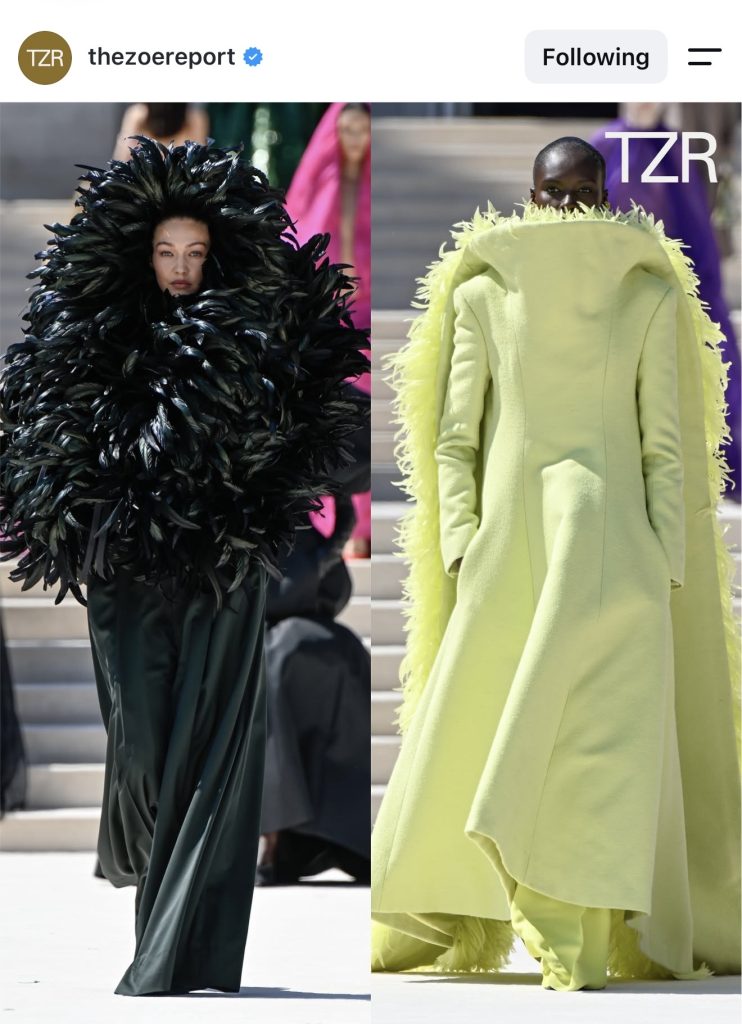
Photo via @Thezoereport on Instagram
Pierpaolo Piccioli presented his first haute couture collection for Balenciaga on July 8th, 2026, in the central courtyard of the Cité Internationale Universitaire de Paris, under the midday sun, during a summer heat wave. The choice of venue said everything about the direction he intended to take. No darkened rooms, no theatrical scenography, no controlled atmosphere. Guests including Demi Moore, Cynthia Erivo, Naomi Watts, Shailene Woodley, and Teyana Taylor sat encircling a simple manicured hedge with the heat and the natural light and the open sky above them, the clothes exposed to real wind and real sun in a way that immediately separated this presentation from the dense, concept-heavy show environments that had defined the brand’s recent history. British singer Anohni, a long-time collaborator from Piccioli’s Valentino years, performed live throughout, the raw emotional quality of her voice providing the show’s only soundtrack and setting a tone that had nothing to do with spectacle and everything to do with presence. The combination of the heat, the open air, the live music, and the unvarnished simplicity of the setting created an atmosphere that felt genuinely unusual for a couture debut of this scale, the kind of atmosphere that can only be described as human in the most literal sense, exposed and warm and real.
In the days before the show, Balenciaga had cleared its social media platforms and replaced them with portraits and profiles of the individual artisans who lead the atelier, the people who had spent months making the fifty looks that were about to walk out. The show closed not with a solitary bow but with Piccioli walking the courtyard alongside his entire couture studio and atelier team, all wearing their traditional white lab coats. That decision and the final walk together formed a consistent argument across the entire day, that the human labor inside the clothes was the point, that the clothes existed to honor that labor rather than the other way around, and that luxury in the context Piccioli was proposing had nothing to do with inaccessibility or irony but with the sustained, specific attention that one person gives to making something for another. For a house that had spent the better part of a decade making luxury feel deliberately uncomfortable, the shift in register was immediate and total.
Piccioli arrived at Balenciaga in May 2025 after more than twenty-five years at Valentino, where he had been co-creative director alongside Maria Grazia Chiuri from 2008 and sole creative director from 2016, winning Designer of the Year at the Fashion Awards in both 2018 and 2022. He was recruited by CEO Gianfranco Gianangeli, appointed in November 2024, as the seventh creative director in the house’s history since Cristóbal Balenciaga founded it in 1919. The task he inherited was specific and demanding, to follow a decade of Demna Gvasalia’s subversive internet-aligned irony and find a way to reconnect the house with the architectural and structural codes Cristóbal had established without making the result feel like a retreat into the archive. His first two ready-to-wear collections, beginning with the Spring Summer 2026 debut and continuing into the Autumn Winter 2026 collection titled ClairObscur, initiated a process of subtraction, refining the brand’s monumental volumes while softening its severe streetwear codes with fluid draping and face-framing portrait collars. The haute couture debut was where that process arrived at its fullest and most considered expression, the moment when the direction he had been building across two seasons finally had the technical resources and the creative framework to say everything it had been working toward.
Piccioli described his preparation for the collection as beginning with the people inside the Balenciaga atelier, understanding what they knew how to do and then building the clothes around that knowledge rather than imposing a vision on top of it. He also spent significant time in the archives studying Cristóbal, whom he described backstage as the inventor of modern fashion, obsessive in his conversation with the human body, always keeping the body present rather than making the clothes abstract and disconnected from movement. The synthesis Piccioli was attempting was to take that obsession with the body and the structural vocabulary that came from it and bring it into contact with his own philosophy, which has always been about emotion and color and the relationship between a garment and the specific human being wearing it rather than the ideal form the garment might theoretically describe. He described his technical approach as removing internal structures wherever possible and prioritizing engineered cuts over excessive layers of fabric, the volume coming from the precision of the pattern rather than from what was built inside to support it. Couture, he said backstage, remains a space where there are no maps, a sentiment that has run through his work at every house he has touched and that felt particularly resonant in the context of Balenciaga, a house whose recent history had been defined by exactly the kind of knowing, self-referential certainty that the absence of a map is the opposite of.
The Collection
The show opened with a pair of oversized floor-sweeping beige chinos worn with a relaxed posture that felt almost deliberately anticlimactic for a haute couture debut, the ease of the silhouette grounded and entirely human rather than architectural or imposing. It was a precise opening choice, establishing immediately that the grandeur of what followed would not come from formality or rigidity but from the relationship between the clothes and the body underneath them. There is a long tradition in couture of opening with a strong declarative look that announces the season’s visual thesis before the audience has formed any expectations, and Piccioli used that convention to say something specific, that his Balenciaga would begin with the body in its most ordinary state and build from there rather than beginning with an ideal and working backward. The hybrid tailored T-shirt dress that came shortly after, in inky black and optic white with a fitted canvas-tailored bodice transitioning into a free-hanging skirt, referenced Cristóbal’s 1957 sack dress while translating it into something entirely present-tense, the crystal City bag it was styled with making the connection between the house’s heritage and its contemporary identity legible without laboring the point.
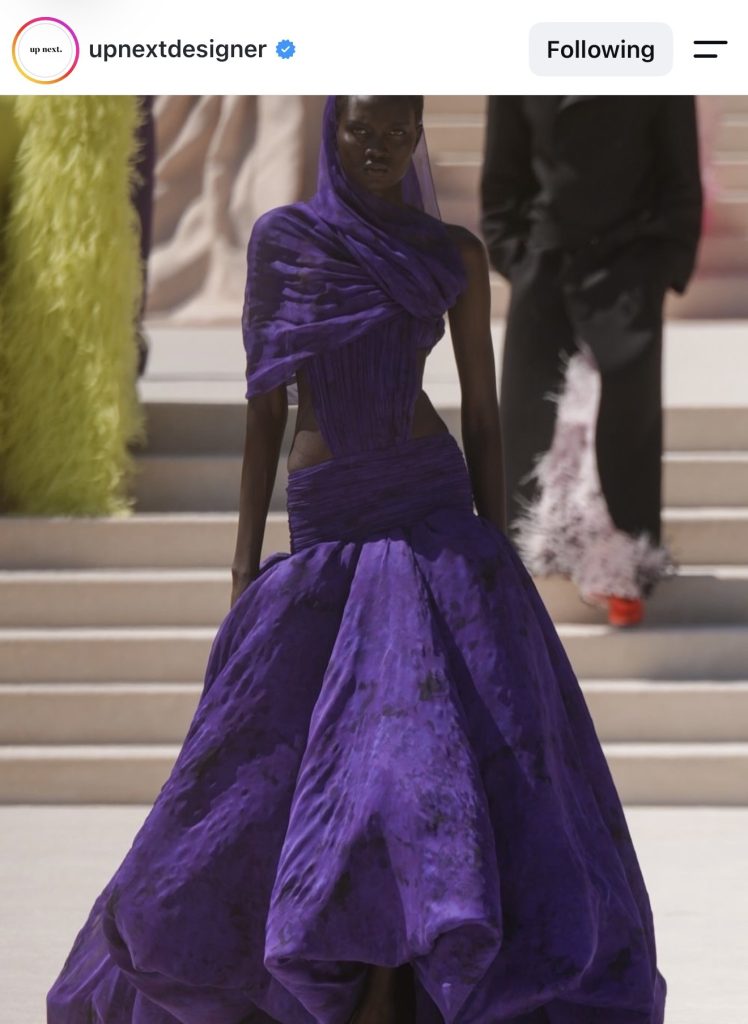
Photo via @upnextdesigner on Instagram
The molded cashmere hourglass coat in camel arrived relatively early in the lineup and was one of the collection’s quieter and more technically extraordinary pieces. Constructed with zero seams by molding the double-faced cashmere directly onto a funnel-necked Stockman form using 3D body scans as the base, the coat held its architectural shape through the precision of the cut alone, no internal structure of any kind, and worn in the heat of the open courtyard it looked like something that had simply decided to take the shape of the body beneath it rather than something that had been engineered into that position. The tailoring was so precise that the garment appeared inevitable rather than constructed, and it was the piece that most directly echoed Cristóbal’s own obsession with the relationship between fabric and the body it surrounds, the one that made Piccioli’s connection to that lineage feel most genuinely earned. These early and mid-show looks set a rhythm of ease that the collection maintained even as the silhouettes grew considerably more elaborate, so that nothing that arrived later felt disconnected from the human body that the opening had established as the collection’s fixed center of gravity.
The technical centerpiece of the collection was a material called Amsilk, a bioengineered silk alternative developed through DNA editing and protein engineering, free of fossil fuels and reportedly two and a half times stronger than steel, which Piccioli and the atelier used to construct the collection’s most dramatic volumetric pieces without the internal wires and synthetic stiffeners that would ordinarily be required to hold those shapes. Understanding what Amsilk made possible changes how you read the bigger looks in the collection, because the volume they carry is not supported from inside but held by the fabric itself, which means it moves differently and responds to the body and the surrounding air differently than structured couture silhouettes typically do. The stacked circular architectural gown in shocking pink, with its concentric self-supporting volumes referencing both Brancusi’s geometric simplicity and Piccioli’s signature relationship to expressive color, was the clearest demonstration of what this meant in practice, the circles holding their shape in the open afternoon heat without any of the internal scaffolding that a piece of that scale would conventionally require.
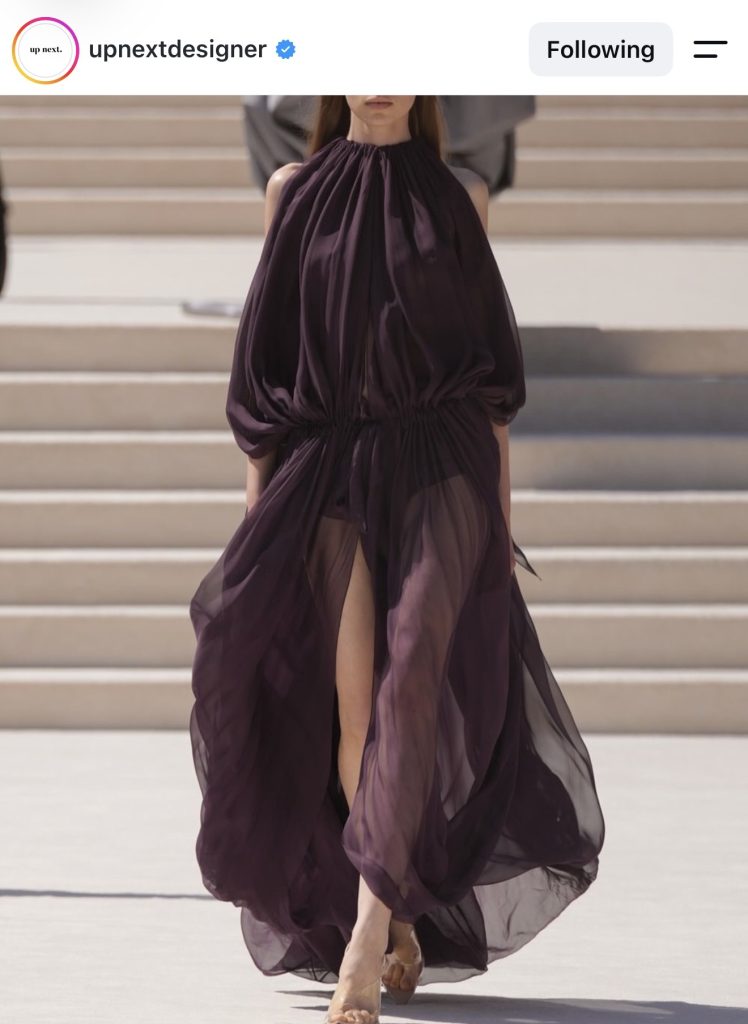
Photo via @upnextdesigner on Instagram
The Kinetic Petal Strapless Gown was the moment the collection and the outdoor setting met most completely. Made from 24,150 individually shredded gazar petals, each one sewn to move independently with the wind, it was a piece that could only have been fully realized in an open-air environment and that Piccioli must have known would look different every time a breeze moved through the courtyard. The petals lifted and settled and caught the light in constantly shifting combinations, the garment essentially unfinished until the weather completed it, which was one of the more genuinely poetic ideas in a season full of them. The balloon bomber and tank in optic white and cerulean used double-layered silk gazar to create a dramatic air-filled back dome referencing the historic Watteau back popularized in 1950s couture coats, the archival gesture executed in a new material and worn casually enough that the grandeur of the reference and the ease of the wearing existed simultaneously without contradiction. A plum fringe skirt paired with a sheer lavender blouse, the heavy fringed panels stitched onto a structured waistband and the sheer blouse providing the contrast between weight and weightlessness that ran through the collection’s approach to fabric throughout, was one of the most purely beautiful combinations of the season and one of the strongest expressions of the painterly approach to color that has always defined Piccioli’s work.
The Color and the Finale
One of the most significant departures from the house’s recent history was the palette, which moved far from the black that had dominated Balenciaga for the better part of a decade into an expressive range of neon and electric pink, neon orange, mint green, turquoise, mulberry, plum, and lavender, all of them anchored throughout by the classic inky blacks and optic whites that remained a consistent thread across the fifty looks. A lemon yellow sequined gown caught and refracted the afternoon sun in a way that only outdoor natural light can produce, the sequins doing something in natural light that they simply cannot replicate under the controlled lighting of an indoor show, the color shifting between gold and yellow and almost white depending on where the light was hitting at any given moment. The mulberry and lavender pieces that arrived in the final third of the lineup felt specifically personal in the way that color can feel when a designer has a genuine relationship to it rather than a theoretical one. Piccioli has spoken for years about color as a form of emotional communication rather than a decorative choice, and in the context of Balenciaga, a house that had largely abandoned expressive color under its previous direction, the arrival of these shades had the quality of something being restored rather than introduced, a return to a kind of warmth the brand had not been associated with for a long time.
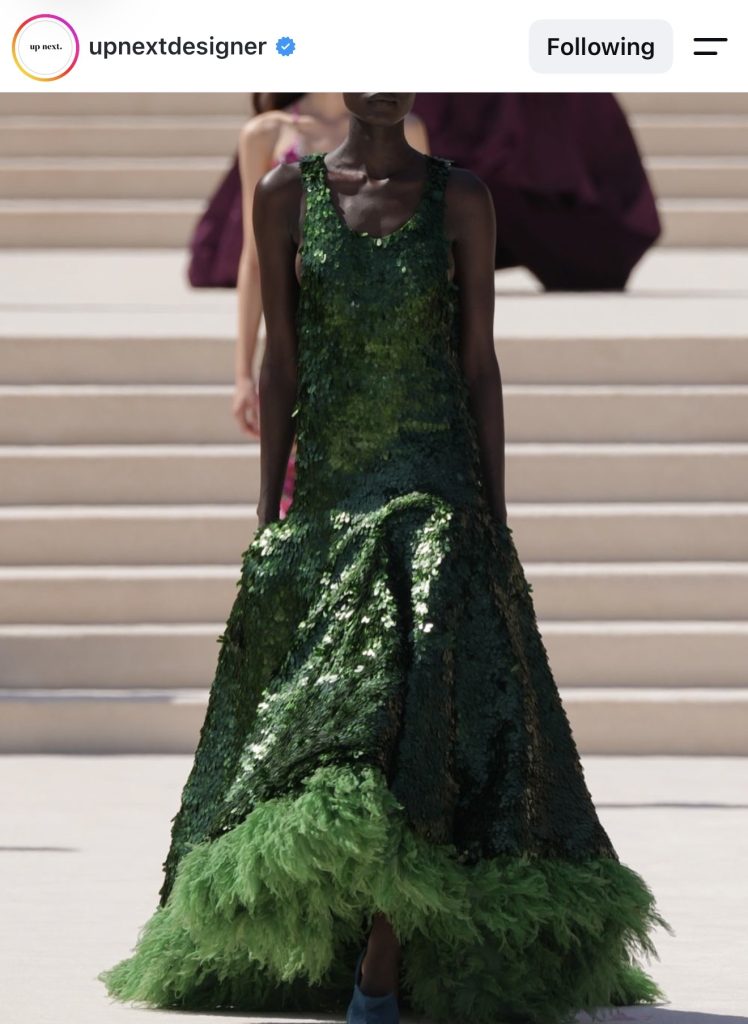
Photo via @upnextdesigner on Instagram
The soft pastel pink pieces, including the Kinetic Petal Gown and the smaller more intimate gowns toward the collection’s middle section, carried a warmth that the open courtyard amplified rather than diluted. Natural light brings out the complexity in pinks in a way that indoor show lighting rarely achieves, the way different angles produce different depths in the same fabric, and Piccioli seemed to have understood this when he chose the venue and chosen these colors together as a single decision rather than two separate ones. The more saturated colors, the shocking pink of the stacked circular gown, the neon orange pieces that appeared mid-show, arrived with a physical confidence that the open-air setting gave them rather than containing them, the saturation reading as joyful in the heat rather than aggressive in the way that highly saturated color can sometimes feel in a controlled interior environment.
Gigi Hadid closed the show in an oversized face-framing and body-engulfing hood constructed from thousands of high-gloss black rooster feathers, the feathers moving in the summer breeze with the same natural responsiveness as the Amsilk petals earlier in the show, the outdoor setting that could have been a logistical challenge becoming instead the collection’s most consistent creative collaborator across the full fifty looks. The hood was gothic and operatically scaled and genuinely whimsical simultaneously, referencing the organic topiary shapes Cristóbal had favored while arriving at something that belonged entirely to the present, and it was generous enough to close a collection of this ambition without feeling like a separate statement from everything that had preceded it. Hadid wore it with the physical ease that the entire collection had been arguing for since the first chino-clad model walked out, the scale of the piece balanced by the fact that nothing in how she moved suggested it was difficult to carry, which is the hardest thing a couture finale look can achieve and the thing this one did completely.
The broader context of Paris Couture Week gave Piccioli’s debut a specific resonance. While Daniel Roseberry’s Schiaparelli pushed into deep-sea silicone and kinetic tentacles and Matthieu Blazy told fairy tales through hidden embroideries and miniature sculptural heels at Chanel, Piccioli was making an argument that was in some ways quieter than both and in other ways considerably more ambitious, proposing that the future of Balenciaga lay not in concept or spectacle but in the sustained and patient attention of human hands applied to exceptional materials in service of real bodies. This is a more difficult case to make in a week that rewards visual novelty, and the fact that the collection made it persuasively across fifty looks without losing either its technical ambition or its emotional warmth says something about the clarity of the vision and the depth of the preparation behind it. This was a debut that established a direction and executed it with genuine craft and conviction, and the direction it established is one that the house has not inhabited for a very long time.