
By Gabriela Afanador
Monday 1, June 2026
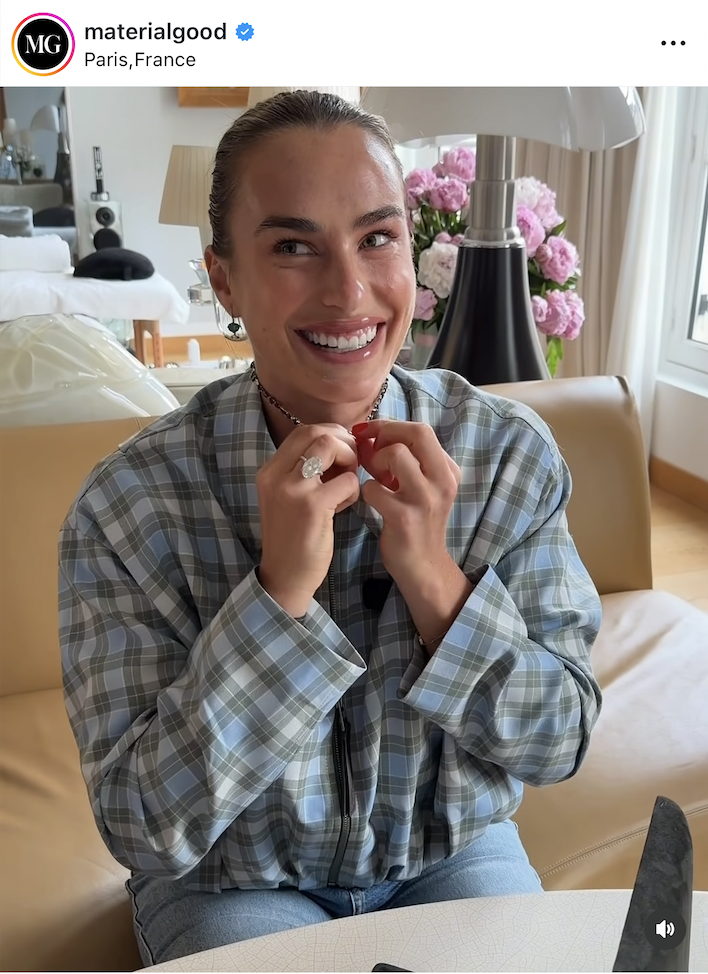
Photo via @materialgood on Instagram
Most athletes remove their jewelry before competing. Aryna Sabalenka puts hers on. The world number one arrived at Roland Garros 2026 wearing a custom high jewelry suite valued at $148,000, designed specifically for her by New York-based luxury jeweler Material Good, and she wore it not to a press conference or a trophy presentation but onto the red clay of one of the most physically demanding tournaments in professional tennis. The decision is as deliberate as everything else about the way Sabalenka presents herself publicly, a 28-year-old four-time Grand Slam champion who has built a commercial identity around the idea that power and femininity and humor and luxury are not competing registers but a single coherent one. Her partnership with Material Good, which appointed her as its first-ever Jewelry Ambassador in early 2026, produced a suite titled Terre Rouge, red earth in French, designed to mirror the exact color profile of the French Open’s famous red clay courts. Every garnet in the collection was selected for its deep saturated crimson, every diamond positioned to catch the Paris sunlight and break the red with sharp points of white light, and the whole thing was engineered from the inside out to survive the physical forces of a professional baseline rally without losing a single stone.
Sabalenka’s commercial trajectory in 2026 has been one of the more interesting stories in professional sports marketing. Alongside her Material Good partnership she announced deals with Gucci and Emirates Airlines, a portfolio that positions her at the intersection of athletic dominance and aspirational lifestyle in a way that few female athletes have managed to do simultaneously rather than sequentially. Her digital presence, which spans over a million TikTok followers and includes content ranging from on-court training footage to choreographed dances with fellow players like Paula Badosa, gives her a generational appeal that traditional luxury sponsorships struggle to manufacture artificially. What makes Sabalenka genuinely compelling as a luxury ambassador rather than simply a high-profile one is that the jewelry is not a performance she puts on for cameras. She has been wearing fine jewelry on court since her 2025 US Open campaign, where she competed in custom Material Good designs featuring fancy yellow diamonds and multi-shape diamond tennis necklaces, and the comfort with which she moves in significant pieces of fine jewelry during the highest-pressure moments of professional sport communicates something about her relationship to these objects that no advertising campaign could fully replicate. Her engagement to entrepreneur Georgios Frangulis, who serves alongside her performance coach and a physiotherapist as part of an informal security arrangement when she navigates public sports complexes wearing six-figure jewelry, adds a personal dimension to the partnership that makes it feel genuinely lived rather than contracted.
Material Good is not a conventional jewelry house, which is part of why this partnership works as well as it does. Founded in 2015 by Rob Ronen and Michael Herman, two former colleagues who met while working for a diamond manufacturer at Rockefeller Center, the brand operates out of residential-style showrooms on the second floors of historic buildings in New York, Miami, Boston, and Dallas, spaces designed to feel like private apartments rather than retail floors, where clients are invited to explore without pressure and the central display cases are omitted entirely. Ronen spent a decade at Audemars Piguet before co-founding the brand, and Herman brought a background in bespoke custom atelier work specializing in diamond engagement rings and private commissions. The brand remains 100 percent founder-owned, which gives its creative decisions a coherence and consistency that publicly traded luxury conglomerates rarely achieve. The Terre Rouge suite was designed by Material Good’s Head of Jewelry Design, Atara LeV, who applied the brand’s signature multi-shape philosophy throughout, combining marquise, pear, oval, emerald-cut, and round stones within single pieces to create an asymmetric, rhythmic interplay of light that reads as cohesive rather than chaotic and that moves on the body in a way that a single-cut uniform piece never could.
The metallurgical foundation of the entire suite is 18-karat white gold, a deliberate and technically specific choice. Eighteen-karat gold consists of 75 percent pure gold alloyed with 25 percent white metals, typically palladium or nickel, a composition that strikes the precise balance between the purity that luxury jewelry requires and the physical hardness that holding gemstone settings under athletic stress demands. Pure gold at 24 karats is too soft for active wear and too yielding to maintain prong tension under the deceleration forces of a professional tennis swing. The cool, highly reflective surface of white gold also provides the ideal frame for both the deep crimson of the garnets and the brilliant white of the diamonds, each material reading more intensely against it than it would against yellow or rose gold, which would pull the warm tones of the garnets toward orange and muddy the contrast between the two stones. The garnets chosen throughout the suite are pyrope-almandine varieties, a specific garnet family that exhibits a blood-red hue with exceptional depth and saturation, the kind of red that reads as rich rather than bright, dark enough to carry genuine weight visually but with enough internal fire to stay alive under movement and changing light conditions.
Terre Rouge Multi-Shape East-West Necklace
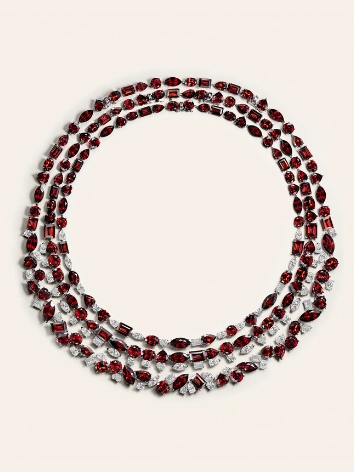
The East-West Necklace is the most architecturally horizontal piece in the suite, designed to sit across the collarbone rather than hanging down the sternum, and its construction reflects a specific understanding of how jewelry moves during physical activity. The piece carries 49.16 carats of garnets alongside 4.75 carats of brilliant white diamonds, the garnets arranged in a dynamic horizontal composition that combines marquise, pear, oval, emerald-cut, and round stones in a rhythmic sequence that creates constant variety across the neckline. Marquise cuts, with their elongated pointed ends, catch light from a different angle than the rounded brilliance of an oval or the flat geometric face of an emerald cut, and placing them in close proximity within a single piece means the necklace reads differently depending on the light source and the angle of the viewer, alive in a way that a single-cut piece at the same total carat weight would not be. The garnets in this piece total nearly fifty carats, a figure that requires some context: a one-carat diamond engagement ring is considered a meaningful stone size for most consumers, which means the East-West Necklace alone carries the garnet equivalent of nearly fifty such stones, arranged across the full horizontal span of the collarbone in a setting engineered to weigh as little as possible against the body. The setting has been hollowed at the back to reduce the gold mass against the clavicle during play, and the chain is a custom-engineered open-link construction designed to resist the sudden deceleration forces of a baseline swing without snapping or cutting into the neck as the muscles flex beneath it. The white diamond accents at 4.75 carats are positioned throughout the garnet composition to introduce bright interruptions of colorless light, preventing the deep red from reading as a single dense mass and giving the piece its sense of movement even when the wearer is standing still.
Terre Rouge Multi-Shape Duo Necklace
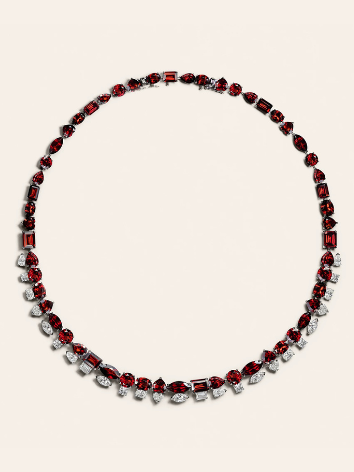
The Duo Necklace is the suite’s most generous piece in terms of stone weight, carrying 72.96 carats of garnets and 9.18 carats of diamonds in a double-layered nested configuration designed to sit below the East-West Necklace and create the layered effect that defines the on-court look. The layering is not incidental but engineered, the two pieces calibrated to sit at precisely calculated lengths so that they move independently without tangling during play, each chain operating on its own axis while the stones interact visually when the body is at rest. The double-layer structure means the necklace has two distinct visual planes, each following its own rhythmic progression of multi-shape crimson garnets and brilliant accent diamonds, and together they create a density of color and light at the collarbone that reads clearly under the high-intensity lighting conditions of a Roland Garros court from a significant distance. At 72.96 carats of garnet weight, the stone total in this single piece exceeds what most people will encounter in an entire lifetime of fine jewelry ownership, and the 9.18 carats of white diamonds distributed throughout the piece create a continuous dialogue between the saturated red of the garnets and the cold brilliance of the colorless stones that gives the Duo Necklace its particular visual intensity. The open-link chain construction that runs through all three necklaces is especially important here given the additional weight of the double-layer configuration, the link geometry distributing tension evenly across the full span of the piece rather than concentrating it at a single point that might fail under the rotational force of a full groundstroke. Paired with the East-West Necklace sitting above it, the two pieces together produce a neckline that is complete and deliberate without reading as excessive, the horizontal architecture of the East-West balancing the vertical weight of the Duo in a combination that was clearly designed to be worn together.
Terre Rouge Multi-Shape Cluster Necklace
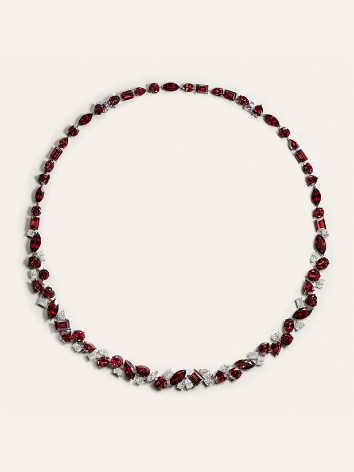
The Cluster Necklace is the suite’s most dramatic piece and, at $46,000, its highest-valued individual item. Carrying 81.64 carats of garnets alongside 8.58 carats of diamonds in a graduated tennis-style silhouette, it features dense clusters of white diamonds positioned across the center of the piece for maximum brilliance, creating a concentrated moment of white light at the sternum that anchors and elevates the deep red of the surrounding garnets in a way the other two necklaces, with their more evenly distributed diamond accents, do not attempt. The graduated silhouette means the stones increase in size toward the center of the piece and taper toward the ends, a classic construction in high jewelry necklace design that draws the eye to the most elaborate point of the composition and creates a natural visual hierarchy within the piece. At over 81 carats of garnet weight, the Cluster is the heaviest of the three necklaces by design, and it is the piece that Sabalenka left in her gear bag during her first-round match against Jessica Bouzas Maneiro, a practical decision made in response to the temperature and humidity conditions on court that day. The additional weight and restriction it would have introduced at the neckline under those specific physical conditions were not worth the visual impact, and the fact that the decision was made in real time on match day rather than predetermined is a useful window into what wearing $148,000 of jewelry to a Grand Slam actually involves: constant real-time calculations about heat and movement and comfort alongside everything else a professional athlete is managing between points. As a standalone object the Cluster Necklace is the most formally impressive piece in the suite and the one that most directly communicates the scale of the commission, the kind of piece that requires no context to understand that it is extraordinary.
Terre Rouge Cushion Garnet and Diamond Studs
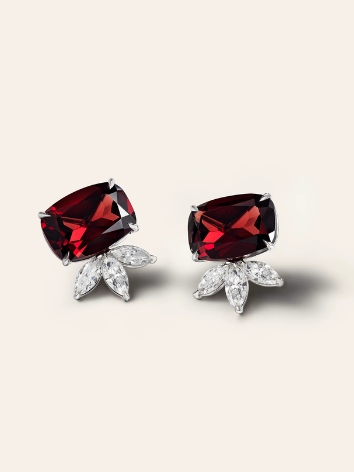
The Cushion Studs are the piece she wore on court alongside the two necklaces, and at $12,500 they are the most accessible entry point into the suite without being in any way a lesser object. Each stud is built around a cushion-cut crimson garnet, a cut defined by its rounded corners and larger facets that produce a softer, more pillowed light return than the sharper geometry of a round brilliant or a princess cut. The cushion cut has been favored for colored gemstones for centuries precisely because its larger facets allow the inherent color of the stone to read more fully, a technical advantage that becomes significant when the stone in question is a deep saturated garnet whose value lies almost entirely in the richness of its color rather than in its ability to disperse white light the way a colorless diamond does. At 14.35 total carats across the pair the garnet weight is substantial enough to carry genuine presence at the earlobe, each individual stone large enough to be clearly legible under court lighting from a distance, without requiring the architectural scaffolding of a larger chandelier or drop earring that would move against the face during play. Beneath each cushion garnet, a delicate fan-like formation of marquise-cut white diamonds underscores the setting in a sculptural arrangement that adds dimension and contrast at the base of the piece, the elongated pointed ends of the marquise cuts directing the eye upward toward the garnet’s color and creating a small but precise visual rhythm between the warm red above and the cold white below. The 1.66 carats of diamond weight across the pair is distributed across multiple marquise stones rather than a single large accent, which gives the base of each stud a lacy quality that softens the overall silhouette without reducing its impact. The closure is a secure post and push-back mechanism engineered specifically for active wear, the kind of hardware standard in medical-grade applications that keeps the earring locked in position through the rotational forces of a full groundstroke and the repeated vibration of ball impact traveling up through the racket frame into the body.
The On-Court Total
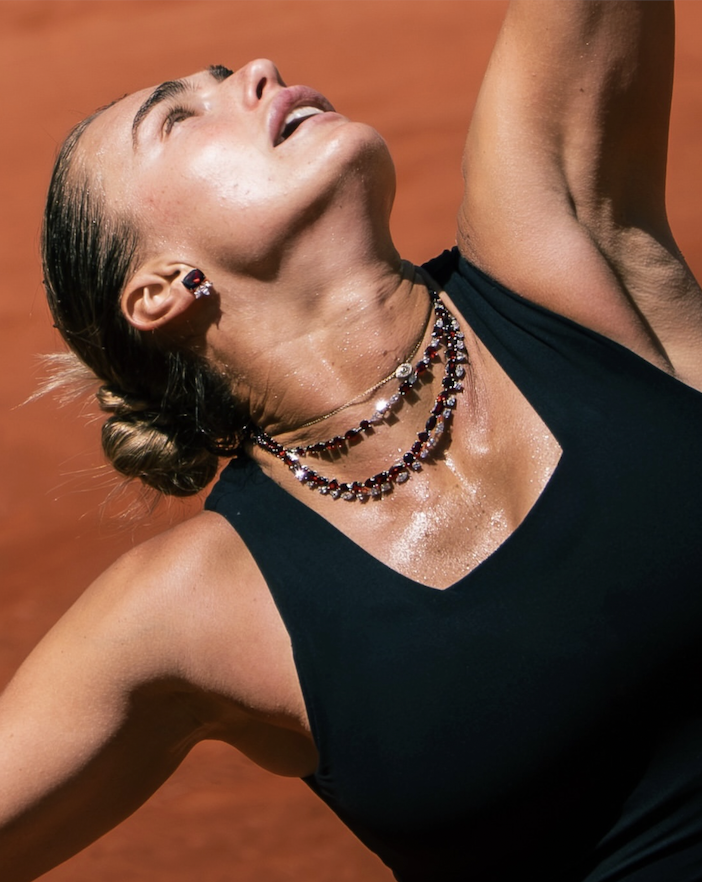
Photo via @materialgood on Instagram
Wearing the East-West Necklace, the Duo Necklace, and the Cushion Studs simultaneously on court, Sabalenka competed her first-round match with 136.47 carats of garnets and 15.59 carats of diamonds on her body, a combined total that would have reached 218.11 carats of garnets and 24.17 carats of diamonds had she included the Cluster Necklace. Those numbers are extraordinary in their own right, but what makes the Terre Rouge suite genuinely interesting as a design object is not the carat weight or the valuation but the fact that it was made to move. Every structural decision in the suite, the hollowed gold settings, the open-link chain construction, the high-security closures, the multi-shape stone arrangements that distribute visual weight rather than concentrating it, was made in service of the same brief: create jewelry that belongs on the body of a world-class athlete during competition without asking her to choose between looking extraordinary and performing at the level her ranking demands. That is a harder problem to solve than it sounds, and the fact that Sabalenka wore two of the three necklaces and both earrings through an entire Grand Slam match and then made a considered real-time judgment about the third based on conditions on the day suggests that the suite succeeded on its own terms completely. The Terre Rouge collection is available through Material Good’s atelier as a bespoke commission, meaning the pieces shown here were made for Sabalenka specifically and any version created for another client would be developed through the same custom process, which is either a limitation or the entire point depending on your relationship to the idea of jewelry that exists nowhere else in the world in quite the same form.