
By Gabriela Afanador
Thursday 4, June 2026
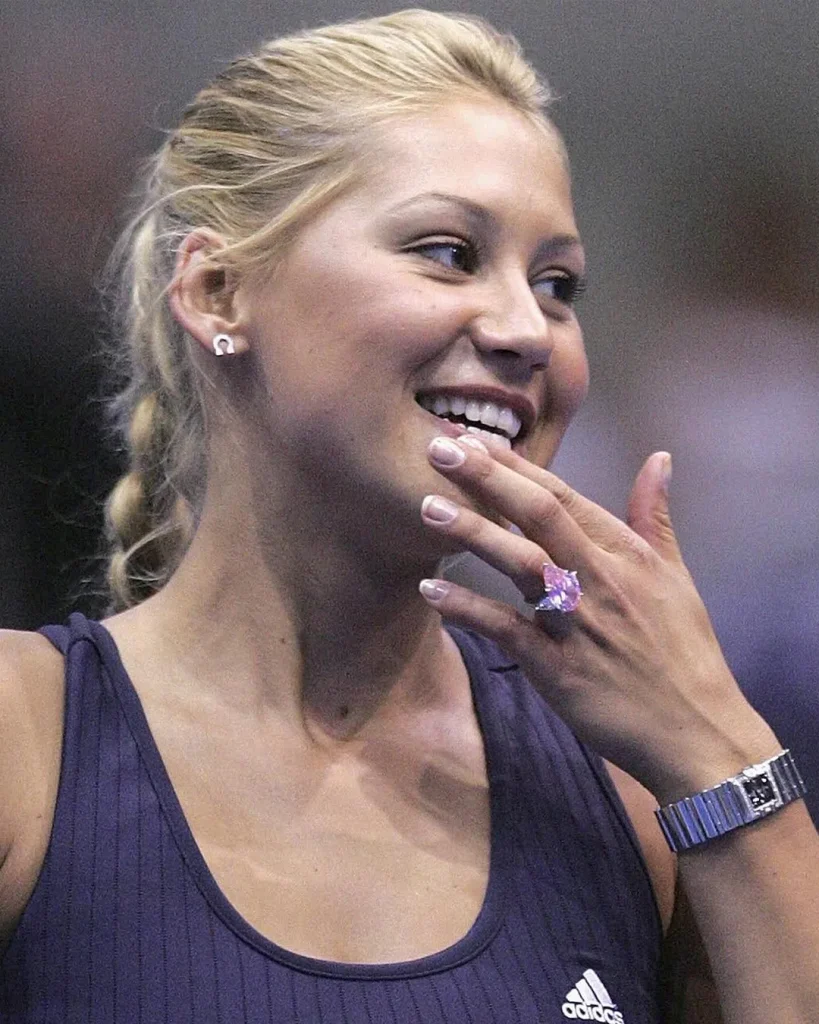
Anna Kournikova walked onto a tennis court in Kansas City in the summer of 2004 wearing an 11-carat pear-shaped natural pink diamond and nobody had ever done anything quite like it before. The ring was a gift from Enrique Iglesias, whom she had met three years earlier on the set of his Escape music video, and its debut during a World TeamTennis match for the Kansas City Explorers was not announced, not staged, and not accompanied by any explanation. She simply wore it the way someone wears something that belongs on their body, caught the stadium lights from across the court, and let the world figure out the rest. Twenty years later the ring is worth somewhere between $5 and $10 million and the moment still holds.
Understanding why requires knowing what the ring actually is. The center stone is a pear-cut natural fancy pink diamond weighing 11 carats, and each part of that description carries more weight than it might initially seem to. A pear cut combines the maximum light return of a round brilliant with the elongated silhouette of a marquise, rounding at the base and tapering to a single elegant point, a shape that reads on a hand in motion during a tennis match as something alive rather than simply decorative. Natural pink diamonds are among the rarest gemological phenomena on the planet, their color produced not by trace mineral impurities the way blue or yellow diamonds get their color, but by a process called plastic deformation, in which immense pressure during the diamond’s formation distorts the stone’s internal atomic lattice, altering how light moves through the crystal and producing the blush tone that makes a pink diamond impossible to mistake for anything else. The stone in Kournikova’s ring came from the Argyle Mine in the remote East Kimberley region of Western Australia, which for nearly four decades produced over 90 percent of the world’s supply of natural pink diamonds and from which, even at peak operational efficiency, the total annual yield of pink diamonds would not fill a single champagne glass. The Argyle Mine closed permanently in November 2020, its economically viable reserves exhausted, which means no new Argyle pink diamonds will ever enter the market. The ring Iglesias gave Kournikova in 2004 for an estimated $2.5 million is now a finite, irreplaceable geological artifact valued at between $5 and $10 million, its appreciation driven not by celebrity or fashion but by the permanent closure of the only place on earth that produced stones like it.
The Ring in Detail
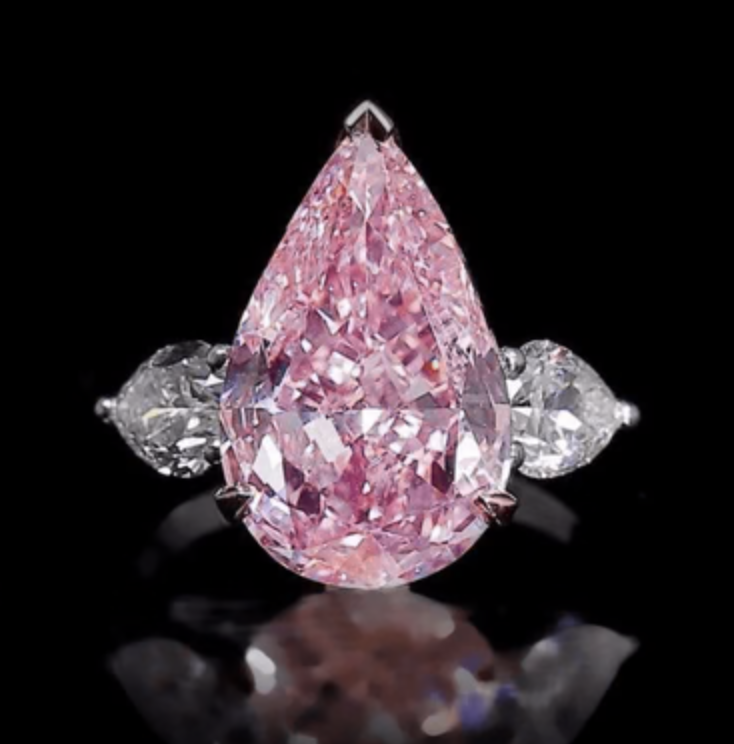
The two stones flanking the pink diamond are trillion-cut white diamonds, triangular with pointed corners that direct the eye inward toward the center stone, amplifying both its perceived size and its color saturation in a way a plainer solitaire setting would not achieve. The entire piece is set in platinum, chosen for its density, hardness, and resistance to the wear that comes from thousands of hours of professional athletic competition, and the prong configuration includes five standard prongs alongside a specialized V-shaped prong at the pointed tip of the pear cut, the stone’s most structurally vulnerable area and the point most at risk of chipping under the deceleration forces of a professional serve. That this engineering consideration was built into the ring tells you something important: the commission was designed for someone who would wear it on a court, not keep it in a box.
Kournikova’s relationship with on-court jewelry actually predates the pink diamond by three years. In July 2001, playing her comeback singles match at the Acura Classic in Carlsbad, California, after a five-month absence following a stress fracture in her left foot that required surgical intervention, she stepped onto the court with two prominent rings on her left ring finger at a moment when international press had been running stories for days about a rumored secret marriage to Russian NHL star Sergei Fedorov in a Moscow register office. She confirmed nothing and denied nothing, but she repeatedly adjusted her cap and reset her racket strings with her left hand throughout the match, keeping the rings in full view of the cameras with a consistency that was entirely intentional. She lost the match. Nobody remembers the score. Everyone remembers the rings.
This is what makes her jewelry legacy genuinely interesting rather than simply glamorous. She understood before the vocabulary even existed for it that a tennis court is a theatrical space and that what you wear on it is part of the story being told. The story she was telling in 2001 was about her private life, kept close but deliberately visible. The story she was telling in 2004 was bigger than that, about what a professional female athlete could claim for herself in a space that had always been defined by utility and performance, about refusing to separate the person from the competitor in a way the sport had always implicitly asked women to do. It is worth remembering that the only precedent for fine jewelry on a tennis court had been set twenty-three years earlier, when Chris Evert’s diamond eternity bracelet detached from her wrist mid-rally at the 1978 US Open and play was briefly stopped so she could retrieve it, an incident that permanently coined the term tennis bracelet. A delicate flexible bracelet that fell off during a rally was the boundary of the conversation in 1978. Kournikova turned up in 2004 with an 11-carat pink diamond worth several million dollars and wore it through a professional match without ceremony, and the distance between those two moments is the full measure of what she changed.
The Yellow Diamond and What It All Means
In 2009, Iglesias gave Kournikova an 11-carat radiant-cut canary yellow diamond ring flanked by trillion-cut side stones on a platinum band, valued at $5.4 million at the time and estimated at $7.7 million today. The radiant cut’s rectangular silhouette and brilliant-cut facet pattern maximize light return under outdoor court lighting with an intensity that reads clearly from a distance, and the canary yellow color, which falls in the fancy intense yellow range of the GIA color grading scale, is produced by nitrogen atoms present within the carbon crystal structure during formation, a geological accident that produces one of the most visually immediate stones in fine jewelry. Two 11-carat statement rings across five years of the same relationship, one blush pink and one intense yellow, each built with the same attention to gemological specificity and physical engineering, describe a consistent philosophy about what jewelry is for and what it means to wear it while doing something physically demanding and publicly visible.
What Kournikova established in those years was not a trend but a precedent, and the distinction matters. She was among the first female athletes to treat her personal style as an active component of her athletic identity rather than a separate domain that had to be left off the court, to insist through the simple act of wearing what she chose to wear that a woman competing professionally was not required to reduce herself to the purely functional in order to be taken seriously. The rings did not make her a better tennis player. They made her fully herself on a court, which is a different and more enduring kind of achievement, and one that the worlds of fashion and sport are still working out the full implications of.