
By Gabriela Afanador
Tuesday 31, March 2026
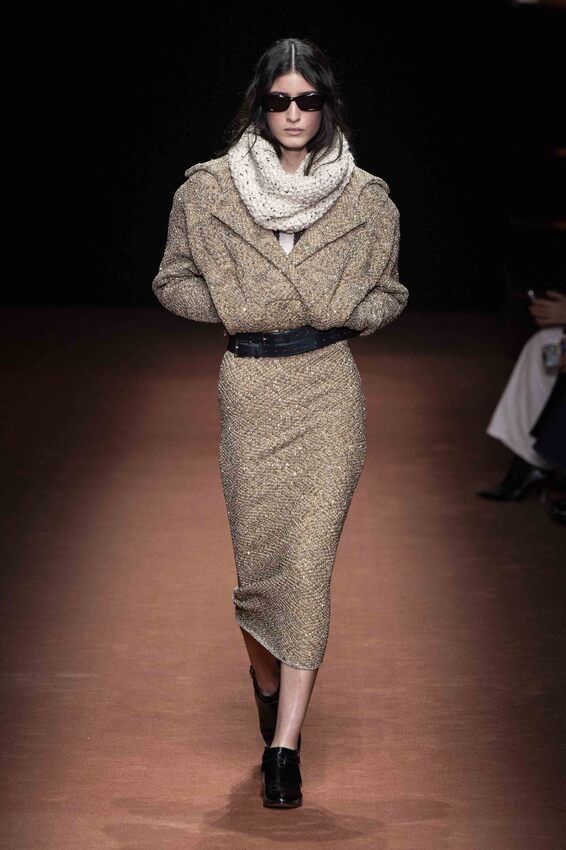
Photo: firstVIEW
Missoni Fall Winter 2026 feels like a collection designed from inside the wardrobe rather than from above it. Alberto Caliri builds his story through the act of dressing as it really happens, one layer added, one piece borrowed, one silhouette adjusted in front of a mirror without overthinking. The runway moves in a clear progression. It begins wrapped and protected, then gradually reveals a more linear, body following language, and ends in a shimmer that still reads wearable. The venue stays secondary to the clothes, with an industrial simplicity that keeps the focus on texture, movement, and proportion.
From shelter to line
The opening looks are all about scale and protection. Outerwear arrives first, roomy coats with a generous back construction that suggests classic tailoring, but softened into something blanket like. These coats do not sit neatly on the body. They hang, they overlap, they create an envelope. Caliri pushes the idea further by stacking layers in a way that looks spontaneous but is actually controlled. A coat over another coat, or a bomber pushed under an overcoat, with scarves and knits folded into the neckline, so the silhouette builds upward and outward before it ever narrows.
Underneath, the lower half stays relaxed and grounded. Trousers are cut with workwear ease, loose through the leg, often held back into shape by a belt rather than by a strict waistline. Bermudas appear with exaggerated volume, making the legs a key visual point against the heaviness above. Shoulders across blazers and sweaters read broad and assertive, while hems often taper, creating a powerful top heavy outline that feels modern and a little tough, even when the fabrics are soft.
Then the collection begins to peel back. Midway, the proportion shifts from pure volume into a deliberate contrast between structure and flow. Tailored jackets appear as if taken from a man’s closet, worn without being softened or sweetened, and placed over dresses that cling and move. The tension becomes the point. A firm blazer over a narrow knit dress, or a strong shoulder above a slim ankle length line. Caliri keeps the silhouette long, but he changes the emotional temperature. The clothes move from protected to exposed, not through nudity, but through the way the body becomes visible again.
By the final stretch, the line is at its most refined. Outerwear turns slimmer, including trench like shapes that hold close to the body. Dresses become more direct and more evening coded, but still grounded in Missoni’s everyday logic. Slip shapes appear with inserts that add swing at the hem, creating movement that is geometric rather than ruffled. The closing mood is compact and sleek, with a quiet sensuality that feels candid rather than staged.
Texture that does the talking
This collection is a reminder that Missoni communicates through surface and structure at the same time. The knits are not just patterned. They are engineered. Wide ribbing shapes the body without looking sculpted, pulling in at the waist and releasing where movement is needed. That rib construction becomes a tool for silhouette, creating dresses that feel secure at the torso and clean through the leg.
Caliri also plays with openwork knit techniques that read like lace but behave with more strength. You see it most in the pieces that shimmer, where the surface becomes airy and graphic, almost web like, yet still stable enough to cut into trousers, wrap tops, and dresses that keep their form. This is where Missoni’s technical identity shows. The fabric looks delicate but carries itself.
The shine comes from metallic yarns and lamé like effects that catch light as the wearer walks. In the earlier looks, the texture is heavier and more grounded, built from wool rich coatings and substantial knits that feel protective. As the show advances, the materials lighten and brighten. Knit blends gain fluidity and become more responsive to movement. The evening pieces lean into metallic threads, sequins, and reflective surfaces, but the effect stays calibrated. It is sparkle with restraint, designed to read as part of a wardrobe, not as a costume moment.
Color follows a similar arc. The opening palette sits in an urban range of earthy tones and deep neutrals, colors that feel practical and grounded, like clothes that live on a chair and are pulled on again tomorrow. Then brighter notes start to appear in controlled doses, jewel tones and aquatic shades that animate the quieter base. Rather than relying on loud classic zigzags, the collection often lets texture and tonal variation create the pattern. You get checks, chevrons, and linear effects that feel quieter and more tailored, with color used as punctuation instead of decoration. Toward the end, metallic golds and silvers take over, shifting the collection into a night register without breaking the continuity of the wardrobe.
Accessories and styling support the same message. Footwear stays grounded with masculine coded shapes like loafers, oxfords, and sturdy boots, which keeps the dresses from floating into romance. Bags move between structured workday forms and smaller evening pieces, mirroring the collection’s duality. Nothing feels over styled. The power is in how the pieces sit together, heavy above and slim below, tailored over fluid, matte next to shine.
Missoni Fall Winter 2026 succeeds because it does not chase reinvention. It sharpens what the house already owns and makes it feel current through proportion, layering, and technical surface work. The collection starts with protection and ends with shimmer, but the underlying idea never changes. A woman dresses by instinct, borrowing strength from structure and pleasure from texture, and she does it without needing to explain herself.