
By Gabriela Afanador
Thursday 5, February 2026
Setting the Scene & Thesis
Dolce & Gabbana’s spring 2001 show is remembered not for a single shock but for the precision with which it reassembles the house’s vocabulary into a clear, wearable argument. The set: a Vespa nosed under climbing roses and paddle cactus, situated the collection somewhere between a Sicilian courtyard and a film set. That sense of compressed place is important: the runway reads like a sequence of street scenes, each look a character sketch built from three persistent ideas tailoring as seduction, ornament as structure, and holiday print as punctuation.
Cut First: Silhouette, Proportion, Materials
The opening passage established the tone with black suiting that refused bulk. Jackets were shaped close through the torso, shoulders firm but not aggressive, crossing neatly at the bust to frame a whisper of lace from a camisole beneath. Paired with pencil skirts that finished just below the knee and compact clutches, the line felt adult, direct, and unfussed sensual because of what’s implied at the neckline rather than anything exposed elsewhere. This is the label’s most persuasive mode: clothes that behave, then flirt.
From there the designers lowered the waist and lengthened the leg. Low-rise trousers cut to ride the hipbones and fall in a controlled, barely flared line reset daytime proportion for the season. One standout came in pale twill worked with scrolling baroque embroidery; the technique reads like leather tooling translated into thread, turning craft into surface architecture. The top half stayed deliberately simple: cropped knit tie tees, a silk headscarf knotted at the nape, and slit cat-eye sunglasses delivered a clean, cinematic edge. Nothing here is nostalgic; the early-’00s vocabulary is handled with the coolness of uniform components rather than costume.
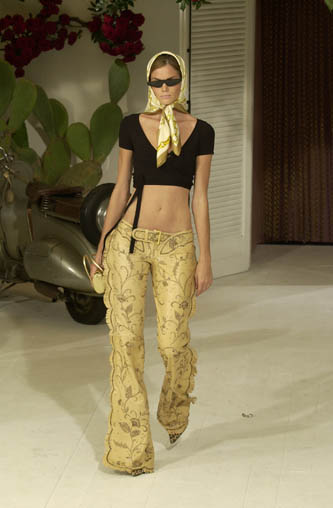
Photo: firstVIEW
Foundation pieces functioned as outerwear, another D&G constant. A run of black micro sets, essentially a straight bandeau and shorts, served as a blank plane for a single statement object: the belt. Wide, jewel-set saddlery slung low over the hip changed the temperature of the silhouette without adding volume. It carved the waist, grounded the hemline, and, more than any motif, supplied the collection’s drumbeat. The idea is elegantly simple: strip the silhouette to essentials, then let one piece do the storytelling.
Color entered with movement rather than noise. A white ribbed tank met a hibiscus circle skirt that caught air with every step, the print pooling saturated reds and purples across lustrous panels. The tension, utility above, postcard below, kept the sweetness in check; white pumps sharpened the finish. Elsewhere, the floral story appeared in flared skirts with the same swing, always grounded by plain, body-skimming tops that put proportion first and palette second. It’s the same control seen in the tailoring: the eye is directed by line, then rewarded by surface.
Materials stayed honest to their tasks. Matte suiting and stretch crepe carried the tailored story; cotton knits and poplin kept the casual looks crisp; embroidery and heavy top-stitching turned ornament into structure, integrated rather than applied. The result avoids the heaviness that baroque detailing can bring. Even the jewelry, shoulder-brushing earrings that move like small chandeliers acts as architecture, adding vertical lines that echo darts and jacket closures.
Styling tightened the message. Headscarves and narrow sunglasses edit the face, while compact clutches and tidy pumps maintain a narrow footprint around the body. Nothing sprawls; nothing feels improvisational. The set amplifies that discipline. A scooter wheel, a tangle of stems, a doorway: fragments of the everyday made theatrical, much like the clothes themselves.
Enduring Codes & Why It Still Works
What emerges is a triptych of D&G instincts made legible. First, tailoring as seduction: the suit is not about power posturing; it’s about proximity to the body, about the invitation implied by a slanted closure and a glimpse of lace. Second, ornament as structure: embroidery maps the leg, belts anchor and carve, jewelry draws verticals adornment deployed to shape the eye. Third, vacation print as punctuation: one exuberant skirt or panel is enough to reroute an otherwise urban uniform. The designers don’t stack these codes so much as alternate them, which is why the runway reads like a wardrobe rather than a thesis.
Two decades on, the clarity is what keeps the collection current. A nipped black jacket over a pencil skirt needs no translation; a printed swing skirt with a plain tank remains the fastest route to polish; a decisive belt over a pared-back base still reprograms proportion instantly. The show offers styling equations rather than disposable trends, and that is why the images continue to circulate whenever the industry rediscovers its appetite for simplicity with bite.
If there is a single lesson to pull from spring 2001, it is that glamour is a function of line management. Where the jacket closes, where the waist sits, how a hem holds air those decisions outlast logos and catchphrases. Dolce & Gabbana’s achievement here is to make those decisions feel inevitable. The clothes look ready to walk off the terrace and into a day that stretches into evening, unbothered by time. In a season that often celebrated surface for its own sake, this collection reminds that surface works best when it’s subordinated to cut. The roses may climb the wall, the scooter may wait by the door, but the sharpest story is still the one traced along the body.