
By Gabriela Afanador
Tuesday 2, June 2026
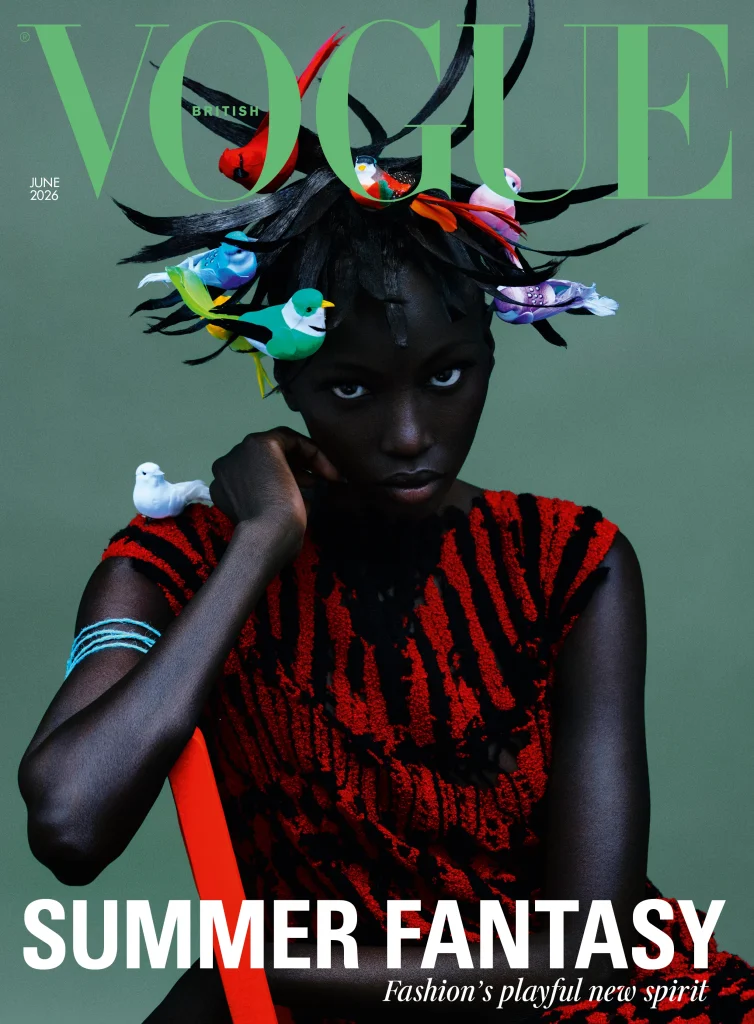
© British Vogue / Condé Nast. Photograph by Rafael Pavarotti. Styling by Kate Phelan. June 2026.
The June 2026 issue of British Vogue arrived with Anok Yai on its cover and a story behind it that most fashion magazines would not have the editorial courage to tell. Framed against an intensely vibrant green studio backdrop under the art direction of set designer Mary Howard, Yai gazes directly into Rafael Pavarotti’s lens wearing a textured silk-knit dress from Matthieu Blazy’s Fall 2026 Chanel collection, styled by Kate Phelan, the green of the masthead rhyming with the green behind her in a graphic, high-contrast composition that generated immediate and sharply divided responses the moment it landed. The cover is striking and deliberately so, but the story it introduces, titled Rebuild a Life in Colour, goes considerably further than the image itself, documenting Yai’s return to the fashion landscape following emergency robotic lung surgery in December 2025, a procedure that nearly killed her and that she had been quietly managing for over a year while continuing to work at the highest levels of a profession that does not pause for illness. That it arrived only days after she received the British Fashion Council’s Model of the Year honor makes the timeline feel almost unbearable in retrospect. The woman accepting an award for the peak of her career was also, at that moment, running out of time to treat a condition that was slowly destroying her lung tissue.
Yai had been living with a congenital defect that was overworking her heart and damaging her lungs, initially asymptomatic and then increasingly impossible to ignore, progressing through a persistent cough and chest pain into acute breathlessness and episodes of coughing up blood. She had attempted to manage her schedule around it, searching for an optimal treatment window while maintaining the global commitments that come with being one of the most in-demand models working today, a response that reflects both the extraordinary pressure the industry places on its top figures and the particular pressure Yai has always navigated as a Black immigrant woman whose presence in fashion spaces has never been allowed to be simply professional. The condition was first detected by Dr. Harmik Soukiasian of Beverly Hills Concierge Health and the surgery was ultimately performed by Dr. Robert Cerfolio, chief of thoracic surgery at NYU Langone, a procedure projected to last two hours that stretched into five, during which the surgical team came close to losing her. The British Vogue editorial is Yai’s first major public engagement with what happened, and the decision to process it not in an interview alone but through a fashion shoot that includes her parents, her father and her mother Nyibol Akuei, transforms the conventional parameters of a high-fashion editorial into something genuinely different: a document of survival that places a supermodel in the context of the family that sustained her rather than the industry that employs her.
The Editorial and the Clothes
The wardrobe Kate Phelan assembled for the shoot functions as a visual narrative of recovery, moving between silhouettes that feel protective and almost clinical and textures that represent a return to physical and sensory vitality. The cover dress from Chanel, soft and structural simultaneously in its silk-knit construction, establishes the tone immediately: something that holds the body without constraining it. A hand-crocheted minidress from Bottega Veneta, worn with a shearling hat from the same house and leather shoes by Phoebe Philo, brought the language of raw manual craftsmanship and physical warmth into the shoot, the labor visible in the fabric in a way that felt appropriate for an editorial about the work of recovery. A duchesse satin cape by Celine, paired with a silk-organza headpiece by Noel Stewart and shoes by Dior, used dramatic oversized proportions in the way that the strongest pieces of protective dressing always do, not as concealment but as armor worn openly. A shearling top and pencil skirt by Mugler with leather mules by Balenciaga explored physical mass and tactile density as a form of sensory grounding, the heaviness of the materials reading as presence rather than weight.
The inclusion of Yai’s mother Nyibol Akuei in the shoot produces some of its most quietly powerful images. Styled in a dress by Emilia Wickstead with leather slingbacks by Christian Louboutin and her own personal bracelet for one sequence, and a maxi dress by CFCL with a Tiffany gold and diamond ring for another, Nyibol brings a dignified, unhurried quality to the editorial that has nothing to do with the fashion industry’s usual vocabulary and everything to do with what it actually means to have someone anchor you through a health crisis. The decision to place her in the shoot alongside her daughter rather than simply referencing her in the interview is the most significant editorial choice in the entire issue, shifting the focus from Yai as a lone exceptional figure to Yai as a person sustained by relationships and lineage, which is a more honest and more interesting story than the fashion industry typically allows its subjects to tell. The portraits of Yai with her father carry a similar weight, the presence of her parents in a space that has historically asked Black models to leave their backgrounds at the door functioning as a quiet but unmistakable act of reclamation.
The Photographer, the Controversy, and the Larger Question
Rafael Pavarotti’s visual relationship with Anok Yai stretches back to the February 2022 British Vogue cover featuring nine dark-skinned African models in structured Balenciaga looks, a landmark image that generated the same polarized response as the June 2026 cover and for many of the same reasons. Pavarotti’s signature approach, characterized by extreme high-contrast lighting, deeply saturated color, and heavy shadow mapping that reduces fill light to near zero, produces images of extraordinary graphic power and raises questions that the fashion industry has been negotiating for decades without resolution. When the fill light in a portrait is eliminated, the natural three-dimensional gradients of the face, the contours of the nose, the definition of the jaw, the transitions that make a face legible as a living surface rather than a shape, are flattened into a two-dimensional silhouette. For dark-skinned subjects photographed under these conditions, the effect is more total than it would be for lighter-skinned subjects, because the relationship between skin tone and shadow depth means there is less visual information surviving the extreme contrast ratio. Critics argue that this is not an aesthetic choice made equivalently across all subjects but a technical failure that recurs specifically when photographers with insufficient training or insufficient commitment apply high-contrast lighting to dark skin, producing images that celebrate the graphic outline of a Black model while erasing the specificity of her face. The fake eyes visible in one frame of the editorial, positioned over Yai’s features, intensified this critique considerably, the gesture reading for many viewers as a literalization of the substitution of surface for person. The processing applied to Nyibol Akuei’s naturally lighter skin tone to match it more closely to Yai’s in certain images was also noted, a choice that prioritized graphic uniformity over authentic familial representation in a way that felt contradictory given the editorial’s stated commitment to centering Yai’s real life and real relationships.
The artistic defense of Pavarotti’s approach is not without substance. His work with Yai has always operated in the register of high-concept sculptural portraiture rather than conventional beauty photography, and the argument that his methodology is a deliberate and uncompromising assertion of dark skin as a subject of graphic grandeur rather than a diluted approximation of lighter-skin beauty standards carries genuine weight within the critical conversation. The vibrant green backdrop, the dramatic headpieces, the saturated color palette: these are the choices of a creative team building a visual world rather than documenting a person, and Yai has consistently been a willing and active collaborator in that world-building across multiple shoots together. The question the controversy raises is not whether Pavarotti’s approach has artistic merit, which it clearly does, but whether that approach distributes its aesthetic demands equitably across different subjects or whether it consistently asks more of its dark-skinned subjects than its lighter-skinned ones, flattening facial specificity in a way that the industry should have learned by now to examine critically rather than defend reflexively.
Yai herself has been navigating exactly this kind of systemic examination since she entered the industry following her discovery at Howard University’s homecoming week in 2017, when she transitioned from a biochemistry student to, within a remarkably short period, the first Sudanese-American model and only the second Black model since Naomi Campbell in 1997 to open a Prada runway show. Her early years in the industry were defined by the experience of confronting structural racism backstage, hair stylists without training in coily-textured hair pulling and ripping her hair violently and dismissing her pain as an overreaction when she spoke about it, an experience that led her to begin organizing backstage solidarity networks, physically walking with fellow Black models to demand equitable treatment and qualified Black hair professionals. The industry responded by labeling her difficult, which is the word institutions use when individuals prioritize collective well-being over quiet compliance, and which Yai has spoken about with a clarity that makes the stakes of the label obvious. At her acceptance speech for the 2025 Fashion Awards, she addressed the gatekeeping directly, telling the room that she had been told she would be a flash-in-the-pan and that her career would only last six months, and then pausing before adding: it has been a long six months. The June 2026 British Vogue cover is the latest chapter in a career that has always been about more than the clothes, made by a woman who has survived both a machine designed to crush her and a surgical procedure that nearly did, and who has chosen to document both with the same unflinching directness that has defined everything she has done since the beginning.